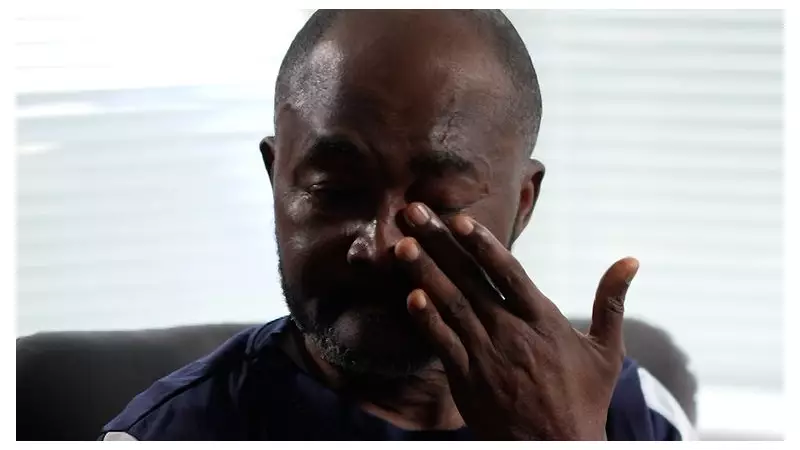
A Manchester father has described the horrifying moment he begged his son not to kill him during a violent attack that claimed his wife's life and left him with life-threatening injuries.
Joshua Obinim, 64, survived multiple stab wounds inflicted by his son Benjamin in August last year, in what a judge later described as a 'rampage of violence'.
A Night of Horror in Manchester
The terrifying ordeal began when Benjamin Obinim, then 22, burst into the family home in Manchester armed with a large kitchen knife. He stabbed his mother Alberta 16 to 17 times, killing her instantly.
Joshua woke to the sound of screaming and confronted his son outside his daughter's bedroom. "I saw my son outside the door of my daughter with a knife, so I asked what was going on," Joshua recalls. "Usually he is someone who listens to me. I just said, 'give me the knife'. I stretched forth my left hand, I held the blade and then he said 'don't try it'."
When Joshua ran outside to seek help from neighbours, Benjamin intercepted him. "He just came and met me there and then he cut my head, so blood was just gushing out, then he went into my belly," Joshua describes.
During the attack, Joshua pleaded with his son: "I was pleading with him not to kill me, because he knows how much I love him. I was lying on the floor and he wasn't giving in."
The Spiritual Struggle With Mental Health
The tragedy was made more devastating by the family's initial interpretation of Benjamin's deteriorating mental health. In the weeks before the attack, his behaviour had changed dramatically.
Benjamin began experiencing hallucinations and paranoid delusions, believing his mother and sister were witches who had implanted a device in his chest and were trying to kill him.
The family, devout Christians from Manchester's Ghanaian community, responded with prayer rather than medical intervention. "I never even thought it was a mental thing," Joshua admits. "I thought he was demonised, that the demons had come to attack him."
On the day she was killed, Alberta had voiced concerns about Benjamin's mental health at their church. Tragically, he never saw a doctor about his symptoms.
Joshua now reflects on this with regret: "If I knew, I would have taken the initiative, I would have done something about it. Praying for someone to get healed doesn't mean the person does not need medical attention."
Aftermath and Awareness
Benjamin's younger sister Bernice, then 18, was also wounded in the attack. She tried to barricade herself in her bedroom before jumping from the window to escape. She has needed plastic surgery and was left with significant long-term physical and psychological scarring.
Joshua suffered multiple injuries to his head, face, neck, chest, abdomen, both arms and his left leg. He was placed in an induced coma and woke to learn his wife had died.
Benjamin was arrested four days after the attack and detained under the Mental Health Act. He was later diagnosed with paranoid schizophrenia, which experts agreed he was suffering from at the time of the attacks.
He pleaded guilty to the manslaughter of his mother by reason of diminished responsibility, and to wounding with intent of his father and sister. A judge ruled he should be detained indefinitely at Ashworth High Security Hospital.
Dr Ronan Brennan, a consultant forensic psychiatrist who treated Benjamin, confirmed that his mental health disorder was the sole reason for the attack.
Bishop Tony Parry, senior pastor at the New Testament Church of God in Leeds, acknowledges the challenge facing faith communities: "Mental illness is a reality in the world that we live in... There are some who are really poorly and then need medical intervention."
Dr Gwen Adshead, a consultant forensic psychiatrist, emphasises the importance of early intervention: "The longer people are mentally unwell, the worse the outcomes are."
Despite his profound loss, Joshua maintains forgiveness for his son. "What I would say to him is that he should be able to forgive himself and he should remember that we have not stopped loving him. We have forgiven him, so he should forgive himself."
His home remains filled with photographs of Alberta, whom he describes as "the linchpin who held the family together".
Joshua now shares his story hoping to reach other spiritual families from minority backgrounds: "We have to be open minded. If I knew, I would have done both together."