
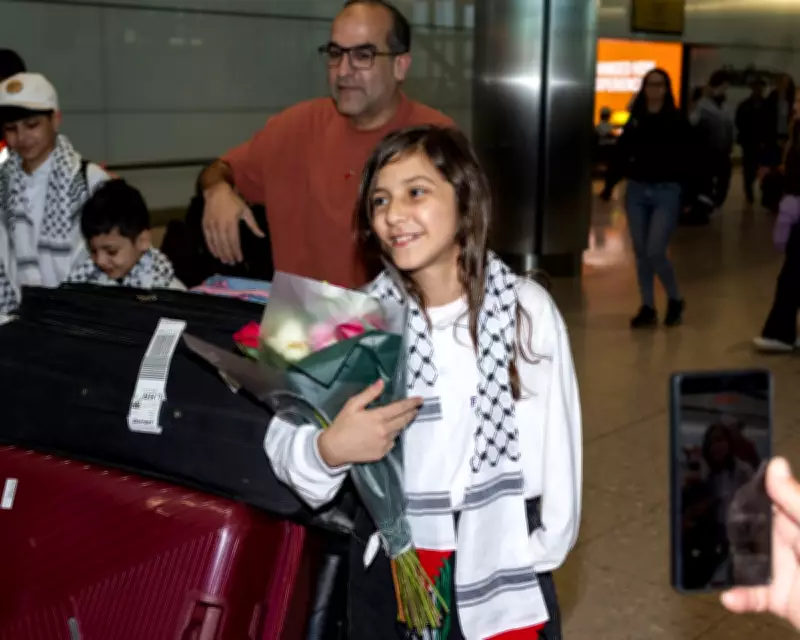
Palestinian Child Receives Lifesaving Care in Britain After Devastating Injury
Mariam Sabbah, a 10-year-old Palestinian girl who suffered the traumatic loss of her arm during Israel's bombardment of Gaza, has arrived in the United Kingdom for critically needed specialized medical treatment. Her journey to Britain represents a significant humanitarian effort amid ongoing international pressure to evacuate more injured children from the conflict-ravaged territory.
From Gaza to Heathrow: A Family's Emotional Arrival
Mariam landed at Heathrow Airport on Tuesday accompanied by her mother, Fatma Salman, and two brothers. The family was greeted by a small welcoming committee bearing gifts, balloons, and floral bouquets—a poignant moment of relief after months of uncertainty. "We're happy that we're here, we never thought we would actually be here in the UK," said Salman, watching her children smile nervously nearby. "They were a bit nervous at the beginning, but now when they feel like everyone is around them, they are happy and excited."
The young girl's arm required amputation after a missile tore through her family's home in Deir al-Balah, Gaza. According to World Health Organization estimates, she is one of more than 11,000 patients evacuated from Gaza, with approximately 18,500 still requiring urgent medical care unavailable within the territory's decimated healthcare system.
Navigating Visa Restrictions and Humanitarian Pathways
Originally, the Sabbah family hoped to travel to the United States for Mariam's treatment. However, those plans were derailed when the Trump administration halted visitor visas for all Palestinians in August of last year, leaving the family stranded in Egypt. Their eventual arrival in the UK was made possible through privately funded specialized treatment coordinated by two organizations: the US-based NGO FAJR Global and the UK charity Project Pure Hope.
Project Pure Hope has been instrumental in evacuating patients and their families to Britain since 2025, operating a model that later served as the blueprint for the UK government's official medical evacuation scheme. "We're hugely grateful that some children have already come over on the government scheme," said Omar Din, co-founder of PPH, who welcomed Mariam with flowers. "I think it would be great for the UK in its tradition of being a charitable and humanitarian-focused country to do more of this work."
Fragile Evacuation Systems and Calls for Increased Action
The UK government's evacuation program, established last year to provide critically ill and injured Gaza children with NHS care, relies heavily on coordination with the World Health Organization and Israeli authorities. This complex process has resulted in extremely limited medical evacuations, a situation exacerbated by the WHO's recent announcement suspending all medical evacuations following the death of a contracted worker.
Mosab Nasser, co-founder of FAJR Global, warned that more lives would be lost due to this suspension. "Because of the war on Iran and the closure of all the border crossings with Gaza, evacuations have actually been halted for a long time," explained Nasser, who accompanied the family from Egypt. "We haven't been able to evacuate anyone since the war on Iran."
Rohan Talbot, director of advocacy at Medical Aid for Palestinians, emphasized that the WHO's decision exposes the fragility of existing evacuation pathways without a genuine ceasefire. "The UK government and other governments must move beyond limited evacuation pledges and exert meaningful pressure on Israeli authorities to permit the unrestricted entry of aid, reopen all crossings and allow humanitarian agencies allowed to operate at scale," he stated. "Without urgent action to uphold international law, we will see more preventable illness and deaths."
Limited Progress Amid Growing Humanitarian Need
When the UK government scheme was announced in August last year, senior Whitehall sources suggested up to 300 seriously ill children might be evacuated. Campaigners subsequently expressed hope for at least 100 evacuations, warning that people would die waiting. To date, however, only 50 children and their immediate families have been evacuated through the program, according to a government spokesperson who declined to comment on how the scheme would be affected by the WHO's suspension.
Other nations have taken more substantial action: Egypt, the United Arab Emirates, and Qatar have assisted the highest number of medically evacuated patients from Gaza since October 2023, followed by European Union countries, Jordan, and Turkey.
Among those welcoming Mariam's family at Heathrow was Soad Abuhemaida, a 28-year-old scholar who arrived from Gaza in November. "When I heard that there was a girl coming in a few days and she's going to get medical care from the UK it really made me feel happy," said an emotional Abuhemaida, whose family remains in Gaza. "I feel what she's feeling now because I was in her shoes."
As Mariam begins her treatment journey, her story highlights both the compassionate response of humanitarian organizations and the urgent need for more robust international action to address the medical crisis unfolding in Gaza.




