More than a hundred eager families poured into a prison visiting room on 13 June, having just endured a security search after hours of travel on a bus. But the energy shifted once their incarcerated loved ones walked through the door for an early Father’s Day celebration. Hearts became full, tears filled eyes and arms embraced. Young children ran and jumped on their fathers, and mothers waited patiently for their turns to say hello.
Program aims to strengthen family bonds and mental health
The early Father’s Day event at the Correctional Training Facility (CTF) in Soledad, California, was part of the Get on the Bus program through the Center for Restorative Justice Works (CRJW). The program provided free transportation and meals for families to visit with their loved ones on the holiday as a way to benefit the mental health of children of incarcerated fathers and strengthen parental connections.
“Their parent is going to go home one day, and we want that bond to remain, so we’re working to help the children with what occurred in the past, and those feelings of abandonment and shame, but also to help them in their own future and have a strong family unit,” said Liz Ríos, executive director of CRJW.
Visits provide rare connection for children and relief for mothers
For the children, it is a rare time to see their fathers or grandfathers. For the mothers, it is a day they don’t have to be a single parent. These visits mean the world to their incarcerated loved ones, because it is a moment they get to mentally and emotionally get away from the prison life to spend time with their families and have motivation and a reminder of what they have to go home to.
As families trickled into the visiting room at 8am, they began to line up for breakfast: packaged snacks, bananas, coffee, juice and donated bagels and donuts. Parents and children who don’t often see each other in person finally got the chance to sit together and share a meal.
Cost savings ease financial stress on families
Families would otherwise have to spend money on overpriced vending machine food if not for the Get on the Bus program. A soda can cost about $3 and a single hot pocket or frozen cheeseburger can cost $10. Families can bring up to five people per visit, so the cost adds up. Alisa Romero, who brought her 14-year-old daughter and seven-year-old grandson to visit her husband, Richard Romero, said she would spend upwards of $100 on a normal visit. Families spend about $350bn a year on incarceration; sometimes, that prevents them from visiting as often as they would like.
“The vending machines are expensive, but we don’t have to pay for it [during the event], so it kind of makes it special that we’re not so stressed about money coming back into the visit,” Alisa Romero said.
Emotional reunions and milestone celebrations
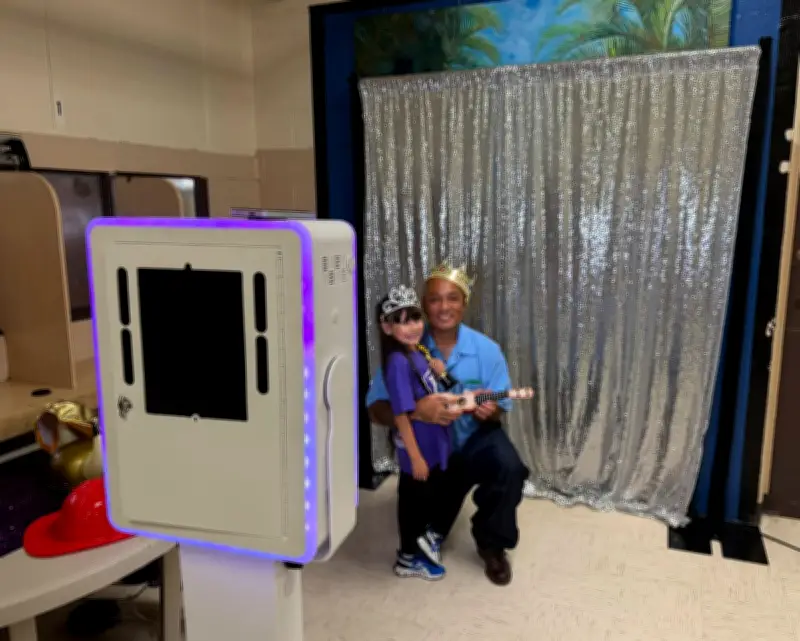
Both children cried when Richard Romero walked into the visiting room, filled with emotion. The family played board games, posed for pictures in the photo booth and had long talks to catch up on the milestones Romero had missed during his incarceration. The event was more than a Father’s Day event for the Vallis family, as the oldest son also got to celebrate his high school graduation with his stepdad, Derrick Ware. While Ware received 30-second videos of the graduation, he said it wasn’t the same as actually being there. That day, they were able to celebrate it and take graduation pictures together.
As the day went on, the dads passed out teddy bears to their children. Since they can’t go home with their children, the bears were a physical item that could serve as a reminder of the special day. Children lit up with excitement when each got their own bear.
Birthday surprise and bittersweet goodbyes
Before the visit ended, a woman got to sing Happy Birthday to her husband on his actual birthday for the first time in years since his incarceration. Taken aback with emotion, he took his hat off and held it over his heart. The visit ended before they knew it. Six hours felt like 20 minutes. No one was ready to say goodbye. The families exited through one side of the room, some of them not knowing when they would see their loved ones again, while the incarcerated fathers left through the other side. Children cried, many not understanding why their fathers couldn’t go with them.
Teddy bears provide comfort on the ride home
On the bus ride back to Los Angeles, children fell asleep cuddling the teddy bears from their fathers for comfort. It was the only thing they had left of them in that moment. A teen girl fell asleep with the bear as a pillow against the window. In the row in front of her, a toddler with a pacifier clung to the bear as she dozed. She didn’t let go the whole way home.