
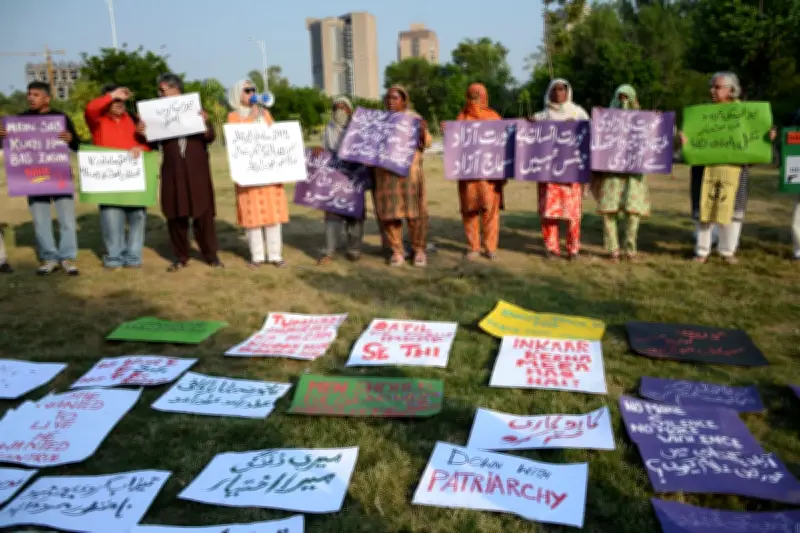
Surge in Violence Against Women in Pakistan
Karachi's chief police surgeon, Dr Summaiya Syed-Tariq, has condemned the increasing acceptance of domestic murders and rapes of women and girls in Pakistan, describing the severity of violence as having "gone through the roof." In a video circulating on social media, a 64-year-old man calmly confessed to murdering his wife, Asma Begum, a 58-year-old mother of four, because she refused him sex. He walked into a police station in Karachi's Orangi neighbourhood and admitted the crime.
Recent High-Profile Attacks
On 5 June, a lift operator at Quetta's Civil hospital threw acid on Dr Mahnoor Nasir, a 29-year-old doctor, when she opened her door. The suspect was killed during police efforts to detain him as he allegedly tried to flee the city. Nasir sustained burns to 35% of her body and was airlifted to Karachi for treatment. Two days later, an unconscious 17-year-old girl was dumped at a hospital in Jhang, Punjab, by three men. Police arrested the suspects using CCTV footage; the girl had been kidnapped, drugged and gang-raped, and later died. Also in June, an 18-year-old housemaid told police in Lahore that she had been repeatedly raped by her employer's son and his driver, shortly before dying from complications related to multiple abortions.
Systemic Underreporting and Concealment
Dr Tariq, who has spent 26 years documenting violence in Karachi's medico-legal system, says these cases are "just the tip of the iceberg." She notes that violence is often concealed, misreported or never reported at all. "If the woman has been killed in the process, they will say, she fell, she took poison, she burnt herself, or she committed suicide. In the last case, they often stage the entire event by hanging a flimsy scarf from a ceiling fan." Families' refusal to allow postmortem examinations remains a major hurdle, despite being against the law. "It's because they don't want us to confirm what we already suspect," she adds.
Femicide Observatory Initiative
Tariq is working to establish a femicide observatory, the first in Pakistan and possibly South Asia, to monitor the premeditated killing of women. "We need to count these women in order to formulate policies to protect them," she says.
Marital Rape and Belief in Survivors
Marital rape is one of the least-reported forms of violence. Tariq says, "We only come to know if the woman is brought to the hospital in critical condition." She laments that survivors are often not believed by doctors, police or courts. "After finding the courage to speak out and crossing so many barriers, if she still receives no help, it is no surprise that such crimes go unreported." She recalls a case where a woman was sexually assaulted with a metal pipe two days after her marriage, and her in-laws concealed her condition.
Societal Attitudes and Normalisation of Aggression
Tariq observes that many men do not see women as human beings but as objects. In the Orangi case, the violence was "extreme" because the wife refused sex. Social media was flooded with videos of men, including lawyers, praising the husband and offering to represent him. Tariq notes that even mothers-in-law sometimes justify such violence, invoking religion. "The common refrain is that angels would otherwise send their laanat [curse] upon her." She believes the normalisation of aggression is evident in everyday interactions, such as boys throwing stones at stray dogs or vandalising park swings.
Violence Across All Social Classes
Tariq dispels the myth that violence only affects certain sections of society. "There is no 'certain' kind. Just as violence takes many shades and forms, the women who experience it come from every social class and background." After decades of listening to survivors, she says their most urgent need is often simply "someone to believe her."




