In the deserts of the United Arab Emirates, a sprawling clean energy project covering an area roughly the size of 12,600 football fields will allow solar energy to power the equivalent of half a million homes through the night. The Gulf state has combined 5.2GW of solar power capacity with 19GWh of battery storage to create the world's largest battery scheme.
Meanwhile, at the US National Renewable Energy Laboratory in Colorado, researchers are developing some of the smallest batteries ever seen. These tiny units, a fraction of the size of grid-scale lithium-ion batteries, are designed to power electronic tags tracking 3-inch-long juvenile salmon and eels.
As traditional lithium-ion batteries push boundaries in size and scale, alternative battery types could provide the same vital role in storing low-carbon energy without relying on critical minerals such as lithium, cobalt, and nickel, which raise environmental and social concerns.

Liquid air in Manchester
Late last year, on the site of a former coal plant in Trafford, former Greater Manchester mayor Andy Burnham marked the start of construction on a long-awaited energy storage project. He said the Trafford green cluster, including the Carrington 'liquid air' cryobattery, could mean 'this decade is the most exciting since the Victorian period for Greater Manchester.'
The Carrington project, developed by British startup Highview Power, captures renewable energy when abundant and stores it as liquid air. The process cools air to -196C, reducing it to one-700th of its volume. When renewable energy is scarce, the liquid is allowed to become gas again, expanding through a turbine to generate electricity without emissions. Once operational by the end of the year, it will deliver 300MWh of storage and 50MW output for six hours, powering nearly half a million homes.
Molten salt in Nevada and Denmark
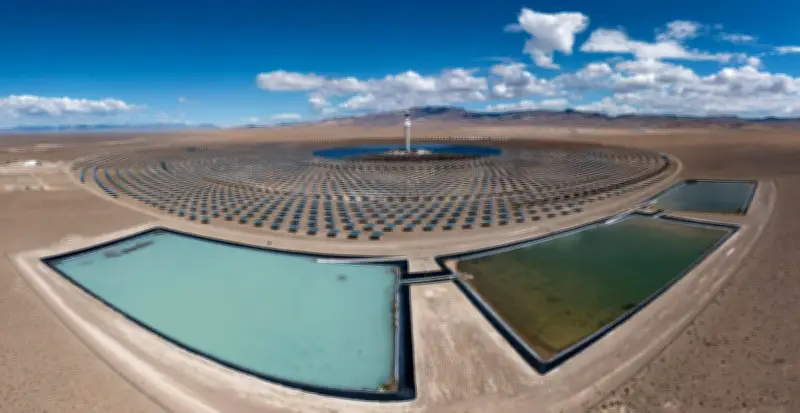
In the Nevada desert, the Crescent Dunes project uses 10,000 panes to heat a reservoir of potassium and sodium nitrate to 560C. The heat can be maintained for 10 hours after sunset, then converted to electricity via a turbine. This molten salt storage also powers most modern guided missiles and nuclear weapons as 'reserve batteries.'
In Denmark, a 1GWh large-scale molten salt battery unveiled this year stores clean electricity for up to two weeks by heating salts to approximately 600C. The hot salt circulates through a generator producing high-temperature steam for industrial processes.
Sand battery in Finland
In Pornainen, southern Finland, a sand battery uses 2,000 tonnes of crushed soapstone to store clean energy as heat, providing 1MW of thermal power and 100MWh storage capacity. The 13-metre-tall, 15-metre-wide battery can cover almost a month of heat demand in summer and close to a week in winter, helping the town eliminate oil use and reduce wood chip consumption by 60%.
Sweat-powered wearables in Japan
Researchers at the Tokyo University of Science are developing a thin wearable patch that generates electricity from human sweat. Using an enzymatic biofuel cell, the patch captures lactate released in sweat and converts it into power. When sweat contacts the cell, enzymes trigger a biochemical reaction releasing electrons, allowing electricity generation without an external power source during everyday activities like walking or exercising.