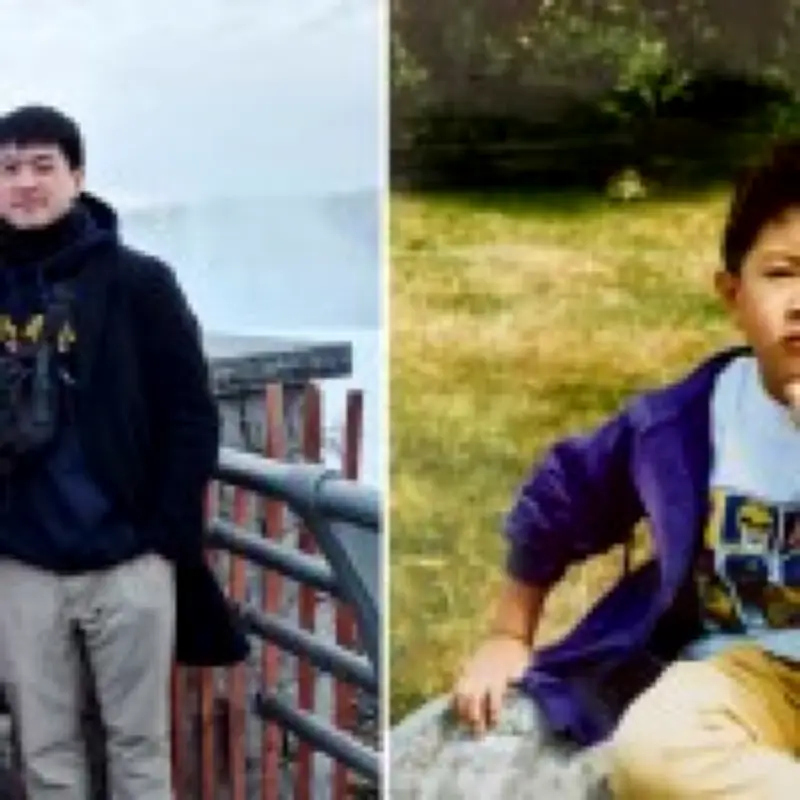
Supa Chantschool was looking forward to his summer holiday travelling with his family to Thailand and Europe. But when his parents took him for travel vaccinations, everything changed. Instead of one appointment, it turned into another trip to the GP and then another, until Supa eventually ended up in hospital. Being eight at the time, he knew something wasn't right – but the little boy had no clue how serious things were.
'When you're eight years old, and your parents are taking you to different places, you don't really question anything. You go to a GP surgery for the lollipop and the sticker at the end of it,' he remembers. However, Supa, from London, had been diagnosed with the potentially deadly liver condition hepatitis B, a blood-borne virus he had contracted at birth through his mother. The condition is estimated to affect over 260,700 people in England.
Diagnosis and early years
Being completely asymptomatic, like most people with hepatitis B, his diagnosis was a chance spot. However, while healthy adults who get the disease usually manage to clear it, children are more susceptible to becoming lifelong carriers. 'My parents were shocked. When you're that young, you don't understand chronic illness, and nobody really explained it to me,' the 35-year-old tells Metro. 'My mum didn't know she had hepatitis B either. It was only after I was diagnosed that the rest of the family were tested.'

Though Supa's parents tried to hide how serious it was, he quickly realised something was up. 'I kept hearing this word "hepatitis" in the house, because my parents told my aunt and uncle, and my grandparents, then it spread throughout the family. I also had to go to King's College Hospital twice a year. But I still didn't feel there was anything wrong with me, as I didn't have any symptoms.'
Emotional impact and stigma
Though Supa experienced no physical issues, the emotional impact took a toll as he got older and more aware of the condition. He learned that most people with the infection live a normal full lifespan; however, some can go into liver failure if the condition progresses, or it can lead to liver cancer or cirrhosis. 'I just assumed I wouldn't have the same future as everyone else. I thought I had some sort of expiry date,' he remembers. 'I felt like I couldn't be around other people – that I was dangerous. It's quite morbid when you're a teenager and think you're going to die young, so you do everything you can under the sun.'
Supa soon learned that growing up with a disease, which can often be misunderstood and stigmatised, meant dealing with misconceptions every day. He recalls going swimming with a cousin when he was young, and having a nosebleed in the pool. 'My cousin jumped out of the swimming pool immediately. He said, "I don't want to have what you have," which hurt. I also had friends at school who would listen if I said I was worried, but we were teenagers. Nobody really knew what to say.'
Transition to adult care and a turning point
Supa had to go to hospital every six months for checkups and blood tests, but as school took over and during the transition from paediatric to adult services, he fell through the cracks at 15 and didn't see a doctor for three years. Even so, he was aware of the dangers of his condition, and when he went to university, Supa avoided joining in the drinking culture – but admits it was hard. 'People would ask, "Why are you not drinking? Do you think you're better than us?" Ultimately it just got to a point where I was just telling people I have a weak liver.'
While at university, Supa signed up to go on a volunteer project in Honduras, which meant he had to get travel vaccinations from his GP. When he mentioned to the doctor he hadn't seen a specialist for years, within a month, the GP had set him up with a liver consultant who explained the condition clearly, and got Supa registered for appointments every six months again. Instead of reinforcing the fears about his health that Supa had carried for years, the doctor reassured him that hepatitis B could be managed, and that he could even drink alcohol in moderation.
'In another timeline, I might never have gone back. If I'd kept ignoring it, my life could look completely different today. But after that conversation, I started believing that I could actually have a normal life.'

Health scare and starting medication
However, at the age of 25, Supa faced his first health scare. After routine monitoring, doctors called to tell him his viral load had increased significantly and posed a higher threat to his liver. It meant that Supa had to start taking lifelong antiviral medication daily to suppress the virus. 'Since I was eight, it was just this thing I had. Then suddenly my viral load shot up and it became real,' remembers Supa, who describes this time as the 'lowest point' of his diagnosis. 'You almost go through the stages of grief,' he explains. 'First you're trying to accept that something has changed, then you're angry, then you're upset, and eventually you realise this is your new normal.'
Meanwhile, daily life, such as dating, was also a challenge. 'When people heard hepatitis B and found out it was also an STI, they didn't even give me the opportunity to explain. You do feel quite tossed aside and rejected,' he admits. In a bid to help manage his condition, Supa stopped drinking for a year and focused on looking after his health. 'I wanted to give the medication the best chance possible.'
Support from family and founding a charity
There was also one person in particular who he turned to for help – his mum, who had already been taking the same medication for years. 'She's a hairdresser, always chatting to people. Hepatitis B doesn't define her life,' he says fondly. 'I remember thinking, "If my mum can be happy on this medication, then I can be too."' Today, Supa takes a tablet each day and continues to live an active, healthy life, with checkups every six months. In 2020, he met his now-wife, who he says never judged him, and took the time to research and listen rather than making assumptions, which helped Supa feel more accepted. 'Once people understand hepatitis B properly, most of the fear disappears,' he explains.
Working in pharmaceutical market research, Supa also studied Biomedical Science and in March 2024 launched the charity Hep B Companion to support those with the infection and spread awareness. He says, 'If people don't understand what a condition does, it's natural to be afraid of it. A lot of it comes down to education.' His organisation is run by volunteers, most of whom have hepatitis B, creating a network who all understand each other's lived experiences. 'A lot of people contact us asking questions they've been too afraid to ask anyone else. Questions like if they can date, or have children. I can say, "I've been there. I've lived this. You're going to be okay."'
The charity's support group WhatsApp chat now has around 50 members, while almost 300 people receive its monthly newsletter. Inside the chat, people openly discuss their worries that once felt impossible to share. 'Someone will post that their viral load has come down, and everyone celebrates with them,' Supa says with a smile. Today, he has helped create a community where nobody feels the need to hide. 'For me, that's the biggest achievement,' he says proudly. 'Hepatitis B has been my longest toxic friend that's walked alongside me my whole life. Yes, it's not good for my liver – but it's pushed me to do more with my life. I wish I'd never had it. But if I hadn't, I don't think I'd have become the person I am today.'