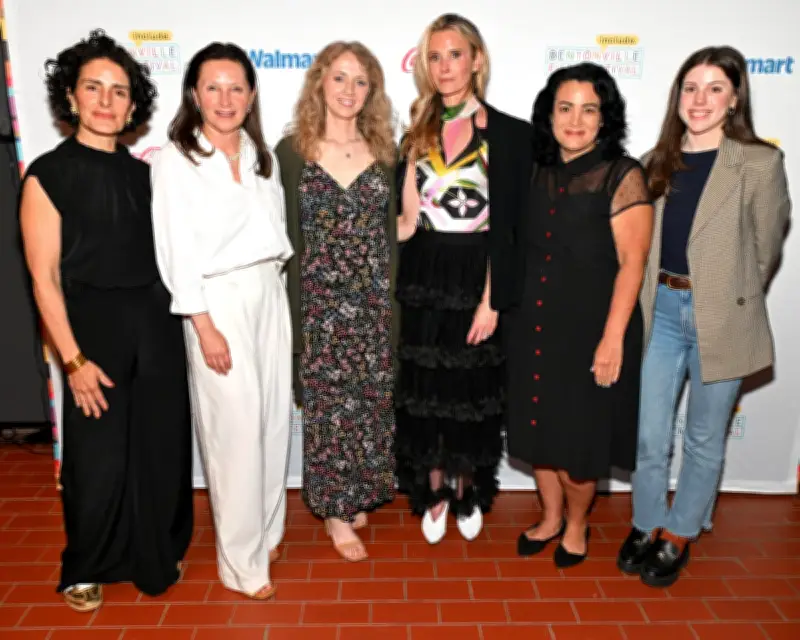
Jennifer Siebel Newsom, center-right, with Camille Servan-Schreiber, Wendy Guerrero, Allie Phillips, Jenelle Riley, and Gretchen Miller at the Bentonville Film Festival in Arkansas on Wednesday. Photograph: Jason Davis/Getty Images.
Interview: Jennifer Siebel Newsom’s New Film Exposes the Human Cost of Unregulated Social Media
In an interview with the Guardian in Washington, Jennifer Siebel Newsom discusses her new documentary, Miss Representation: Rise Up, which examines the cultural backlash against women in the age of algorithms and deepfakes. Shortly after the interview, her husband, California Governor Gavin Newsom, announced a Justice Department investigation targeting Siebel Newsom’s taxes and her nonprofit, the California Partners Project. Newsom called it a personal vendetta by Donald Trump.
Siebel Newsom criticized Trump, stating, “I feel sorry for our country right now because when the father figure, the leader, the president is such a broken, damaging, harmful role model, everyone’s being traumatized.”
Siebel Newsom, turning 52, has long championed causes opposed by Trump. She helped women in Africa and Latin America through Conservation International, acted in Hollywood, and founded a production company focusing on women’s stories. Her 2011 documentary Miss Representation explored media misrepresentation of women. She later launched the Representation Project and, as California’s first partner, continues advocacy for women and children.
Her new film, Miss Representation: Rise Up, features Hillary Clinton, Nancy Pelosi, Amy Klobuchar, Jameela Jamil, Gretchen Carlson, and Katie Couric. It highlights a mental health crisis: 53% of teenage girls reported persistent sadness in a 2023 CDC study, and 27% considered suicide. The film links this to social media “like” and “share” buttons, citing Facebook whistleblower Frances Haugen’s leaked documents showing tech companies exploited children’s neurobiology.
Siebel Newsom said, “AI and social media have been weaponized to objectify and silence women and girls. It’s harming mental health, safety, and power, and it’s happening at an unprecedented rate.” She criticized tech companies’ immunity under Section 230, noting the rise of deepfake pornography by high school boys using AI tools like Elon Musk’s Grok.
The documentary tells the story of Alexandra “Owl” Hinks, who died by suicide after online bullying. Siebel Newsom advocates for guardrails on innovation, citing Pinterest CEO Bill Ready as a positive example. She delayed giving her children smartphones until age 14, but now believes that was too soon. She supports a UK-style ban on social media for children under 16.
The film also addresses the “manosphere” led by Andrew Tate, linking online pornography to real-world violence. It notes that 40% of women and 80% of women in politics face harassment or death threats. The “tradwife” movement, promoted by algorithms, encourages women to abandon economic independence. Siebel Newsom said, “Women should have economic independence and options in life.”
She criticized the alliance between reactionary politics and Silicon Valley billionaires, noting Musk’s support for Trump and Zuckerberg’s presence at a UFC event. “It’s disheartening when people kiss the ring of someone harmful to democracy,” she said.
On women in politics, Siebel Newsom believes gender played a role in Hillary Clinton’s and Kamala Harris’s defeats, along with Russian interference. She said, “Women are essential for a thriving democracy. Our democracy would thrive with more women in leadership.” Asked if America is ready for a female president, she replied, “It’s going to happen in our lifetime. We need to get our country back on track through the 2026 midterms and 2028.”