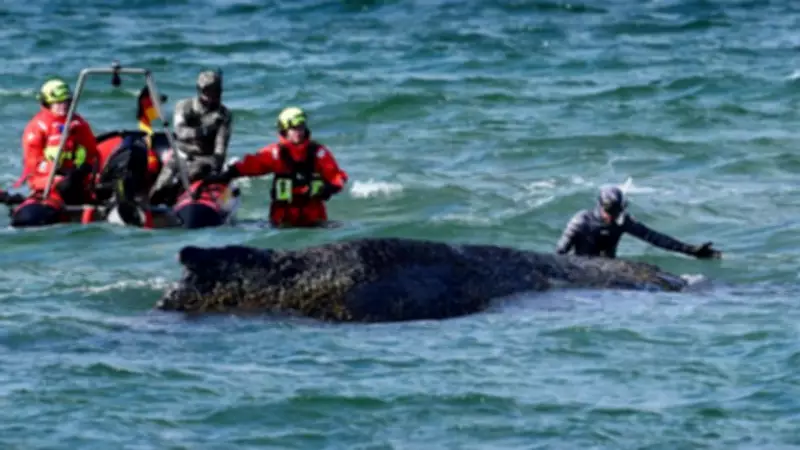
Humpback Whale Successfully Freed After Days Stranded on German Baltic Coast
In a dramatic multi-day rescue operation, a humpback whale that had been stranded in shallow waters off the north German coast has been successfully set free. The whale, measuring between 39 and 49 feet in length and weighing several tonnes, had become entangled in fishing nets near Timmendorfer Strand, a popular resort town on the Baltic Sea coastline.
Race Against Time to Save Struggling Marine Mammal
The whale was first spotted on Monday, but initial rescue attempts proved unsuccessful as the animal remained stuck in the shallow waters. Experts from marine conservation groups and research institutes gathered on Tuesday morning to devise a strategy to save the whale, which was showing signs of distress and facing potential death from its prolonged stranding.
Sven Biertumpfel of the Sea Shepherd marine conservation group explained to reporters that the Baltic Sea is not a natural habitat for humpback whales, suggesting the animal may have followed food sources into the area. "Maybe he followed some fish or some food," Biertumpfel noted, highlighting the unusual nature of the whale's presence in these waters.

Complex Rescue Operation Unfolds
Rescuers faced significant challenges in their efforts to free the massive marine mammal. Early attempts involved boats from the coastguard and fire department creating large waves in hopes of dislodging the whale, but these proved ineffective. The rescue team then tried turning the whale so its head pointed toward deeper water, but the animal returned to its previous position.
Experts emphasized that actively pulling the whale into deeper water was not an option due to the risk of serious injury to the animal. Instead, on Thursday, rescuers employed heavy machinery to dig a channel that would allow the whale to swim out to sea. This was slow, careful work, with rescuers trying to acclimate the whale to the machinery noise to avoid causing additional stress.
Successful Release and Ongoing Journey
By Thursday evening, the rescue efforts finally paid off as the whale began making its way slowly through the newly created channel. The rescue team encouraged the animal with noise, and the whale reportedly responded with humming sounds as it moved toward freedom.
Early Friday morning, researchers confirmed the whale was on its way out of Lubeck Bay, accompanied by a coastguard ship and several other vessels. Stephanie Gross of the Institute of Terrestrial and Aquatic Wildlife Research reported the whale was nearly 1,000 feet off the coast and appeared to be returning to its normal state.
The whale now faces a complex journey through the Danish islands, into the North Sea, and finally into the Atlantic Ocean to return to its natural habitat. The successful rescue operation represents a significant achievement for marine conservation efforts in the Baltic Sea region.