
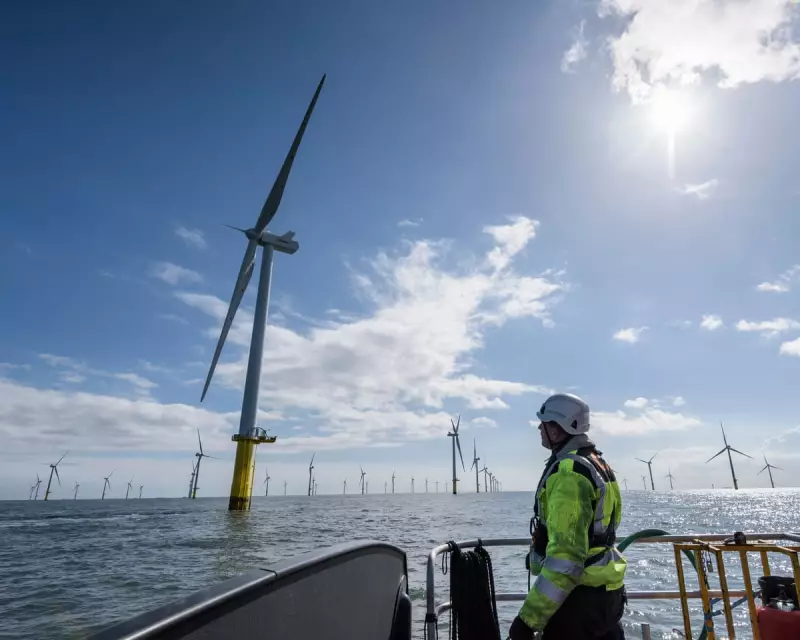
The UK government has hailed its latest offshore wind auction as a monumental step towards clean power, defying earlier fears of soaring costs. The auction, the largest of its kind ever held in Europe, successfully commissioned a massive 8.4 gigawatts (GW) of new capacity in one go.
The Price of Progress: Auction Results and Analysis
Energy Secretary Ed Miliband celebrated the outcome, where winning projects secured contracts at an average strike price of roughly £91 per megawatt hour (MWh). This was notably lower than the £100/MWh some had feared bill-payers would face. Officials pointed to analysis suggesting a £94/MWh price would have been cost-neutral for consumers, arguing that increased wind power reduces gas demand and wholesale prices.
However, a closer look reveals a more complex picture. The previous auction in late 2024 secured capacity at £82/MWh, but for 15-year contracts. This latest round used 20-year contracts, a change estimated to have lowered the headline price by about £5/MWh. A like-for-like comparison suggests this year's price is closer to £96/MWh, an increase of approximately 17%.
New Realities in the Energy Transition
The results underscore two hard truths for the UK's energy strategy. Firstly, the era of consistently falling offshore wind costs is over. Higher borrowing rates and strained supply chains have fundamentally altered the economics. Secondly, while more renewables provide a buffer against volatile gas prices, the immediate impact on consumer bills from this auction will be modest.
The contracts lock in inflation-linked prices for two decades within a system that already has some of the highest electricity prices in the developed world. Energy analysts now believe significant "whole system" savings from a renewables-heavy grid may not materialise until around 2040.
Trade-Offs and the 2030 Target
This auction vividly illustrates that the energy transition is now deep in a phase of difficult trade-offs. The government's target for 95% of electricity from low-carbon sources by 2030 is now under scrutiny. Following this auction, the UK is likely on course for 85%-90%. Some within the energy sector question the necessity of pursuing the final, most expensive percentage points if the law of diminishing returns is taking hold.
More pressing questions are emerging. These include the £80 billion cost of rewiring the national grid, ensuring new transmission lines are built before wind farms to avoid huge "constraint" payments, and formulating a clear plan for backup gas generation for cold, windless periods. A recent government report warned of an "emerging risk" of gas supply shortfalls by 2030 if key infrastructure fails.
There are hints of growing pragmatism. Chris Stark, head of a key mission control unit in the energy department, stated that while the 2030 offshore wind target is "on track," hitting it is "not essential" given the auction's strong results, allowing future flexibility. The challenge for ministers is to balance ambition with the practicalities of cost and energy security in the years ahead.



