Peak District National Park at 75: A Legacy of Wildness and Wonder
From the wild moors to the gentle dales, the Peak District national park remains as inviting today as it was upon its establishment in April 1951. As the first national park in Britain, it stands as a testament to the enduring appeal of natural landscapes amidst urban development.
An Island of Darkness in a Sea of Light
Satellite images of Britain on a clear night reveal a striking contrast: the glowing street lights of towns and cities illuminate the map, while the cupped-hand-shaped boundary of the Peak District national park emerges as an island of darkness. This visual underscores why this site was chosen—it places a national park where it is most needed, surrounded by the industrial conurbations of northern England and the Midlands.
Approximately one-third of England and Wales' population lives within an hour's reach of the Peak District. The teeming populations of cities like Manchester, Sheffield, Derby, Leeds, Nottingham, Stoke-on-Trent, and Birmingham contribute to over 13 million annual visitors, who regard the park as their backyard and playground. This makes it one of the busiest national parks globally.

The Great Escape for Industrial Workers
In the words of the late Manchester journalist Brian Redhead, the Peak District represented the "Great Escape" for workers toiling in cotton mills and steel foundries. Today, it is not uncommon to see well-equipped walkers in Gore-Tex and boots striding through Manchester's Piccadilly or Sheffield's Fargate, heading for a day out in the hills.
When Sir Arthur Hobhouse proposed the Peak District as a national park in his 1947 report, he highlighted its unique value: "Beyond its intrinsic qualities, the Peak has a unique value as a national park, surrounded as it is on all sides by industrial towns and cities ... Its very proximity to the industrial towns renders it as vulnerable as it is valuable."
Geographical Splits: Dark Peak vs. White Peak
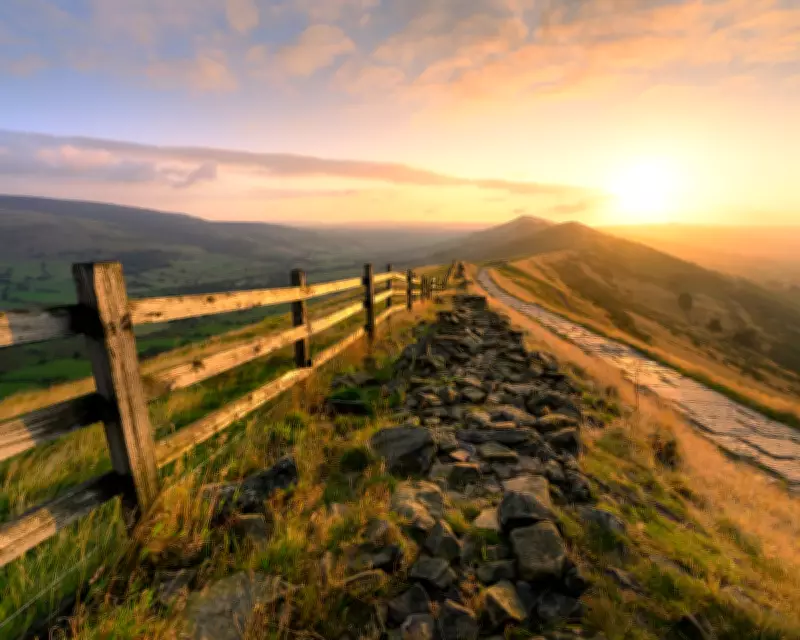
The park is divided into two distinct regions. The White Peak features glorious limestone dales like Dovedale and Lathkill Dale, while the Dark Peak encompasses gritstone moorlands such as Mam Tor and Bleaklow, known for their uncompromising terrain.
Many, including the author, prefer the Dark Peak for its top-of-the-world feeling of freedom in places like Kinder Scout or Stanage Edge. However, not all share this view. Alfred Wainwright, in his 1968 Pennine Way Companion, expressed disdain for Bleaklow's peaty bogs, stating, "Nobody loves Bleaklow. All who get on it are glad to get off." Similarly, nature writer John Hillaby described Kinder Scout's summit in his book Journey Through Britain as looking "entirely covered in the droppings of dinosaurs."
Historical and Cultural Significance
Kinder Scout, the highest point in the Peak at 2,087 feet, holds a special place in rambling folklore as the scene of the 1932 Mass Trespass, where five ramblers were imprisoned for asserting their right to roam. Another Dark Peak favorite is Alport Castles on Bleaklow's southern slopes, Britain's largest landslip, where peregrine falcons nest among gritstone walls.
Lud's Church, hidden in Back Forest, is steeped in Arthurian legend as the likely location of the Green Chapel from Sir Gawain and the Green Knight. Visitors might spot the Green Knight's profile in the rock wall, though escaped wallabies are now a memory.
Iconic Landmarks and Pubs
The Old Nags Head at Edale is a traditional pub and the starting point of the 268-mile Pennine Way, envisioned by rambler Tom Stephenson in 1935 and opened in 1965. In the White Peak, Dovedale's gin-clear waters, praised by Izaak Walton in 1653, attract crowds in summer, while Lathkill Dale offers a quieter stroll, though its river often disappears underground.
After a walk, the Church Inn at Chelmorton provides a pint in one of the Peak's highest villages, with a golden locust weathervane honoring John the Baptist. The White Peak also boasts prehistoric sites like the Neolithic stone circle of Arbor Low, about 5,000 years old, and the haunted Magpie Mine, a well-preserved lead mine.

Modern Challenges and Innovations
As a pioneer, the Peak District has implemented traffic management schemes in the Upper Derwent and Goyt valleys and converted former railways into walking and cycling routes like the Tissington and High Peak Trail. However, government funding cuts have hit hard, with a 50% real-terms reduction leading to a 10% staff decrease last year. This prompted the creation of the Peak District Foundation and discussions of a visitor tax.
During the Covid pandemic, the park served as a vital lifeline for locked-down residents, a role it has proudly filled for 75 years. As it celebrates this milestone, the Peak District continues to balance conservation with accessibility, ensuring its wildness and wonder endure for generations.