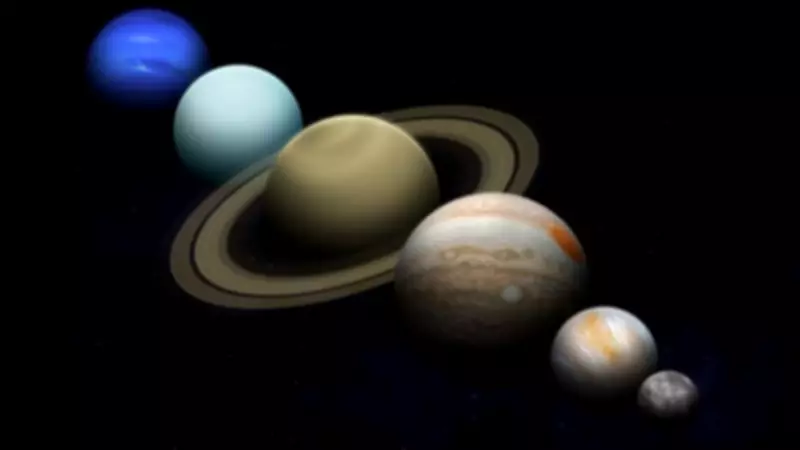
Six-Planet Alignment: A Rare Celestial Spectacle in UK Skies
This weekend, skywatchers across the UK are in for a treat as a relatively rare planetary parade unfolds in the night skies. The phenomenon will feature an alignment of six planets: Mercury, Venus, Saturn, Jupiter, Uranus, and Neptune. According to the Greenwich Royal Observatory, this event offers the potential to see all six planets at once, with some visible to the naked eye under clear conditions.
When and How to Spot the Planets
The planetary alignment will be visible after sunset on Saturday, 28 February 2026, and Sunday, 1 March 2026. For observers across the globe, Mercury, Venus, Jupiter, and Saturn will be discernible without optical aids, provided skies are clear. However, Uranus and Neptune will require binoculars or telescopes to be spotted, as noted by the Royal Observatory.
Mercury, Venus, Saturn, and Neptune will appear in the west, very close to the horizon. This positioning means that sunlight and any obstructions on your skyline could pose challenges for viewing. In contrast, Jupiter will be the highest planet in the sky for most of the night and, according to the Royal Observatory, will be the easiest to locate. Even in areas with light pollution, Jupiter will shine as a bright, non-twinkling point of light visible to the naked eye.

For those in the UK, Sunday is expected to be the optimal day for planet-spotting. Astronomy website Star Walk suggests that the best times to look up are around 6:10 PM in London and 6:16 PM in Manchester.
Identifying Planets in the Night Sky
At least one bright planet is typically visible on most nights, according to NASA. To distinguish planets from stars, planetary scientist Sara Mazrouei from Humber Polytechnic in Canada offers a simple tip: "If it is twinkling, it's a star. If it is not twinkling, it's a planet." This rule of thumb can help observers confirm their sightings during the alignment.
The Science Behind Planetary Alignments
In simple terms, planetary alignments occur as the planets in our Solar System orbit the sun, occasionally lining up in space. NASA explains that the term "planetary alignment" can refer to apparent line-ups with other planets, the moon, or bright stars. When this happens, the planets always appear along a line or an arc from Earth's perspective, though in reality, they are not in a perfect straight line but are clustered on one side of the sun.
Rarity of the Event
Dr. Shyam Balaji, a researcher in astroparticle physics and cosmology at King's College London, previously told Sky News that "planetary alignments, where multiple planets appear close together in the sky, occur periodically but are relatively rare." He added that alignments involving six or more planets happen approximately every few decades. NASA notes that while Jupiter and Saturn are frequently seen, the inclusion of Venus and Mercury makes this event particularly noteworthy.
Weather Conditions for UK Observers
The forecast for the UK offers a mixed outlook. On Saturday night, England and Wales are expected to have clearer skies initially, with cloudier conditions increasing from the north and west later. On Sunday night, showery rain will spread to the east, becoming heavy in the northwest. This means clearer skies are more likely in southern England, so observers in that region may have the best chances.
Tips for Maximizing Your Viewing Experience
To enhance your chances of spotting as many planets as possible, Dr. Balaji from King's College London recommends the following tips:
- Find a location away from city lights to reduce light pollution.
- Use current astronomical software or websites to track the latest positions of the planets.
- Exercise caution when observing near sunrise or sunset to avoid eye strain.
- Check reliable astronomy websites for updated viewing information as the date approaches.
This celestial event provides a unique opportunity for both amateur and seasoned astronomers to witness a rare alignment. With proper planning and favorable weather, skywatchers in the UK can enjoy a memorable view of our solar system's planets in harmony.