
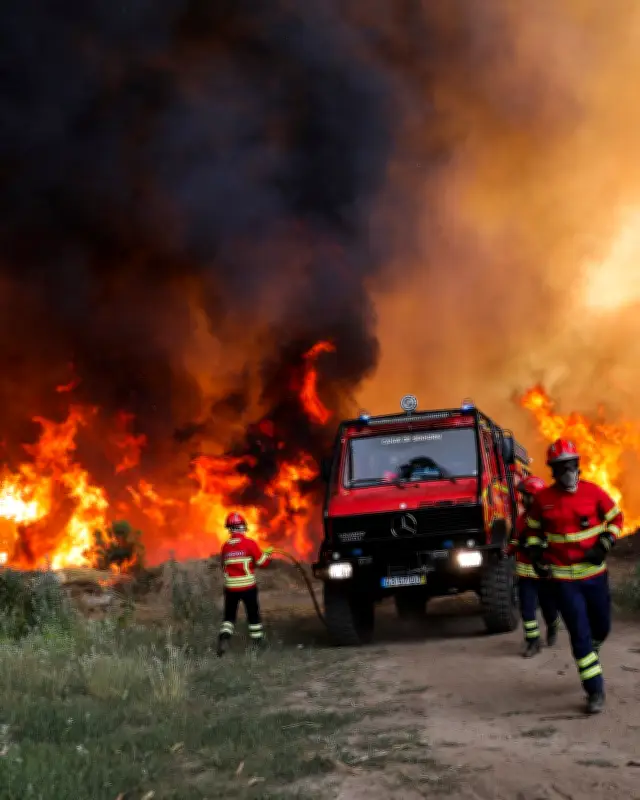
Firefighters across the globe are increasingly forced to make impossible choices as climate change intensifies wildfires, pushing them into new regions and overwhelming resources. César Alcaraz, an officer with Alicante's provincial firefighters in Spain, likens his job to that of a doctor in an emergency room with too few ventilators.
Operational collapse looms as fires multiply
“It’s not just about having more fires to fight, it’s the risk of operational collapse,” Alcaraz said. “When two or three fires break out simultaneously, we are forced to make immediate triage decisions.” He has seen concurrent blazes occurring more often and earlier in the year.
Deadly wildfires have engulfed western Europe this month following three heatwaves that turned vegetation into dry tinder. France, Portugal and Spain have each seen record-breaking numbers of wildfires for this time of year, with an unprecedented area of France burned and 13 people dead in Spain. The UK experienced 19 separate wildfires in one week, prompting experts to warn of a “firewave” more widespread than ever before.
Smoke crosses continents
Across the Atlantic, smoke from 100 fires in northern Ontario made Toronto the most polluted city globally on Wednesday before crossing the US border to choke New York. A study found that Canadian wildfire fumes caused 82,000 early deaths in 2023, including 33,000 in the US and 22,000 in Europe. On Friday, the EU's Copernicus agency warned of “extremely poor” air quality in areas like New Jersey.
While the global trend in wildfire size has seen fewer hectares burned due to farmland fragmentation in Africa, fires are now hotter, less predictable, and greater in number. Carbon pollution raises global temperatures, drying plants and allowing small fires to escalate into infernos, spreading into forests, moorlands, cities, parks and gardens.
France and Spain under pressure
In France, firefighters tackled 250-300 fires simultaneously over the past three weeks, according to Julien Marion, head of the civil protection agency. In Spain, firefighters used to dealing with a couple of blazes at a time now struggle with increased number and strength, worsened by wet winters that boost vegetation growth and farmland abandonment.
“In the end, the response capacity is limited,” said Juan Caamaño, head of training at the Pau Costa Foundation. “When we face these huge fires, these extreme events, it’s like trying to put firefighters on a beach to stop a tsunami.”
UK faces new wildfire threats
In the UK, blazes have broken out from cities to national parks after a scorching start to summer. A wildfire in Walthamstow, east London, drew about 125 firefighters after a falling tree hit power cables. Dr Thomas Smith, a wildfire scientist at the London School of Economics, noted that large parts of the country had a 100% probability of sustained ignition. “Especially for grass fuels, which dry out very quickly, it only requires 2-3 weeks of dry weather to reach those thresholds,” he said.
“The climate of the 20th century is now gone,” UK scientists reported, noting last year was the hottest on record. A wildfire in Scotland’s Cairngorms national park burned 300 hectares (740 acres).
Simultaneous fires strain resources
“Simultaneous wildfires place enormous pressure on emergency services,” said Dr Maria Barbosa of the UK Centre for Ecology and Hydrology. “Fire agencies depend on their ability to move personnel, equipment and aircraft between regions as conditions change. But when multiple large fires occur at the same time, that flexibility is greatly reduced.”
The shift from fighting all fires to picking battles is “a very new thing for northern European countries”, said Smith, though not for the Mediterranean. “They’re having to change tactics when they fight fires, while we’re really struggling with strategic decisions.”
Staffing cuts worsen crisis
London firefighters remember the 2022 wildfire that destroyed 18 houses in Wennington during a heatwave, the worst day for the London fire brigade since World War II. The service has since bought four all-terrain support vehicles, mobilised 34 times this year. Steve Wright, general secretary of the Fire Brigades Union, said 12,000 fewer firefighters in the UK than in 2010 have delayed responses. “This is only going to get worse, and the government has to get a handle on it,” he said. “It’s happening in towns, cities and villages across the UK.”
Global fire seasons overlap
Fire seasons in North America and Australia are getting longer and increasingly coincide, hampering sharing of aircraft and firefighters. A study found the overlap could increase to between 4 and 29 days each year by 2050. The return of El Niño has alarmed Australia and Indonesia, with Australia’s Bureau of Meteorology warning it could be the strongest on record.
“The climate emergency kills,” said Spanish Prime Minister Pedro Sánchez. “As a result, all levels of government and society as a whole must rise to the challenge before us.”
Policy shifts slow to materialize
Policies to cut carbon pollution fall short of stopping 1.5C warming. Controlled burns to prevent mega-fires are still novel in many countries, except Canada and Australia, which incorporate Indigenous fire strategies. In June, EU member states approved a non-binding strategy to manage wildfire risk, and its civil protection mechanism was increased with pre-emptive deployments. However, Caamaño noted that firefighting teams are deployed in extreme situations they have never seen. “I have the feeling that we’re always behind the emergency,” he said. “And it is the emergency that governs us, rather than us governing the emergency.”



