
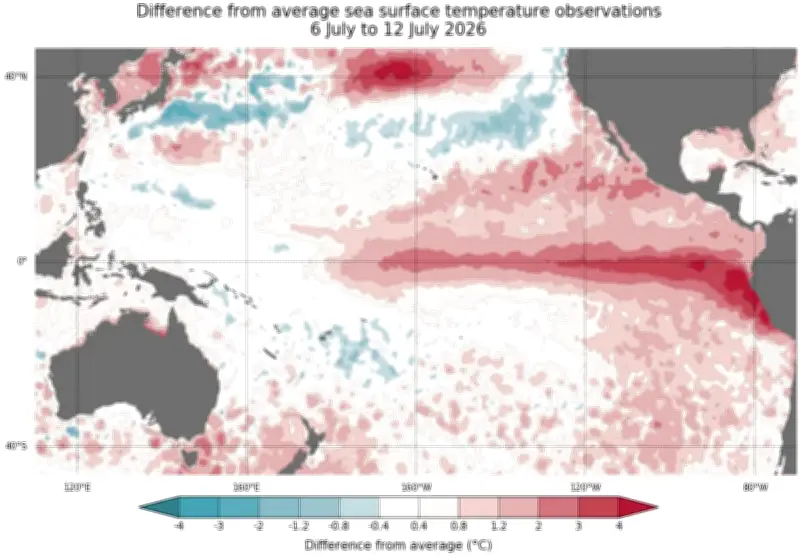
The El Niño climate phenomenon, linked to record global temperatures and now locked in place in the Pacific Ocean, could develop into the strongest on record, according to Australia's Bureau of Meteorology (BoM). Climatologists are watching the strengthening El Niño with increasing alarm, calling the forecasts from climate models in the coming months 'mind blowing' and 'astounding'.
Potential for Record-Breaking Strength
Dr Zhi-Weng Chua, a senior climatologist at the bureau, said the highest reliable temperature value for previous El Niños was a monthly average of +2.6°C seen in the Niño 3.4 region of the equatorial Pacific in January 1983. However, climate models suggest this El Niño could peak between +2.2°C and above +3°C. 'There is a realistic chance that the peak anomaly of this event will rank in the top events, with a chance it could rank as the highest. It is remarkable, and it shows just how much heat there is in the ocean,' Dr Chua said.
The bureau's own model has the El Niño peaking at about +3.3°C, with the phenomenon staying in place until at least the coming summer. Dr Zeke Hausfather, a climate scientist at Berkeley Earth, reviewed 14 different seasonal model forecasts of the Niño 3.4 region from around the world. 'It looks like this year's El Niño is not only very likely to be the strongest event since reliable records began – it may end up the strongest by a truly mind-blowing margin,' he wrote in The Climate Brink newsletter.
Global and Local Impacts
Globally, experts have said a strong El Niño could work in tandem with global heating to deliver the hottest year on record either this year or, more likely, in 2027. The bureau has stressed that the strength of an El Niño does not necessarily correlate with the strength of impacts in Australia, but the system generally brings hotter and drier conditions in winter and spring for southern and eastern parts.
Prof Sarah Perkins-Kirkpatrick, a climate scientist and expert in heat extremes at the Australian National University, said: 'Every time I look at it, I have this sense of awe but deep concern. I think it will be one for the record books. But this doesn't mean the impacts here in Australia will be extreme. But we are waiting with bated breath.'
Forecast for Australian Cities
The bureau's latest long-range forecast shows that for August to October, huge areas of the country have a high chance of seeing maximum temperatures in the top 20% on record for that period. Brisbane, Sydney, Melbourne, Hobart, Adelaide and Perth all have an at least 80% chance of experiencing those temperature extremes. All those cities also have an increased chance of unusually low rainfall.
Dr Kim Reid, an expert on seasonal predictions and rainfall at the University of Melbourne, said if the climate models were right about the El Niño, it would be 'astounding to see that amount of heat being released from the ocean into the atmosphere'. 'That's going to have considerable impacts around the world. For Australia, the strength is not super correlated to the impacts we feel,' she said.
Additional Climate Factors
Reid was particularly watching conditions in the Indian Ocean, where some models were predicting cooling in the waters of Australia's north-west in the coming months. When this phenomenon – known as a positive Indian Ocean Dipole – had combined with El Niño in the past, Reid said this had led to very dry periods such as the 'tinderbox drought' which preceded Australia's black summer bushfires in the summer of 2019-2020.



