
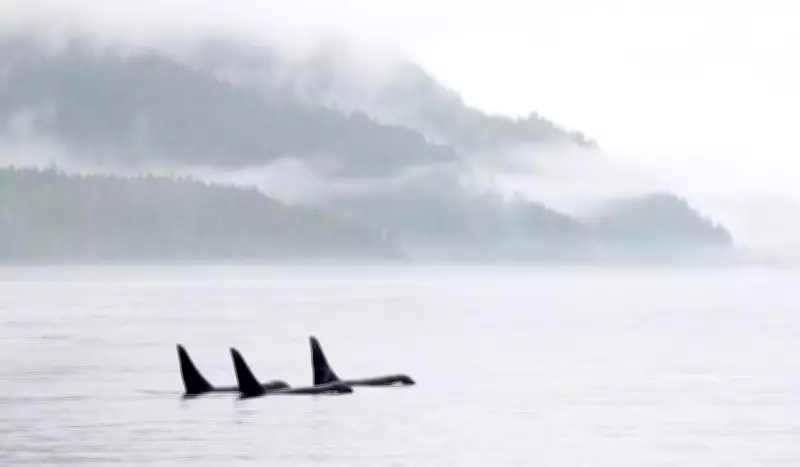
Environmental groups in Canada fear that endangered orcas could become a casualty of Mark Carney's push for a new oil pipeline, as the rush to develop fossil fuel infrastructure collides with laws meant to protect threatened species. The decades-long tragedy of the critically endangered southern resident orcas has become emblematic of an ecosystem in crisis. Fishermen, whale-watching companies, and the marine transport industry have long feuded over who bears the most blame.
The southern resident orcas can only survive on a diet of chinook salmon, a species that itself is in steep decline. While there were more than 200 orcas at the beginning of the 20th century, nowadays only about 70 swim the waters between British Columbia and Washington state.
Environmental groups have raised the alarm over increased ship traffic along the southwest coast of British Columbia, the result of a busy Trans Mountain oil pipeline that terminates near Vancouver and a new liquefied natural gas terminal further north. On Friday, Carney announced plans for a new oil pipeline from Alberta to the Pacific coast, with construction expected to begin by fall of 2027.
A new policy discussion paper has raised fears that in pursuit of the project, the federal government might bypass legal protections for the orca. The document, titled 'Getting Major Projects Built in Canada,' called the process for building mines, ports, airports, and pipelines 'slow, expensive, and confusing' and suggested changes to existing rules. One part proposes exempting major projects from the 'jeopardy test for species at risk,' which forces regulators to ask whether a project would jeopardize the survival or recovery of a protected species.
'In practical terms, this provision is intended to prevent projects from pushing endangered species into extinction. Weakening this safeguard has direct implications for southern resident killer whales and their protection under the Species at Risk Act,' said Misty MacDuffee, a biologist at Raincoast Conservation Foundation. 'As the federal government has acknowledged in its imminent threat determination, these whales face extinction under the existing conditions.'
The proposed changes are open to public comment until June 9. The development, first reported by the Toronto Star, prompted the federal government to respond that the reporting 'could not be further from the truth.' Transport Minister Steven MacKinnon pointed to recent investments, including C$91.3 million to address threats to the southern resident orca population, and changes to ship distance laws from 200 meters to 1,000 meters to minimize disturbance.
'We would not take any actions that would undermine these important strategies and substantial investments. Our approach to assessments isn't about cutting corners, but improving coordination, efficiency, and long-term planning resulting in faster decisions, without weakening oversight or standards,' he wrote in a statement.
Critics say that while the government has made key promises to protect whales, they appear to be looking for a carve-out by exempting projects of national interest from stringent reviews where endangered species might be affected. After the new pipeline deal was confirmed, environmental groups swiftly condemned the agreement. MacDuffee said: 'Recovery requires improvements in habitat quality, including reductions in underwater noise and disturbance. Weakening the protective provisions to enable projects that worsen these conditions would push southern residents closer to extinction.'
Environmental law charity Ecojustice said the move 'jeopardized' Canada's ability to protect whale habitats. Director Margot Venton stated: 'No project that threatens the extinction of iconic southern resident killer whales and puts communities' health at risk could be 'nation building.' Increasing tanker traffic in the already busy Salish Sea ups the risk of oil spills and ocean noise, pushing the critically endangered whales further towards extinction. Experts have been unable to find a way to offset the noise from increasing tanker traffic. These whales cannot handle any more tankers in their habitat.'
In the past, threatened or endangered species have delayed construction of major projects. When the government was building the Trans Mountain pipeline, a rare species of hummingbird temporarily halted work. However, the effectiveness of Canada's species at risk laws has been questioned, especially when requirements clash with lucrative industries. Successive environment ministers have declined to designate chinook salmon as a species at risk, largely over implications for the fishing industry.
Nature Canada, one of the country's oldest conservation groups, called on supporters to urgently contact lawmakers to vote against any fast-tracked legislation, warning it could lead to zones of 'environmental lawlessness.' Akaash Maharaj, director of policy at Nature Canada, said: 'The effort to redefine environmental responsibility as mere 'red tape' is dangerously short-sighted. Nature is not an impediment to economic development; environmental assessment is the 'credit check' before we write the loan. It is due diligence, fiduciary responsibility, and the only way to build prosperity that endures.'



