
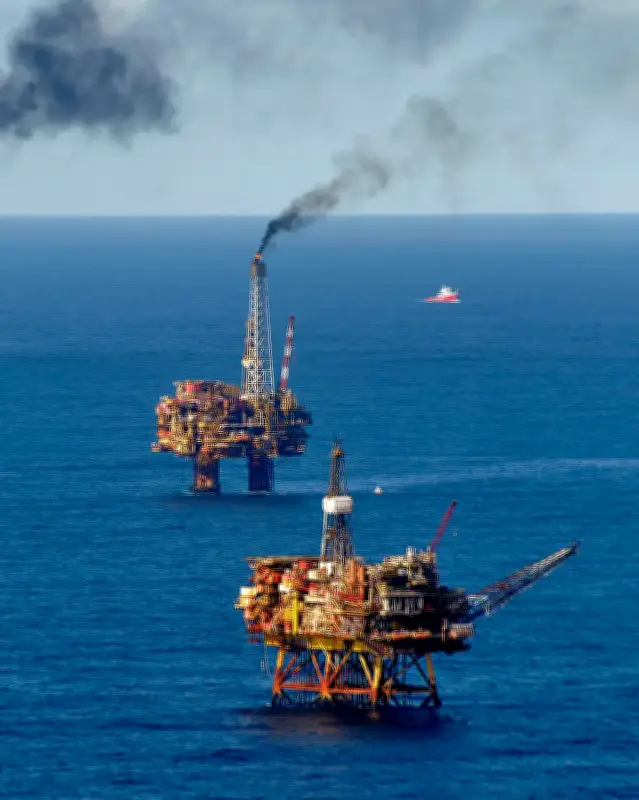
The North Sea oil basin, once a cornerstone of the UK economy, is now a shadow of its former self, with production set to fall to just 15% of its peak by 2030. Despite this decline, it remains a powerful political symbol, central to debates over energy security, climate policy, and national identity, as recent calls for expanded drilling from political leaders and former US President Donald Trump demonstrate.
From Pickle Jar to National Icon
When oil was first discovered off the north-east coast of Scotland in September 1969, industry folklore has it that the duty superintendent on the rig carefully poured it into a pickle jar commandeered from the canteen and took it back to Amoco’s Great Yarmouth office in Norfolk. There, it was emptied into an ashtray, sniffed, and then set alight.
From that modest start, North Sea oil emerged as a driving force of the British economy and a symbol of national power and renewal as the UK emerged from the Opec oil crisis. By 1977, the then Labour prime minister, Jim Callaghan, declared: “God has given Britain her best opportunity for 100 years in the shape of North Sea oil.” A subsequent white paper said it offered “a unique opportunity for Britain to improve her economic performance, raise her living standards, move forward to full employment, and develop a socially just society”.
A decade later, the basin became a central part of Margaret Thatcher’s political project, with its revenues approaching 10% of the UK’s total tax take at times, supporting a programme of tax cuts and privatisation. Output peaked at the turn of the century, when the basin produced a staggering 4.4m barrels of oil equivalent a day. Aberdeen, chosen over Dundee by the fossil fuel corporations for their onshore headquarters because it had fewer links to trade unions, was booming, with offshore jobs plentiful and well paid.
Symbolic Power Outlasts Economic Decline
Ewan Gibbs, a specialist in the history of energy in the UK at the University of Glasgow, said that as the oil began to flow, it was seized upon by politicians and the public as a symbol of British imperial might. “At its peak, oil was associated not only with immense wealth but also with power and international prestige,” said Gibbs. “It came to embody a sense of national renewal.”
Now, those boom years are firmly in the past. The amount of economically viable oil and gas has declined rapidly in the past two decades, and by 2030 the basin will produce just 15% of its peak output. Many of the biggest oil and gas corporations have left as stocks dwindle – BP was the latest, announcing this summer an end to six decades in the basin. During the boom years, North Sea oil directly employed about 120,000 people and supported hundreds of thousands more jobs indirectly. Data from the Office for National Statistics suggests that figure has now dropped to about 27,000 direct employees.
However, although its economic significance has waned, the idea of North Sea oil has retained a disproportionate grip on the national psyche. “Even as it declines, there is still a strong sense for many people that this is Britain’s oil, that it is bountiful and belongs to the country, and that if we don’t exploit it we are turning our back on something important,” said Gibbs. “It is this emotional attachment, this idea that this is our oil that means, even as the area becomes less economically significant, it retains an outsized importance in the country’s imagination.”
Political Storm Over Drilling
In the run-up to the 2024 general election, the Labour party announced there would be no new exploratory licences for oil and gas in the North Sea. This was a significant moment in the fight against climate breakdown, as the International Energy Agency had said in 2021 that there could be “no new investments in oil, gas and coal” if the world was to avoid the worst impacts of the climate crisis. It was also a victory for the then energy secretary, Ed Miliband, who argued that a rapid transition to cleaner energy systems would make the UK a “clean energy superpower” and unshackle it from the volatile fossil fuel market.
But fast forward two years, and despite wars in Iran and Ukraine again highlighting the perils of dependence on a volatile fossil fuel market and an escalating climate crisis, those plans are once more at the centre of a political storm. The leader of Reform UK, Nigel Farage, and the Conservative party leader, Kemi Badenoch, have called for a massive expansion of drilling in the North Sea, claiming they would reverse the ban on new licences if elected. Donald Trump has also weighed in, claiming the basin was “one of the greatest reserves anywhere in the world … with 500 years of oil and gas reserves left”.
Such statements have left climate experts, geologists, and energy specialists scratching their heads. Steve Pye, a professor of energy systems and the deputy director of the Energy Institute at University College London, said: “The North Sea basin has been in decline since 2000. There are no credible prospects of reversing this.”
The Reality of Energy Security and Jobs
Experts point out that energy prices are set globally and there is not enough oil or gas in the North Sea to have any impact, so there would be no reduction in UK bills whatever the country did. Also, the vast majority of what is left in the North Sea is oil that overwhelmingly goes abroad to be refined and then sold on the international markets, meaning it has no impact on the UK’s energy security. More of the gas produced in the North Sea goes to UK homes and businesses, but there is less of that left, certainly not enough to make any meaningful impact on our reliance on imports.
A recent study by Carbon Brief found that even if the government allowed new licences, it would only make a fractional difference: gas extraction from the North Sea is forecast to drop 99% by 2050 without new licences, compared with 97% if new licences were awarded. Conversely, the study found that continued expansion of renewables and low-carbon technologies in the North Sea would reduce reliance on volatile gas imports much faster than allowing new drilling, with energy from new wind and solar from the latest government auction expected to produce six times more electricity by 2030 than new drilling licences would.
On employment, the campaign group Uplift points out that the number of jobs supported by the oil and gas industry has more than halved in the last decade – from 441,000 to 214,000 today – despite previous governments issuing hundreds of new licences in six separate licensing rounds. Tessa Khan, the director at Uplift, said it was “a dangerous fantasy” to talk up the potential of North Sea oil as a fix for Britain’s problems. “We have seen that, time and again, the arguments put forward by the fossil fuel lobby and their supporters in favour of more drilling have fallen away upon making contact with reality – from falsehoods about lowering bills to exaggerations about improving energy security. After 50 years of drilling, the fact is the UK has burned through most of its gas reserves, while most of what remains is oil that is largely exported.”
The Green Transition and Its Challenges
In October last year, the UK government unveiled plans for an extra 400,000 jobs in the burgeoning green economy over the next five years. Making the announcement at the Siemens turbine factory in Hull, Miliband said the government planned to double the number of people working in green industries by 2030, with a particular focus on training those coming from fossil fuel jobs, school leavers, the unemployed, veterans, and ex-offenders. The green economy is certainly becoming an increasingly significant part of the UK’s future. A recent report from the Confederation of British Industry found it already supported a million jobs and higher wages, with nearly half a trillion pounds of further investment in the pipeline.
This rapid growth is visible in the North Sea itself, with huge windfarms springing up across the basin. The electricity they generate accounts for about 18% of the UK’s total. Overall, in 2025, renewables provided 50.4% of the UK’s electricity, compared with 31.8% from fossil fuels. Despite this rapid growth, there are growing concerns that any benefits from these developments are bypassing the workers and communities that need them most. Unite and GMB, the unions representing oil and gas workers, say the transition to renewable energy is not delivering the secure long-term jobs that were promised, and they have been vocal about their support for more drilling in the North Sea.
Connor Watt, of Platform, which works with current and former oil workers, unions, community groups, and climate activists across Scotland, said: “The three main wins from the transition to renewables should be jobs, cheaper energy and income from electricity generation that can be used to bolster public finances, to help local communities. But at the moment, despite huge renewable projects going ahead, none of those three things have materialised and people are beginning to wonder why.” Oil and gas workers, unions, and community energy groups have organised a campaign to rethink how the government is conducting the “just transition”, calling for a greater role for community ownership and nationalisation to stop the profits and benefits bypassing local workers and communities.
Many campaigners look to Norway, where the government set up a sovereign wealth fund when it discovered oil and gas in the North Sea. It is used to safeguard the economy and fund future public spending and is now worth more than $2tn – the biggest fund of its kind in the world. Analysts say that if the UK had taken a similar approach, a UK sovereign wealth fund could be worth about £850bn now. Watt said: “If you compare what has happened here with what Norway did with its sovereign wealth fund, which has had huge benefits for the people of that country, we did something totally different – a market-led approach which has seen the vast majority of the benefit flow into the profits of global corporations rather than local communities.”
The debate about North Sea oil and gas extraction looks set to rumble on, even as its economic significance dwindles. But for many whose lives and livelihoods are entangled with what happens there, it is a distraction from the decisions that will actually shape their future. Watt said: “The real question policymakers and local communities must grapple with now is: can the UK capitalise on the renewable energy revolution? And if it does, will it be the workers and communities across the UK who benefit, or corporate profit margins?”



