
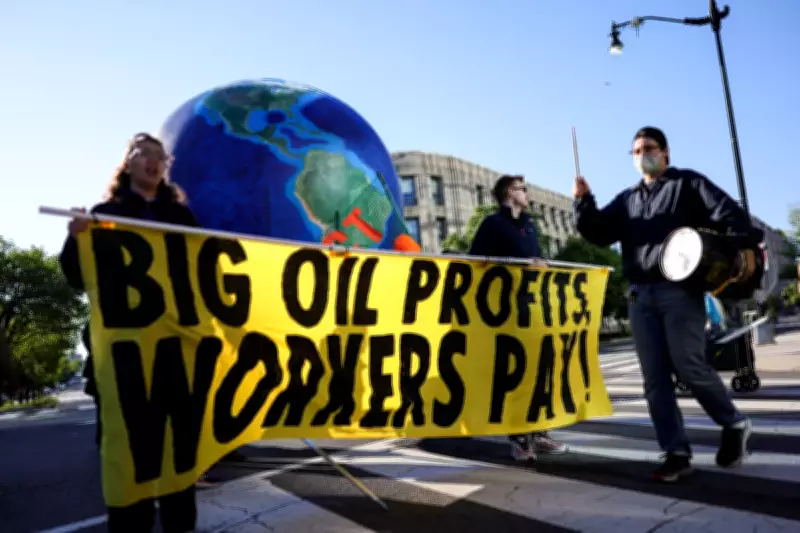
Climate activists blocked a highway ramp near the American Petroleum Institute in Washington DC on May 1, 2026, drawing attention to a new proposal that argues climate action can lower household costs. The Climate and Community Institute (CCI), a left-leaning thinktank, released a platform titled 'Stop Greed, Build Green' to counter the narrative that climate policy is politically toxic.
Green Economic Populism
CCI's framework, called 'green economic populism,' posits that decarbonization should be seen as a tool for affordability. The group, which has written federal bills for Alexandria Ocasio-Cortez and Bernie Sanders, argues that the climate crisis drives the cost-of-living crisis. A survey by CCI and Data for Progress found that 70% of voters, including 65% of Republicans, believe climate action can lower living costs.
Building on the Green New Deal
The approach builds on the Green New Deal but focuses on tangible benefits like lower bills, heat pumps, affordable EVs, and free electric buses. Naomi Klein, a prominent author and CCI advisory board member, said the strategy challenges the perception that reducing emissions makes life harder. Daniel Aldana Cohen, CCI's founding co-director, emphasized the need for 'climate policy you can touch.'
Political and Union Support
CCI launched the platform in New York City with speakers including Louise Yeung, chief climate officer for Mayor Zohran Mamdani, and representatives from the Democratic Socialists of America. The group also met with lawmakers in Washington DC. Katie Wilson, Seattle's socialist mayor, aligned her priorities with the platform, focusing on green social housing. The Chicago Teachers Union and tenant campaigns in Minnesota are cited as examples of the approach gaining traction.
Policy Proposals and Feedback
The platform calls for rent and insurance caps, expanded free public transit, and taxes on polluters. At a DC convening, labor advocates raised concerns about job quality, and Biden administration officials questioned the feasibility of large-scale spending. Jigar Shah, former clean energy loans czar, suggested a balance between regulation and innovation. Despite feedback, Sameera Fazili, a former deputy director of the National Economic Council, said green economic populism could 'tuck climate aims into other policy.'
Patrick Bigger, CCI's research director, stressed that long-term emissions cuts require broad political support. 'The really big emissions wins come from broader structural transformation,' he said. 'To get there, we need buy-in.'



