
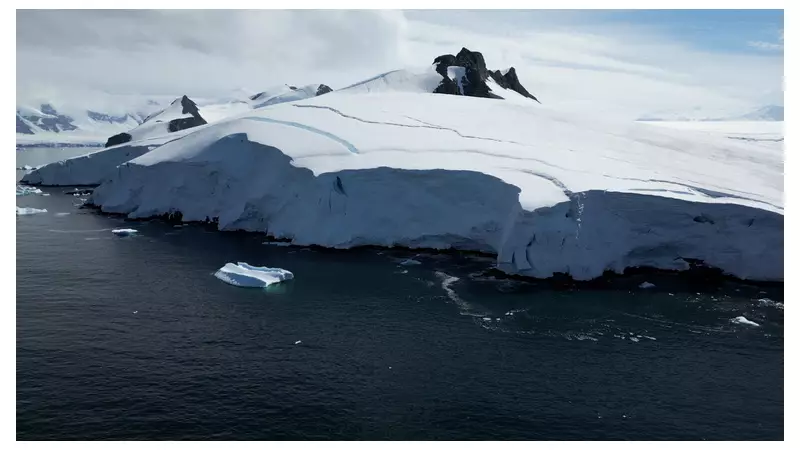
In the frigid waters off the Antarctic coast, scientists are racing to understand a newly discovered phenomenon that could dramatically accelerate global sea level rise: powerful underwater tsunamis generated by collapsing glaciers.
The Hidden Mixer Beneath the Ice
Researchers from the British Antarctic Survey (BAS), accompanied by Sky News, are investigating a critical missing piece in the climate puzzle. The focus is on the Sheldon Glacier on the west Antarctic peninsula, where ice that was 250 metres thick 50 years ago has retreated over a mile.
The new suspect in this rapid melt is not just warmer air or ocean currents, but colossal waves created beneath the surface when skyscraper-sized blocks of ice calve from the glacier's face. "When a piece of ice the size of a tower block falls off the front of the glacier, what impact does it have below the surface?" asks the team.
These submerged tsunamis, which can be up to 100 metres high, violently churn the ocean layers. They mix the cold, fresh meltwater at the surface with deeper, saltier, and crucially, warmer water from below. By pulling this heat upwards towards the ice, the process could be turbocharging glacial retreat.
"By mixing that warm water upwards, you're altering where that heat ultimately ends up," explains BAS oceanographer Dr Alex Brearley. "And we have to understand that in order to make those better predictions about sea ice melt."
The Doomsday Glacier's Ticking Clock
While the research begins at Sheldon, the implications are continent-wide. Approximately 1,000 miles southwest, an international team is drilling into the colossal Thwaites Glacier—often dubbed the "Doomsday Glacier" due to its potential to raise global sea levels by 60 centimetres alone.
Thwaites, the size of Florida, is retreating rapidly. Its likely collapse could destabilise the entire West Antarctic Ice Sheet (WAIS), which holds enough ice to raise sea levels by over three metres. "What we want to learn is how effective these dams are in holding that ice back," says BAS oceanographer Dr Peter Davis, who leads the drilling effort from a South Korean ship. "And ultimately, how quickly therefore is sea level going to change over the next 100 years."
Scientists are divided on the timeline. Some fear the WAIS could start disintegrating this century, while others believe the process may take 200 years. This uncertainty has huge consequences for coastal cities worldwide, which must plan costly defences or relocation.
Antarctica: The Planet's Thermostat and Carbon Sink
The significance of Antarctica extends far beyond sea level. It acts as a global climate regulator. The vast Antarctic Circumpolar Current has absorbed about 75% of the excess heat generated since the Industrial Revolution, functioning like a planetary air conditioner.
Furthermore, the Southern Ocean has absorbed over 40% of human-produced carbon dioxide, thanks largely to phytoplankton. The nutrients that feed this algae are stirred up by glacial melt and, potentially, by these very underwater tsunamis. "That ice going allows that new life to come and that new life takes carbon out of the system," says Prof Lloyd Peck, a BAS marine biologist.
However, the current pace of change—most warming occurring in less than a century—is unprecedented. The ecosystem may not adapt quickly enough to become an efficient carbon sink. Prof Peck's year-round diving research at Rothera station shows species struggling with sustained warming of just one degree, indicating a fragile system nearing potential tipping points.
As Prof Dame Jane Francis, Director of the British Antarctic Survey, summarises: "Antarctica is a continent miles away from where we live in the UK, but it has a profound influence on what happens across the whole planet." Understanding the hidden forces at work beneath its icy surface is now an urgent priority for predicting our collective future.



