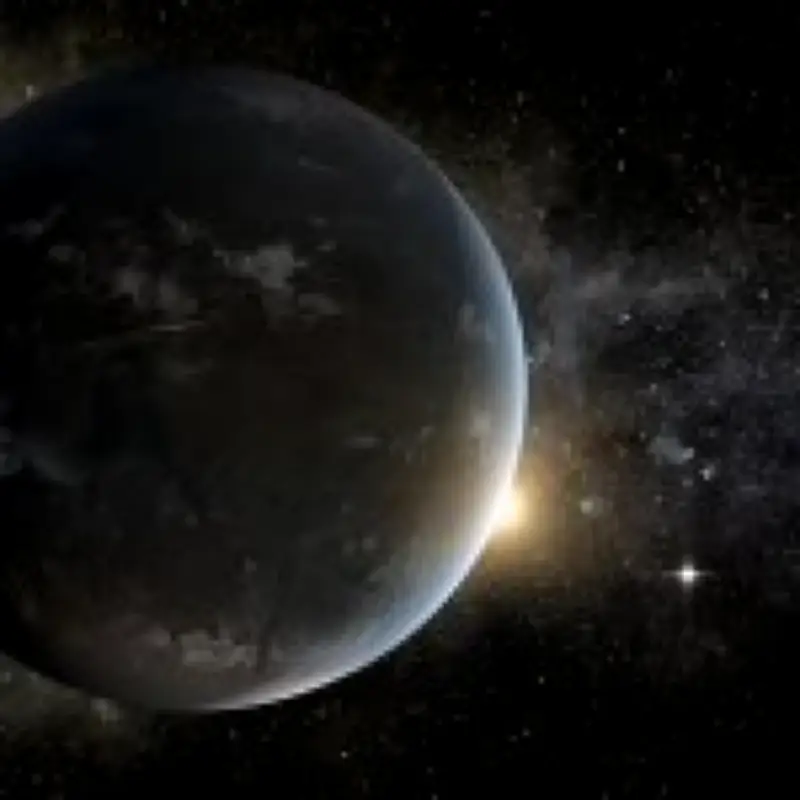
Astronomers have identified a nearby exoplanet, GJ 3378b, as a promising candidate for hosting extraterrestrial life. Located just 25 light-years from Earth, this rocky world orbits a red dwarf star and sits within the so-called 'Goldilocks zone', where conditions are neither too hot nor too cold for liquid water to exist. The findings, published in The Astrophysical Journal, suggest that GJ 3378b's atmosphere could be thick enough to support life.
Key characteristics of GJ 3378b
GJ 3378b is more than twice the size of Earth, making it a 'super-Earth'. It orbits its host star every 21.5 days, receiving about 90% of the radiation that Earth gets from the Sun. Paul Robertson, associate professor of astronomy at the University of California, Irvine and lead author of the study, described the planet as 'one of our closest cosmic neighbours'. He added: 'This one's exciting. It's one of our closest cosmic neighbours. 25 light-years sounds like a long way, but the Milky Way is about 100,000 light-years across, so in that respect it's our next-door neighbour.'
Atmosphere and habitability
The team used the Habitable-zone Planet Finder on the Hobby-Eberly Telescope in Texas and the NEID Spectrometer on the WIYN Telescope in Arizona to study the planet. They found that GJ 3378b's location in the 'cosmic shoreline' is critical: if it were slightly closer to its star, radiation would strip away its atmosphere, as happened on Mars. Robertson explained: 'If you scale the Earth down to the size of an apple, its atmosphere would be about as thick as the skin of the apple. That's just enough to maintain the kinds of surface pressures where you can have liquid water. It's enough that there'll be breathable air and it provides maybe a little bit of protection from the harsh radiation environment of space.'

Searching for biosignatures
While Earth remains the only known planet with life, over 6,000 exoplanets have been discovered. Lisa Kaltenegger, director of the Carl Sagan Institute at Cornell University, noted that signs of life are 'written in a planet's light'. She explained: 'As an exoplanet passes in front of its host star, its atmosphere lights up. Gases swirling above change the colour of the starlight beamed to Earth.' Scientists look for biosignatures such as oxygen or other gases produced by living organisms. Kaltenegger and her team compiled a list in March of 45 Earth-like planets that could harbour life.
Broader implications
Kaltenegger cautioned that life on other worlds might be very different from Earth. 'If the planet is not much hotter or much colder (if water evaporates or freezes completely, then you need another solvent for life),' she said. 'We hope that the methane and ethane lakes on Saturn's moon Titan could also allow for life, but we don't know that yet.' For now, the search continues, but GJ 3378b offers a tantalising possibility just next door in cosmic terms.