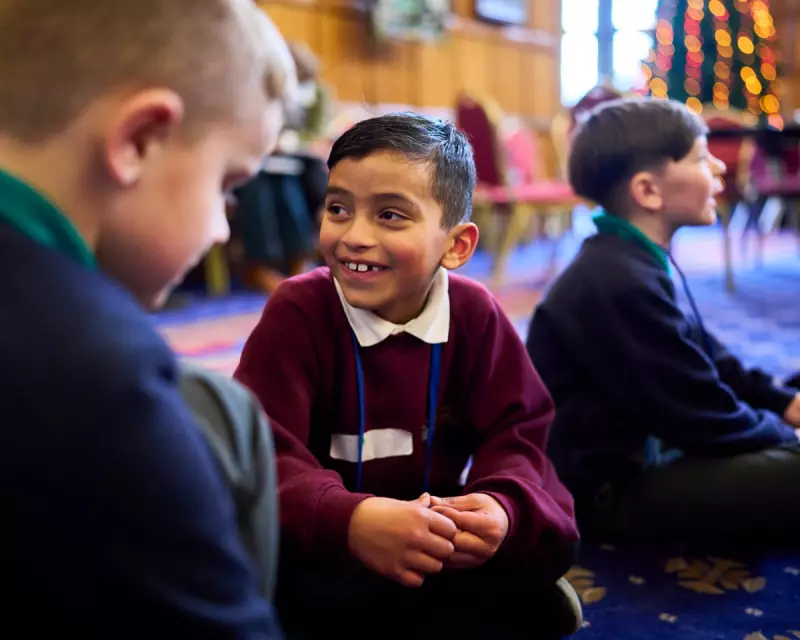
On a crisp winter morning, the historic grandeur of Bradford City Hall echoes with an unexpected sound: the joyful laughter and chatter of sixty primary school children. Within its ornate chambers, where the city's future is debated, these pupils are forging friendships and sharing dreams, thanks to a pioneering charity initiative.
Bridging Bradford's Demographic Divide
The event is organised by The Linking Network, a charity established in the wake of Bradford's 2001 civil disturbances. Now supported by the Guardian's 2025 charity appeal, its mission is to build hope and relationships between children from vastly different walks of life who might otherwise never meet.
On this day, two paired school classes are meeting face-to-face for the first time. One class is from Horton Grange Primary School in west Bradford, where 87% of pupils speak English as an additional language and just 0.4% are white British. The other is from Hill Top Church of England Primary School in the south, where 81% of children are white British and only 3% have English as an additional language.
"When you look at them now, they're all joining in. They've just met as complete strangers," exclaimed Julie Ball, Hill Top's headteacher, visibly moved. "People in our country need to see this. [Children] don't see the differences."
Structured Encounters for Lasting Understanding
The day at City Hall is not a one-off. It is a carefully orchestrated step in a year-long programme. The process begins with classroom work, followed by an online meeting where a simple question like "Does anyone like chicken nuggets?" can break the ice. The first physical meeting is held in a neutral, culturally significant venue like a museum or city hall. Later, the children will visit each other's schools.
Nahida Nazir, the charity's primary advisory teacher who grew up in Bradford, passionately advocates for the scheme. "I feel like I wasn't offered these opportunities," she says. "Every primary school across the country needs to be doing this."
The charity's work has expanded significantly from its Bradford roots. It now operates in 26 local authorities across England, from Rochdale and Bristol to Buckinghamshire and Kent. Co-directors Linda Cowie and Meg Henry oversee this growth, stating the programme gives children the chance to "see beyond the boundaries of their own experience." They emphasise that through sharing stories and learning together, children build "empathy and understanding that lasts a lifetime."
A Legacy of Friendship and Hope
The impact is palpable by the day's end. Initial nerves have dissolved into genuine connection. One boy said sadly, "I don't want to leave him," pointing to his new friend. Another pair, one from each school, showcased a breakdance routine together. Two girls—one wearing a hijab, one without—couldn't stop smiling at each other, while two aspiring paleontologists were amazed to discover their shared dream.
The Bishop of Bradford, Toby Howarth, who chairs the charity's trustees, calls the network "a gem." He highlights its profound importance: "These kids are growing up with a friend from another background. When they hear false narratives, they can say: 'But I know this person.' This is not fluffy. It's dealing with real issues."
The programme's enduring legacy is perhaps best summarised by Kathryn Swales, headteacher of Girlington Primary, one of the two founding schools in 2001. At annual leavers' assemblies, children consistently recount their linking experience as their most memorable primary school moment. "There is no greater testament to the programme than this," she affirms, proving that the bonds formed here are both powerful and permanent.