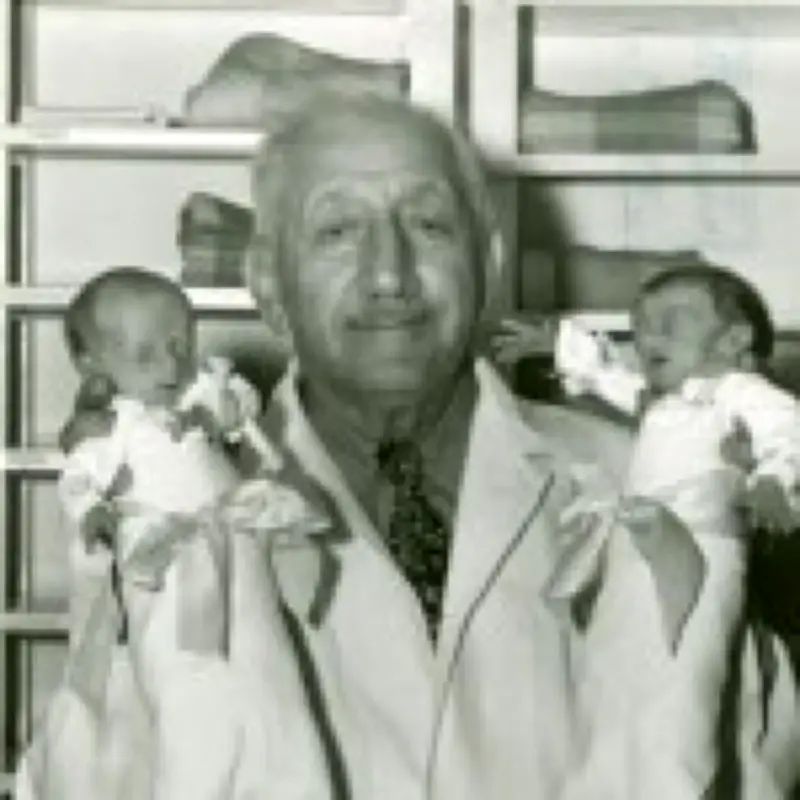
In the first half of the twentieth century, thousands of tiny babies spent their early weeks amid the smell of hot dogs and carnival music, fighting for survival. Dismissed as 'weaklings' with little chance of survival, many premature infants were simply left to die. But one man, Dr. Martin Couney, had the technology, know-how, and motivation to save them.
With parents' permission, he took preterm babies from homes and hospitals and admitted them to his child hatchery—a precursor to today's neonatal unit. Couney recognized the need for sustenance, human contact, and warmth to survive after his own experience of having a premature baby with his wife, a nurse. He set up rooms full of incubators to keep them alive.
However, these rooms were not in hospitals—they were in fairs and expositions worldwide. It was an expensive operation, and Couney controversially charged people to come and see the 2-pound infants under the catchline 'all the world loves a baby.' He soon became known as 'The Incubator Doctor,' but his work riled the medical establishment.
The New York Society for the Prevention of Cruelty to Children accused him of exploiting children, while an editorial in the Lancet warned the show exhibited babies 'just as they might have exhibited marionettes, fat women, or any sort of catch-penny monstrosity.' Couney claimed medical training in Leipzig and Paris, but author Dawn Raffel found no record of him at German medical schools, no German doctoral thesis in the National Library of Medicine, and no US medical license.
Explaining the reason behind the extreme circus show, Raffel told Metro: 'Infant mortality at the time was extremely high, hospitals were terrible, and most people preferred to give birth at home. There weren't many resources for newborns, and there wasn't the dedicated nursing needed to keep a baby alive in an incubator. He was begging for money all the time, but it was hard to convince people because of the eugenics movement in the United States. They were focused on building better babies.'
That meant tiny weak ones were left to die until Couney stepped in with his hatchery at expositions, world fairs, and amusement parks in the UK and US, including shows in London in 1897 and Nebraska in 1888. He later set up his spectacle on Atlantic City boardwalk and Coney Island alongside other circus 'freak show' acts. It was a huge success.
At the 1933–1934 Chicago World's Fair, the incubator pavilion drew 1,250,000 visitors. At Coney Island, The New Yorker described Couney watching 'the crowds flocking into his concession' and noted loyal 'repeaters' who picked a favorite baby and returned weekly. One woman returned once a week for 36 seasons.
Medically, Couney's results were miraculous. While babies had a 90% mortality rate in hospitals, they had an 85% to 90% survival rate in his incubator exhibit. This success came without families paying a penny for care. 'He was a visionary, but a lot of the smarts came from the nurses who were doing most of the work,' Raffel explained.
Couney hired wet nurses to breastfeed newborns—sometimes a mother of a baby in the show—and a cook to provide three square meals a day. If he caught staff eating a hotdog or drinking soda, he fired them on the spot, insisting on a wholesome diet. He kept the rooms spotless and practiced excellent hygiene.
While preemies treated in hospitals in the 1940s and early 1950s frequently went blind, babies treated in Couney's sideshows retained their eyesight. It wasn't until the mid-1950s, after his death, that doctors discovered the cause—overuse of oxygen. Oxygen toxicity caused blindness in singer Stevie Wonder, born six weeks premature in 1950.
Couney was undeniably controversial. Child protection charities accused him of exploitation, and detractors called him mercenary. His credentials were questionable. 'He made the medical profession uncomfortable because he was a showman, a carnival guy. He didn't see any conflict between his own self-interests and saving babies,' Raffel said. 'In researching the book, I found many inconsistencies. He said he invented the incubator, which he did not. He said he was trained in Leipzig and Paris, but he wasn't even in Europe at that time.'
Nevertheless, his work was vital and revolutionary. Couney's incubator shows saved an estimated 6,500–7,000 babies, many still alive today. 'It can make you uneasy to think about. It's as if there were a cure for breast cancer but you have to be in a circus to receive it. Some surviving patients said their parents were extremely embarrassed or appalled, yet he saved their lives. How do you weigh those two things? At the same time, there wasn't another way to do it then. You could think of it as medical crowdfunding,' Raffel said.
Couney's legacy continues. Dr. Julius Hess, a Chicago pediatrician who worked with him, took what he learned back to hospitals, which then invested in incubators and neonatal care, earning Hess the reputation as the father of American neonatology.
So was Couney an exploitative showman or inspirational visionary? The final say should go to those tiny babies now grown. 'Some felt it was really cool, and some felt proud of it. They felt special because they were in his show as a baby. But most of all, they felt they survived because of this guy,' Raffel said.
A version of this article was first published in November 2025.