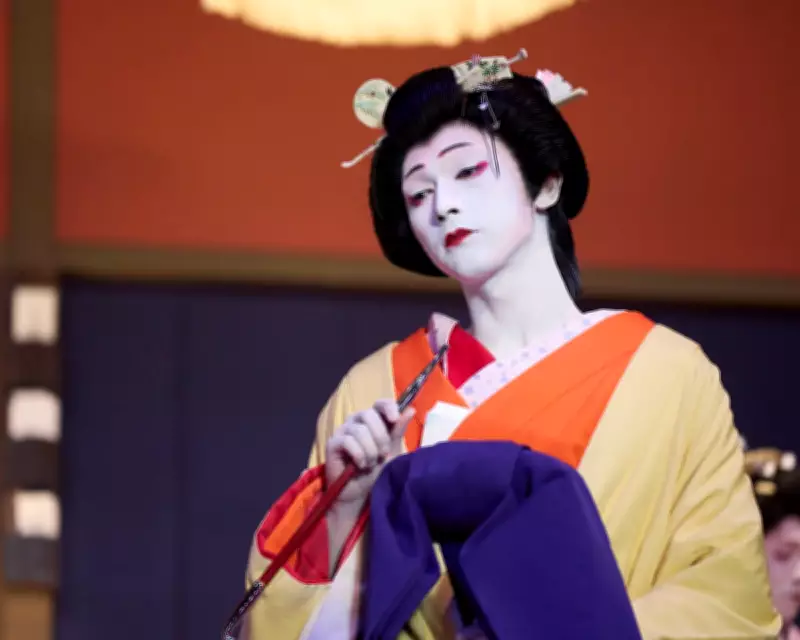
Lee Sang-il's heartfelt and muscular epic, titled "Kokuho" (meaning "national treasure"), was a box-office smash in Japan, earning numerous festival awards and an Oscar nomination. This mighty Cain-and-Abel drama spans five decades, set in the rarefied world of kabuki theatre, where the most exotically prized performers are the onnagata—men who master the rigorously observed discipline of playing women in classical kabuki roles. This convention arose from Japan's 17th-century ban on women performing on stage, similar to England's earlier prohibition. It is a semi-intentional irony that this intensely male film relegates actual women to subordinate roles.
Outrageous Melodrama Begins
The story opens in an outrageously melodramatic fashion, with a situation that could itself be adapted for kabuki. In 1960s Nagasaki, a yakuza gangster hosts a social event to display his prestige, providing kabuki entertainment for his guests. His reverence for this high-cultural form leads him to allow his teenage son Kikuo to perform as an onnagata. Kikuo's performance stuns renowned kabuki actor Hanjiro (Ken Watanabe). However, a rival gang attacks the event, killing the yakuza. Hanjiro then offers to adopt Kikuo and train him as an onnagata in his company, alongside his own son Shunsuke.
Brothers' Bond and Rivalry
Kikuo (played as an adult by Ryô Yoshizawa) and Shunsuke (Ryûsei Yokohama) become famous and close as brothers. Their bond is tested to destruction when Hanjiro favors the upstart Kikuo, naming him his successor. Shunsuke storms off, taking Kikuo's girlfriend Harue (Mitsuki Takahata) with him. In Shunsuke's absence, Kikuo grows ruthlessly ambitious, joking about a pact with Satan for success. He heartlessly refuses to acknowledge his daughter with a geisha mistress and has an abusive relationship with a corporate sponsor's daughter. But Shunsuke bides his time for a return.
Kabuki Performances Interwoven
The action is elegantly interspersed with kabuki performances, whose titles and stories are summarized in chyron subtitles. The most significant is "Sagi Musume" or "Heron Maiden," about a heron in love with a man who transforms into a woman and dances until death. The onnagata actors similarly transform into women, perhaps yearning for an idealized delicacy, nobility, and beauty unattainable as men.
Queer Reading or Dedication to Art?
One Westernized reading might see this as a queer narrative challenging gender norms. When Kikuo performs at tea-shops, he suffers what amounts to a homophobic assault from a fascinated hooligan who cannot accept a man dressed as a woman. Yet, this could be reductive. The film emphasizes discipline and commitment in service of art—a vocational self-immolation where transforming pain into beauty is the central point. Kokuho is in UK cinemas from May 8.