Across the United States in 2025, public spaces transformed into powerful canvases for dissent. From evocative murals to provocative statues and large-scale performances, protest art provided a crucial focal point for collective action on a host of pressing political and social issues.
Powerful Symbols and Ephemeral Statements
The year's protest art took many forms, blending the permanent with the transient. On the National Mall in Washington DC, a striking ice sculpture installed on 15 October served as a chilling, melting metaphor for democratic erosion. Elsewhere, more permanent installations made bold statements. A controversial statue linking Donald Trump and Jeffrey Epstein appeared on the same Mall on 23 September, while in San Juan, Puerto Rico, art directly referenced the island's energy crisis and the Financial Oversight and Management Board on 6 August.
Street art also played a major role. Banksy-style posters appeared in Washington DC's Georgetown on 31 August, depicting a protester throwing a sandwich at commentator Pete Hegseth. Meanwhile, in Fort Lauderdale, Florida, an LGBTQ+-themed mural created on 25 August was ordered to be painted over by the state, itself becoming a symbol of the cultural battles being fought.

Commemorating Lives and Demanding Justice
A significant thread of the year's art was dedicated to remembrance and calls for accountability. In Minneapolis, the fifth anniversary of George Floyd's death on 25 May was marked by the 'Say Their Names' cemetery, a poignant installation created by two University of Pennsylvania students near George Floyd Square. The organisation Memorialize the Movement, led by founder Leesa Kelly, was active in the same city, underscoring the enduring legacy of the Black Lives Matter movement.
Other works highlighted individuals at risk. In Los Angeles, an art installation on 17 July depicted people taken by Immigration and Customs Enforcement (ICE). That same day, performers in LA staged a human art installation titled ‘The Disappeared/Los Desaparecidos’, meant to represent people sent to El Salvador’s Cecot prison. Demonstrations calling for the release of specific individuals, such as Mahmoud Khalil in New York's Times Square on 12 April and Kilmar Ábrego García in Los Angeles on 1 May, were frequent.
Activism in the Streets and at Institutions
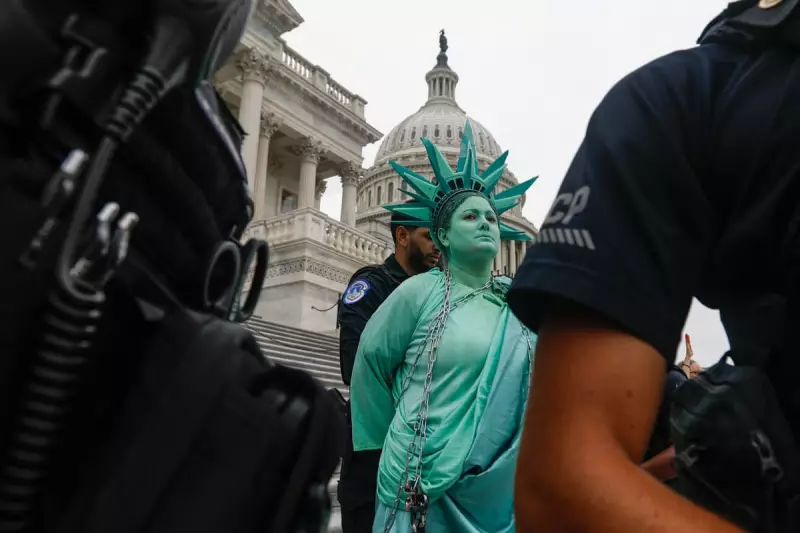
Protest art often appeared at the heart of political power and during major demonstrations. Pro-Palestinian protests in Washington DC on 24 September saw demonstrators taken into custody by US Capitol police, with the event captured in powerful imagery. An emergency rally in the capital on 27 August protested an Israeli airstrike in Gaza that reportedly killed journalists and health workers.
The reach of activism extended to the doors of institutions. Weekly vigils continued, such as the 24th weekly Bearing Witness demonstration at the Burlington, Massachusetts, ICE facility on 1 October. In Los Angeles, a press conference was held on 8 September after the Supreme Court cleared the way for sweeping immigration operations to continue. Creative forms of mass protest also emerged, including a large human banner assembled at San Francisco's Ocean Beach during the No Kings protests on 14 June.
This diverse array of artistic expression—from the frozen to the human, the painted to the performed—defined the visual landscape of American protest in 2025. It demonstrated how art continues to evolve as an essential, unifying tool for drawing public attention to injustice, commemorating loss, and demanding political change.