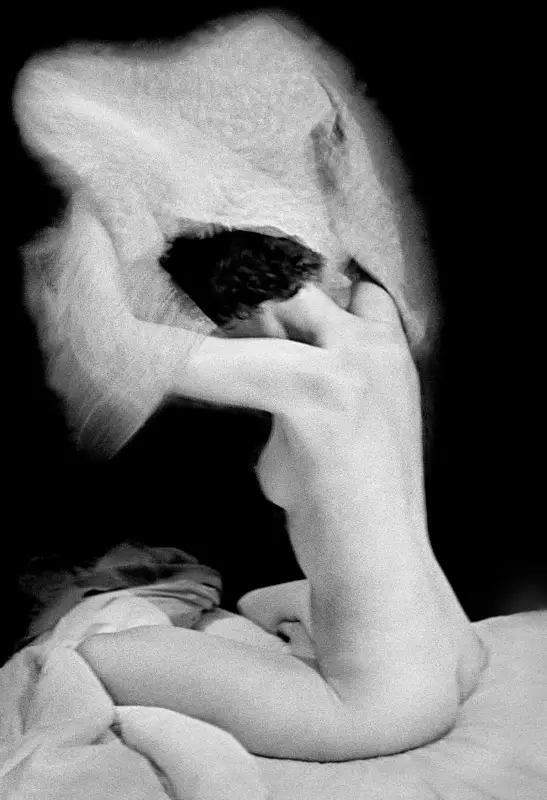
In 1952, a young Swiss couple on their honeymoon in Paris created a series of photographs so intimate and candid that they would scandalise the conservative art world of the era. The photographer, René Groebli, and his new wife, Rita Dürmüller, spent their time in a Montparnasse hotel room, where Groebli captured a tender, poetic portrait of marital intimacy. These images, now celebrated as a landmark in photographic history, are the focus of a new exhibition in Zurich.
A Parisian Honeymoon That Changed Photography
The series, later published under the title The Eye of Love, depicted Dürmüller in moments of unguarded domesticity. She is shown undressing, hanging laundry, and resting in their shared space. Groebli’s artistic approach was deliberate: he sought to visualise the emotional connection between them, rather than simply document reality. Rita Dürmüller, a graduate in painting, was an active collaborator in the scenes, her comfort and naturalness palpable in every frame.
"She felt absolutely comfortable and, hence, acted perfectly natural," Groebli, now 98, explains from his home in Zurich. "She was not an actor, but an artist helping to create scenes. The pictures are the result of a collaboration in perfect harmony."

Scandal and Subsequent Vindication
When the work was first published in book form in 1954, the reaction was one of public outcry. In a post-war era where photography was not widely accepted as fine art, the nude studies were misconstrued as pornography. Critical letters flooded photographic journals, and newspapers published damning editorials. A final image showing Dürmüller’s hand, adorned with a wedding ring, holding a cigarette over the edge of the bed led some to mistakenly believe it depicted an illicit affair.
Groebli responded by titling the series The Eye of Love to clarify its intent. "It puts into words what the photographic essay is all about: love," he states. "It is not about voyeuristic sex, it doesn't exhibit my wife as an 'object of desire'.'' His perspective was later validated by the influential American photographer Edward Steichen, who included Groebli’s work in the seminal 1955 exhibition, The Family of Man, at New York’s Museum of Modern Art.
A Lifetime of Capturing Movement
Born in Zurich in 1927, René Groebli’s career was defined by a fascination with motion, rejecting the rigid, geometric style prevalent in Swiss photography at the time. His first major photo-essay, Rail Magic (1949), captured the dynamic energy of a steam train with an impressionistic blur, establishing his poetic signature. This focus on fluidity informed his later pioneering work in psychedelic, colour-saturated photography during the 1960s.
Throughout a prolific seven-decade career, Groebli also worked in photojournalism and advertising, creating portraits of iconic figures including Charlie Chaplin, Robert Frank, and Walt Disney. Yet, his most personal and enduring works remain those intimate honeymoon pictures. He reflects on the medium's evolution, noting the challenge today lies in distinguishing photographs from AI-generated images.
The current exhibition at Bildhalle Zurich showcases an oeuvre built on experimentation. However, the heart of the show remains those timeless images from a Paris hotel room. As Groebli poignantly concludes, "I still see, as I did in the early days of our relationship, her love for me and my artistic work, and my love for her." The exhibition, René Groebli: Movement, runs until 31 January.