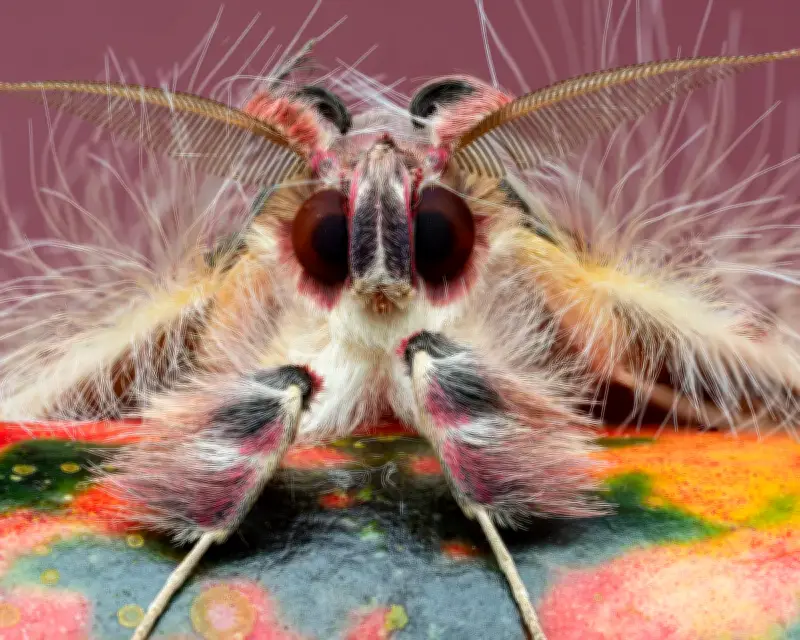
Macro photography, the art of photographing the natural world at extremely close range, has seen a surge in popularity over the past few years, driven by a wave of influencers, more affordable lenses, and the coronavirus pandemic, which left many photographers with nowhere to go but their own back gardens. Photographers like Dara Ojo and Marit van Ekelenburg have become prominent figures in this niche, using their lenses to reveal the intricate details of insects that are often invisible to the naked eye.
The rise of macro photography
Ojo, a 35-year-old wildlife photographer who grew up in Lagos, Nigeria, and was based in China during the pandemic, began photographing insects after a friend suggested it. He recalls being fascinated by the design of their faces: “When I started taking photos of them, when I’d never seen them that close up before, I was just fascinated by the design of their faces. It’s very intricate and it made me fall in love with them.” This sense of wonder is shared by van Ekelenburg, who photographs as Macro by Marit from the Netherlands. She started eight years ago when her mother asked her to photograph her garden for her website. “I had never held a professional camera, and at that time my knowledge ended at recognising the difference between a wasp and a bee,” she says. While photographing flowers, she became distracted by the insects inside them: “It started with a bee, then a weevil, and before I knew it I was so mesmerised.”
The demanding craft behind the images
Macro photography is a demanding form, relying on techniques like focus stacking, which combines multiple images taken at slightly different focus distances to create one final frame. This is challenging enough with a still subject, but insects are rarely static, and wind or a sudden flight can ruin hours of effort. Ojo describes the patience required: “I always just pray ‘please don’t fly away’.” His favourite capture, a video of a damselfly grooming itself, took two to three years to achieve. He found it in an 8-hectare (20-acre) botanical garden, arriving at sunrise because his research indicated that damselflies are most likely to clean themselves then. “I waited for an hour and 30 minutes for it to do it. I always tell people if you’re doing macro, you’re not going to get your steps in,” he says.
A growing career path and conservation mission
Macro photography is also an increasingly viable career, with income from monetisation, print sales, books, and brand partnerships with camera and lens manufacturers. Beyond commercial success, photographers are driven by a conservation mission. Ojo notes that insect decline is at about 45% to 47% right now, and he wants to appreciate them: “Lions, tigers and giraffes get all the PR. They are such a fundamental part of the ecosystem. They’re the foundation of it.” He runs workshops with children in schools to instil a love for invertebrates, while van Ekelenburg teaches group workshops from Olgarden on the outskirts of the Dutch village of Deurningen. As she puts it: “The power of macro photography is that the curiosity you had as a kid still sparks. It’s like a whole new world, and you don’t even have to go that far for it. These are creatures that we live with. Maybe we should treat them better.”