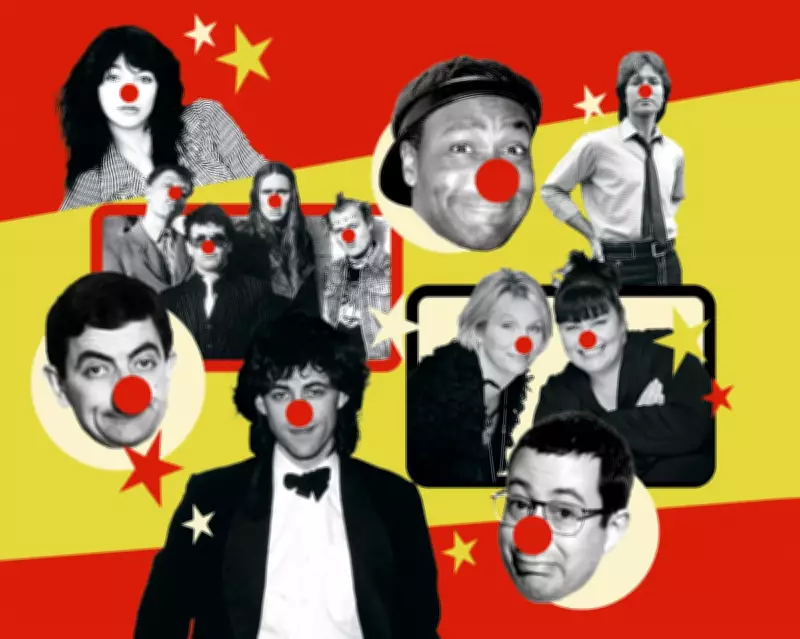
Today, Comic Relief is a fundraising juggernaut, but when it was born 40 years ago this month, things were very different. The inaugural event at London's Shaftesbury Theatre was a sweary, shambolic all-nighter that set the stage for a charity phenomenon.
The Nether Wallop Beginnings
In 1984, a year before Live Aid, a remarkable gathering of British comedy elites took place in the tiny Hampshire village of Nether Wallop, chosen for its amusing name. The event was a comedy alternative to the Edinburgh Festival, but it also introduced Jane Tewson's concept of 'the golden pound'—every penny donated goes directly to the cause. Tewson recalls a wild, windy day watching Bill Wyman play with the Young Ones. 'We were fearless in calling the good and great, and they came,' she says. Soprano Jessye Norman sang with the village choir, and ballet choreographer Lynn Seymour directed the local school group.
Comedy producer John Lloyd remembers Nether Wallop as 'one of the greatest nights of my life.' His contribution was Mel Smith and Peter Cook playing synchronised swimmers on stage, having had 'a bit too much to drink.' He sees the event as a skeleton of what was to come.

The Ethiopian Inspiration
At Christmas 1985, after Live Aid and Band Aid, Tewson bumped into Richard Curtis at a dinner. She planned to visit Sudan; Curtis offered to go but ended up in Ethiopia alone. 'I was amid the kind of images we'd seen on Live Aid,' he says. But he also saw laughter: a small child slipped through a nappy leg, and people laughed. 'They didn't feel they had to sacrifice that side of their personalities.' This insight inspired Comic Relief—combining tragedy and comedy to humanise famine victims.
Curtis and Tewson recruited Lenny Henry as a third founder. 'Out of conversations came the belief that comedy could bring people together,' Henry says.
The First Live Show
Comic Relief's first salvo was the Young Ones' recording of 'Living Doll' with Cliff Richard, which hit No 1 for four weeks. The live show at the Shaftesbury Theatre used Rowan Atkinson's set. 'We started at 10.30pm and ended at 3am,' Curtis recalls. 'It was chaotic.'
The lineup featured French and Saunders, Rik Mayall, and Billy Connolly. 'Billy was in amazing form,' says Curtis. 'I told him he could do 15 minutes; he said, 'Ben Elton's not doing 40 minutes and me 15! I'll do as long as I want!'' The show was not live on TV, so comedians felt free to roam.
Risk-Taking and Experimentation
The show allowed risk-taking, from Connolly's swearing (requiring edits for TV) to Stephen Fry performing with Midge Ure and Bob Geldof, and Frank Bruno attempting Romeo and Juliet with Lenny Henry. The tone was progressive—'not racist or homophobic,' says Lloyd. The challenge was balancing moving films with funny bits.
Transition to Telethon
After the first event, Curtis, Henry, and Dawn French realised they were TV people, not theatre people. With BBC One controller Michael Grade's approval, Comic Relief became a telethon. Grade left his job a month later, leaving no record of the budget. Veteran producer Michael Hurll helped Curtis navigate the high-wire act.
Lenny Henry and Griff Rhys Jones were sent to Africa with Helen Fielding to film short documentaries. 'Lenny found a tone that was humane and still funny,' says Curtis. In one clip, Henry and an Ethiopian teenager both get the giggles, and they left it in.
Modern Challenges and Evolution
Comic Relief has faced controversy, including accusations of 'white saviour' syndrome in 2019. Tewson says, 'These issues are ever-present. We must do things with people, not for them.' Henry adds that they now put the people they support at the heart of storytelling, working with local crews.
The content has evolved with declining sketch shows, now featuring spoofs of The Traitors, Mamma Mia!, and Game of Thrones. Curtis recalls a duet between Steve Coogan as Tony Ferrino and Björk in 1997 as a high point. 'Dream scenarios are allowed because it's for Comic Relief.'
Forty years on, Comic Relief is an institution, raising £30m in 2026. 'There are very good-hearted people at the core,' says Lloyd. 'Nobody is doing it for opportunism; everyone is doing it for the love.'