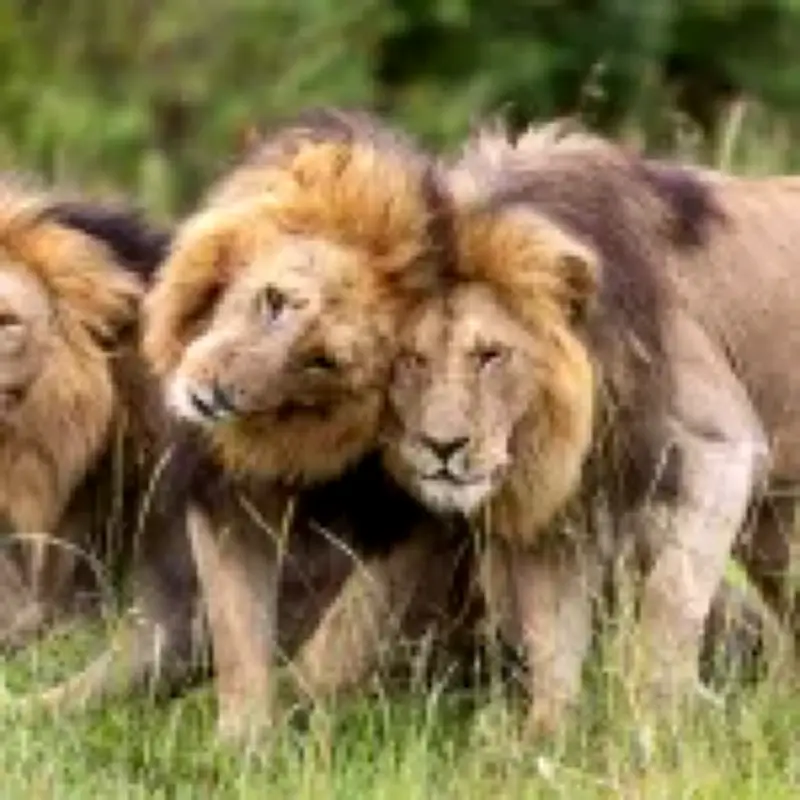
Executive producer Mark Gunton, a longtime collaborator of Sir David Attenborough, has revealed that the natural history legend thought he was 'mad' for following a single male lion cub for four years in National Geographic's groundbreaking new series Lion. The series, which follows a cub called Kio from eight weeks old until he becomes an adult strong enough to claim the throne, is now available to stream on Disney Plus.
Attenborough's reaction to the ambitious project
Gunton, a senior executive at the BBC Natural History Unit, said that when people first heard about the plan to film a cub's journey for a significant amount of time, they were met with doubt. 'When people heard we were doing this, they all thought we were mad. Even when they didn't even know we were just following a male cub, because of course, you try and keep these things a bit quiet because you don't want anybody to know what you're doing,' Gunton recalled.
He added: 'Following a male cub is almost insanity because lots of them don't make it; they have a higher mortality rate. But also they tend to leave. The nature of lions is that when males get to a certain age, they tend to be evicted by either the males that are the current kings, or for other reasons, and disappear. And often properly disappear, never seen again. So it was a huge risk.'
Gunton, who has worked with Sir David for around four decades, said the natural history legend also expressed doubt. 'He actually did say he thought I was mad, but he also thought if you can pull this off…he very kindly said it's a kind of new genre. So he's a big supporter of it because it's another window into learning about nature,' Gunton shared.
The remarkable journey of Kio and the crew
The crew followed Kio in Kenya's Maasai Mara for four years, from the early stages of his life – when he was first introduced to his pride by his mother – into adulthood. Gunton noted that only around one in eight male lion cubs survive to adulthood, while various statistics claim that between 20 to 50% of cubs make it past the age of two. This made the fact that the film crew were able to track Kio for four years even more remarkable.
'To my knowledge, nobody's ever been able to tell the story of a single male cub from the moment it effectively emerged out of the den to becoming a powerful king amongst kings, so that opportunity has been amazing,' Gunton said.
The idea for Lion came from a few different sources. Gunton had recently worked on Dynasties, a BBC series that follows different groups of animals, including a pride of lions in the Maasai Mara. Jon Favreau directed the 2019 live-action remake of The Lion King, while composer Hans Zimmer scored the film and the original 1994 animated release. For all three of them, this new endeavour was a major passion project.
'Jon, Hans and I, our job was to drive the vision of it. It was rather nice that Jo, Hans and I have worked together now, either together, all three of us, or individually, on a number of projects,' Gunton said. 'Hans did the music for The Planet Earth projects I worked on. Jon and I worked on the series Prehistoric Planet for Apple. Our paths crossed on many occasions. This one seemed the one where absolutely it's a no-brainer to come together, because of Jon and Hans having worked on the remake Lion King, Hans on the original Lion King. There's a lot of emotional investment in this from all of us in different ways, and you don't get these opportunities very often.'
Parallels to The Lion King and the series' appeal
Gunton hopes that Lion will appeal to audiences of all ages, from six-year-olds to 90-year-olds. The ambitious series provides an illuminating insight into what life in a pride, and away from one, is really like for a lion, and demonstrates that these powerful creatures are far more than 'jaws and claws'.
'Of course, lions are predators; they eat things, and they fight. But much more of the time, it's more subtle. It's much more about social connections and decisions about alliances and politics, so we've majored on that, which I think is more relatable to our own lives, because there's a lot of parallels to what goes on about maternal care and about brotherly rivalry,' Gunton explained.
The parallels to the tale of The Lion King are undeniable – and in some instances, intentional. 'We have both accidentally and deliberately made connections with the original Lion King, and there are lots of parallels,' Gunton acknowledged. 'The fundamental difference is that in The Lion King there is only one king, whereas in nature, there's never one king. They're a coalition of kings, plural. Within them there'll always be one that maybe has a slight edge at times, and that's another dynamic. Maybe that's the story of series two.'
In one early moment in the series, Kio climbs on top of his big-maned dad as he lies down on the ground, almost perfectly mirroring Simba clambering over Mufasa before the king's tragic demise.
Gunton also praised the vast crew who worked on Lion, including the cinematographers who had to practise incredible patience while watching the lions. 'The cinematographers on this, just amazing sixth sense about how to get those one-off moments. Sophie [Darlington] was the DOP [director of photography]. She worked on the Dynasties show, so there's a lovely connection. Simon Blakeney, who was the producer of that programme, he's worked on this,' Gunton shared. 'We've drawn on a huge amount of historical experience. Everything I've ever worked on, David's voice or shadow is always there, just a little bit in the background, saying, "Have you thought about this?" He's a great guru, even if he's not literally telling you what he thinks. His shadow is a long shadow to cast.'
Lion is available to stream on Disney Plus.