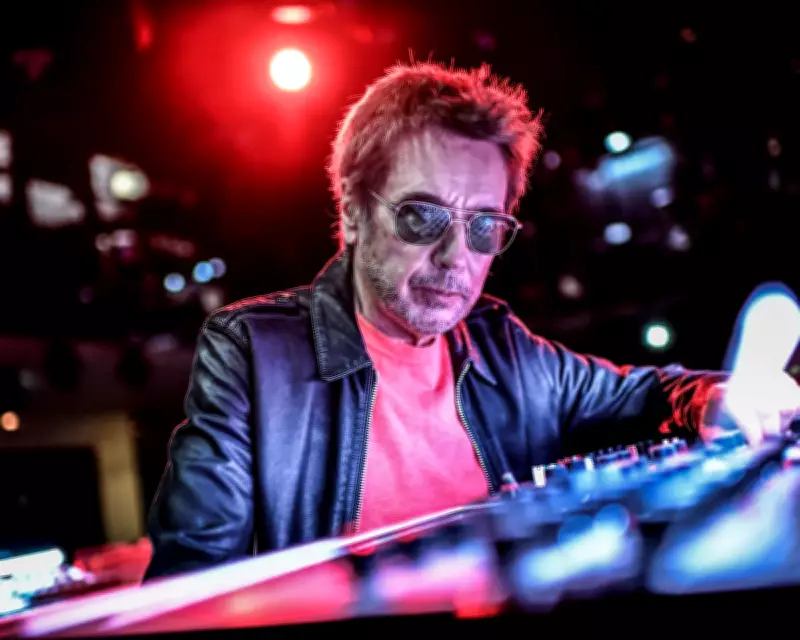
Jean-Michel Jarre, the iconic French musician and pioneer of electronic music from the 1970s, has launched a bold critique against the conservatism of the music and film industries regarding artificial intelligence. In a striking departure from widespread anxieties, Jarre urges these sectors to embrace AI rather than resist it, framing the technology as a catalyst for future creativity.
A Call for Innovation Over Fear
Speaking at the launch of the second AI film festival in Cannes, where he serves as an ambassador, Jarre argued that while established creative industries are "freaking out" over AI, artists will harness it to forge new artistic frontiers. He envisions AI enabling "the cinema of tomorrow, the hip-hop of tomorrow, the techno of tomorrow, the rock'n'roll of tomorrow," emphasizing that its power to generate images and sounds should not be seen as a threat to talent.
Drawing parallels to historical technological shifts, Jarre noted how pioneers in the early 20th-century film industry embraced moving images and sound, suggesting AI represents a similar evolutionary step. His comments stand in stark contrast to the deep concerns voiced by other prominent musicians, including Elton John and Dua Lipa, who have raised alarms about AI models being trained on copyrighted material without permission or compensation.

Navigating the AI Wild West
Jarre, who has sold 85 million records and formerly presided over the International Confederation of Societies of Authors and Composers, acknowledged the current challenges, stating, "AI today is the wild west so we need to establish rules." However, he downplayed fears of copying, pointing out that artistic inspiration has always involved subconscious harvesting of memories, culture, and environment. "It's absolutely unfair to reduce the huge possibilities of AI by just thinking of doing a fake pop song, a fake heavy metal song," he added.
Having integrated AI into his work since 2018, Jarre reflected on past resistance to technological change, recalling how musicians in the French opera house unplugged PA systems in 1971 when he introduced electronic music, fearing it would end orchestras and jobs. He urged creatives to view AI as "augmented imagination" rather than a replacement, comparing it to the 1970s Fairlight sampling system embraced by artists like Peter Gabriel and Herbie Hancock.
Embracing a New Creative Era
Jarre emphasized that AI should not be feared as a job-taker but embraced as a tool for new modes of expression. "Every technological revolution seems to be always considered as a threat by the previous established media or mode of expressions," he said. "And AI is exactly the same. We should never be afraid of technology." He criticized the music and film industries for being "more conservative than lots of other sectors in our society," with stakeholders focused on disruption risks.
Looking ahead, Jarre expressed confidence that AI will not overshadow emerging talents like Bad Bunny, Billie Eilish, or Lorde, but rather augment creative possibilities. "It's because we have invented the violin that Vivaldi existed," he mused. "It's because we invented electricity that we had Tarantino or Jimi Hendrix. And it's because also today we are inventing a new learning model, a new AI algorithm, that the new genre of cinema, the new genre of music, will be created in the future."