At this year's Edinburgh Fringe, a handful of shows are demanding epic endurance from their performers through the use of jazzed-up gym equipment. Megan Tomei, creator and performer of SpinQueen™, leads a high-intensity spin class gone wrong, cycling 16km per show. Connor Delves cycles a whopping 27km per show in his cycling-obsessed play, Cadel: Lungs on Legs. Ben Norris runs roughly 8km per show on a treadmill in The Distance. These performers are pushing themselves to their physical limits, with no understudies, to authentically illustrate the struggle for success, the pain of failure, and the escape from reality.
SpinQueen™: Toxic Positivity on a Bike
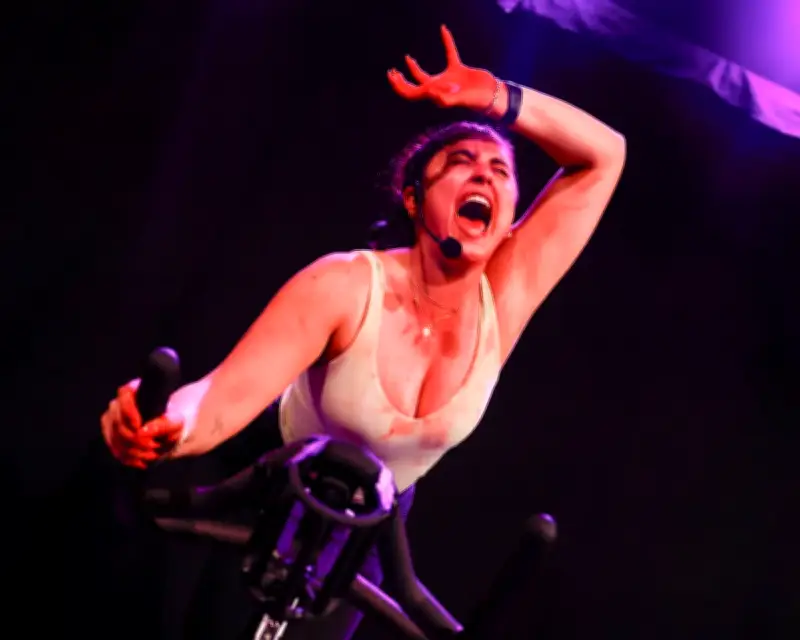
In SpinQueen™, Tomei plays a heightened, emotionally cracked version of herself as a manic spin instructor, spewing out what she calls "toxic positivity." Her character is obsessed with thinness, optimisation, and escape from the quiet that lets thoughts seep in. "Keep pushing, keep starving!" she calls in the show with a too-wide grin. In real life, Tomei is similarly peppy, but without the desperate about-to-fall-apart energy of her character. However, that version of herself isn't a world away, she says; the story's climax borrows from a traumatic experience she had with an ex. "It's a physical representation of her emotional state," Tomei explains.
Tomei started taking spin classes with her dad in high school and began teaching it to earn money alongside acting. After running the New York marathon, she got injured. "I had to slow down for the first time in my life," she says. "I struggled with it, and it made me think of all the standards we hold ourselves to, because of what we think makes us better or successful. It made me think: 'Why are we killing ourselves trying to reach this standard that can't be met?'"
Cadel: Lungs on Legs: Riding to Victory
Connor Delves's calves are worth watching. The workout from his play is so powerful that people have come up to him after shows, wanting to touch them. "To make sure they're real," says Delves, who cycles 27km per show. Does he mind this attention? He shrugs. "If they're OK with getting their hands sweaty, go for it."
Delves grew up in his parents' bike shop in Perth, Western Australia. His mum was a triathlete, his dad an international mountain-biker. "It's always been acting and sport for me," he says. When he was replaced by a bigger name in a transferring show, he decided to make a production in which he was irreplaceable. "I'd never seen a play that showed endurance sport at its best," he says, "where the sport is an actual effort."
Cadel is a sincere, leg-burning ode to Cadel Evans, the first Aussie to win the Tour de France. Delves performs on a series of the real bikes that Evans used to win the 2011 race, clamped in place. The operation is a family affair: Delves's father is the show's mechanic. Head down, Delves's teardrop-shaped helmet is steady as his legs whir round for the sprint stages, riding the same mountain gradients as in the Tour. "It means you've got to think about nutrition," Delves says of his show. "About sleep." He quit drinking to train for it. "It means treating acting like being an athlete."
The Distance: Running on Empty
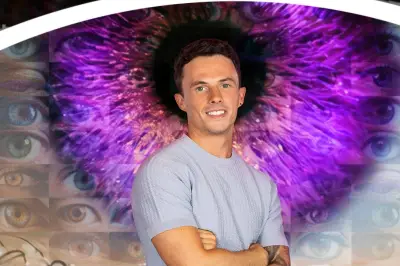
While Evans's story is the hero's arc, The Distance is about the also-rans. "I'm interested in what happens to the legions of sportspeople who are very, very good, but not good enough to make a living from it," says Ben Norris, the show's writer and performer, vocally recognisable as farmer's son Ben in The Archers. "For every one who wins the Olympics," he says, "there are at least eight who lose the final. Then 100 or 200 who were in the heats. Then tens of thousands who are very good but don't get there." So, he asks, what happens then? "Who are you when the thing to which your identity has been shackled is no longer viable?"
Norris plays Chris, a young boy realising his potential as a cross-country runner and dreaming of competing in the Olympics. The Distance is inspired by Norris's time as a teenage international long-distance runner, but he worked hard to extricate it from himself. When he was mentored by Phoebe Waller-Bridge, she told him: "Be less concerned with being likable." During each show, he runs roughly 8km on a "geriatric, old, foldable treadmill" that he's wheeled all over the country. "One time, a local MP helped me on to the train with it," he says.
Norris starts running as the audience file into the room. Soon, his clothes are drenched. As he strips down, we see the effort this is taking; his chest heaving, his body glistening. The sweat and ragged breath are important, he explains. "You're watching it cost something. You're watching this body really work." That cost is already making itself evident. Norris pulled his calf in March, then again in April. "I've had to start behaving like I'm an elite athlete again, in terms of the rigour of my training and recovery," he says. "I'm not 18 any more. Everything takes longer on an older body."
To be fit enough for the show, he has been cross-training, doing strength and conditioning, and phoning friends while on the treadmill to practise speaking at the same time as running at a furious speed. Throughout the fringe, he's forcing himself to rest. "I've done a musical at the fringe and that requires a different kind of discipline. This will be like that, but on steroids," he says, frowning. "Although crucially," he adds, "not on steroids." His one request for accommodation: could he please have a bath?
No Understudies: The Risks and Rewards
What happens if these performers fall or twist an ankle during the fringe? "The same thing as in the Tour de France," Delves says frankly. "I think that's part of the allure of this. There's no understudy." With her massage gun packed, Tomei is more conscious of the emotional health she needs to maintain across the festival. "Every performance, I'm reliving what happened to me," she says. "It's a high-intensity emotional workout too."
Even when their characters near the dreamed-of success in these shows, failure is only a breath away. One fall, one second behind in a race, one last chance. These plays capture the itch of pushing just that tiny bit harder, as well as the dangers of running on empty. "There's a little ambition monster within you," Norris says, "that will wonder if you should just quit everything else and give this one last big go." You can keep batting it down, he says, but the monster is persistent. "LA Olympics 2028?" Norris muses, only just joking. "Is it too late?"
SpinQueen™ is at Jade Studio at Greenside @ George Street, until 29 August. The Distance is at Main Hall at Summerhall, until 31 August. Cadel: Lungs on Legs is at Auditorium at Gilded Balloon at the Museum, until 30 August; then Riverside Studios, London, 13 October-15 November.