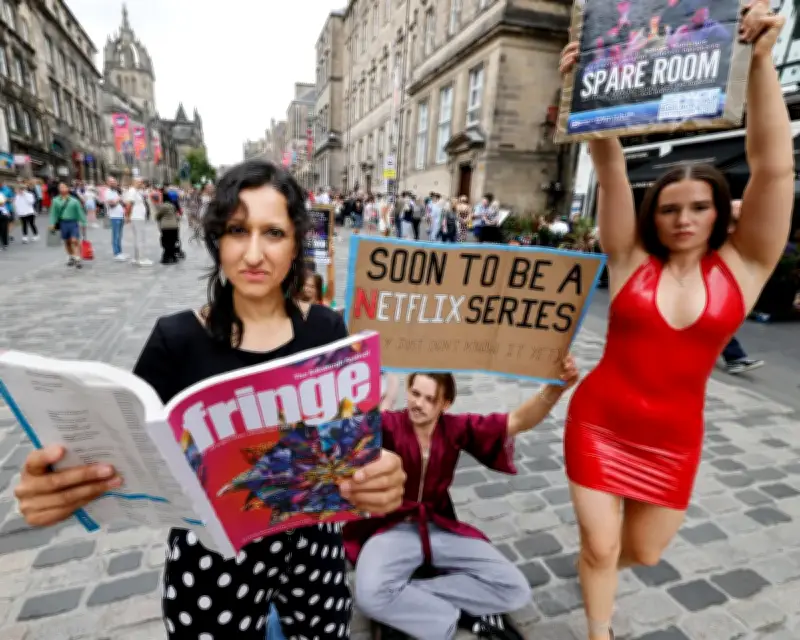
Somewhere in Edinburgh, a man drinks his own urine. Elsewhere, a musical about a religious sect that commands followers to use "butt plugs" plays out. In another room, a comedian sings the same song for an hour. These shows sustain the welcomingly weird lore of the Edinburgh festival fringe, which has been accused in recent years of becoming commercially savvy. The radical experimentalism may be intact, but it now sits at the fringes of the fringe, according to a Guardian report.
Soaring costs threaten fringe spirit
Francesca Moody, a superproducer at the festival, says putting on a show has become increasingly expensive. When she produced Phoebe Waller-Bridge's stage version of Fleabag in 2013, it cost about £10,000. By 2019, when she co-produced Richard Gadd's Baby Reindeer, it cost about £40,000. Putting on a one-person show now costs her closer to £100,000. The reasons include soaring accommodation costs, funding cuts, and rising production costs, which some argue might dial down the risky spirit on which the fringe was founded. "It was a space for messing around and building your craft, your sense of taste," says Moody. "As a producer or as an artist, you're working out what your voice is, and doing that over a number of years."
Artists and producers may now want more out of it: to be scouted for a London transfer or a television series like Fleabag or Baby Reindeer. Some high-profile productions have lined up transfers before their shows debut. Hannah Reilly's show Roleplay, about a woman who becomes a "slutfluencer" and is produced by Moody, already has a London transfer. So does Bigfoot Ripped My Dog In Half I Saw It, featuring a clown duo. The musical Bliss, which turns the traditional fairytale on its head, will travel to London with backing from the entertainment company ATG.
Low-budget gems still found
Moody believes low-budget gems are still out there. Comedian Rory Bremner agrees. Although he is a big name with his show Making an Impression at the 1,000-seater McEwan Hall, he still tests out "work-in-development" material alongside new, unknown acts. "It's an opportunity to try stuff that I've written in the last couple of days," he says. These below-the-radar gigs take place in pubs or tents, sometimes with as few as six people in the audience and often raising money for charity. Moody thinks small-scale, risk-taking work will find a home because people are "hungry" for it. "There is always going to be a weird, idiosyncratic little show in a back room or basement that people discover at the fringe. It's just about finding it," she says.
Truthmachine, produced by the Australian company Counterpilot, plays in an upstairs room of the city's Quaker Meeting House. A maximum of 12 people at any one time sign up to a 30-minute participatory show with a lie detector test at its heart. Seated before voting machines, people are selected at random, put under a spotlight, and asked to state "yes" or "no" to questions ranging from the conceptual ("has capitalism failed?") to the icky ("have you ever touched yourself at night?"). One person is strapped up to a polygraph machine. A young woman is asked, "Have you ever had a sexual dream about a family member?" and "Have you had a sexual experience in public?" The show explores group dynamics, exposure, and shame.
Horror and satire in small spaces
Succubus, a one-woman horror show written and acted by burlesque performer Georgina Collins (AKA Strawberry Duvall), features a trigger warning of cannibalism. It was inspired partly by her experience with doctors dismissing her medical symptoms as "hormonal issues." The play touches on medical misogyny in dark, satirical ways, with a low-budget set design that includes a string of fake sausages representing human intestines. It is performed at the 60-seater Dexter stage at the Underbelly and is packed on the day I attend. Directed by Grainne Robson, it is produced by Emily Ritchie and Zara Jayant, former theatre publicists. "When we started the company, there were so many artists whose only resort was to wait for the door to open. We thought: 'Why not build the door ourselves?'" says Jayant. Succubus was financed on a profit-share model, its £6,500 budget raised through crowdfunding, a supper-club, a horror-themed film quiz night, a burlesque cabaret night, and a raffle.
Bunny! at Summerhall Arts features Craig Manson's drag alter ego, who emerges in a blond wig and off-the-shoulder gold dress. The self-produced show is about Bunny, a struggling performer desperate for a breakthrough after a decade of rejections. In real life, Manson has been vocal about arts funding in Scotland. Bunny decides to kill off her competitors, beginning with an artistic director. Mother, Maiden and Crone at the Bedlam theatre is a modern-day adaptation of Macbeth by an Edinburgh-based drag troupe, involving a hen do for a bride called McBride, with a violent denouement involving fatal quantities of foam and lube.
Student talent and hidden gems
Moth And Dog Are Dying to Get Out, selected for the National student drama festival at Curve theatre in Leicester, features two teenage boys navigating same-sex desire under homophobia and peer pressure. Written by full-time student Aidan Monks and inspired by the poet Peter Scalpello, it stars Dylan Swain as Dog and Ben Stuart as Moth. One boy has been "outed" as gay with a graphic image stuck on his locker (a photo of his "spread arsehole" from Grindr). It is a heart-rending play, lo-fi in production values but full of promise. Other shows include Letícia Rodrigues's autobiographical production about body size, 116 Grams: A Play to Lose Weight, which shocks with expressive, sometimes harrowing, nudity. Thank You, F**k You and I'm Sorry, in the studio space at C Arts, is a sung-through requiem mourning a dead father, with an audience of three on the night I attend. Welsh performer Jonathan Powell (also known as Jonny Forever) powers on, playing violin and guitar alongside vocals. It is entirely self-funded and deeply personal.
QFWFQ, with Los Angeles performer Gregory Nussen, directed by Hannah Pilkes, is an accomplished riff on Italo Calvino's novel, If on a Winter's Night a Traveller. It features postmodern stops and starts, direct addresses, and reflections on story construction. Nussen leads one audience member to the toilet, makes phone calls, and tells stories of coming out as non-binary, going to Jewish summer camp, and a tour of concentration camps in Poland. Nussen arrives at Zionism, the genocide in Gaza, and the brutality of Israel's government before interrupting themselves with another layer of story. As the winner of the best solo show at the 2025 Hollywood Fringe, it is immaculately structured, surreal, and labyrinthine. The best of the fringe, found in a basement room and stumbled across before noon, is what the festival is all about.