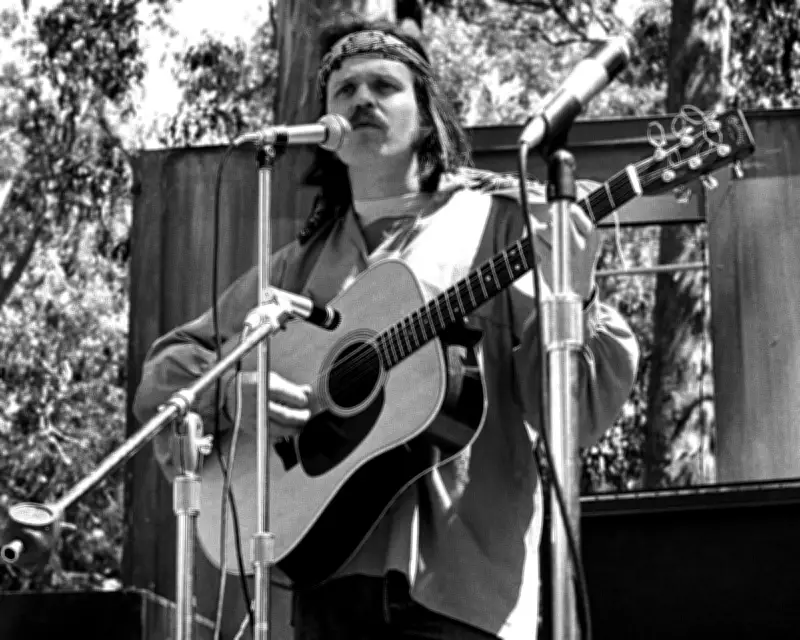
Country Joe McDonald, the legendary hippy rock star whose protest anthem "I-Feel-Like-I'm-Fixin'-To-Die Rag" became a defining soundtrack of the Vietnam War era and a highlight of the Woodstock festival, has died at the age of 84. The musician passed away on Sunday in Berkeley, California, with his death attributed to complications from Parkinson's disease, as confirmed by his wife of 43 years, Kathy McDonald, in a statement released by his publicist.
A Life Defined by Music and Activism
Born in 1942 in Washington DC and raised in El Monte, California, McDonald began his musical journey as a teenager, teaching himself folk, blues, and country songs on guitar. He emerged as a prominent figure in the vibrant Bay Area music scene, rubbing shoulders with iconic peers such as the Grateful Dead, Jefferson Airplane, and his former girlfriend, Janis Joplin. Over his prolific career, he wrote or co-wrote hundreds of songs, spanning psychedelic jams to soul-influenced rockers, and released dozens of albums that cemented his legacy in American music history.
The Song That Shook a Generation
McDonald's most famous work, "I-Feel-Like-I'm-Fixin'-To-Die Rag," was penned in less than an hour in 1965, coinciding with President Lyndon Johnson's escalation of ground forces in Vietnam. Inspired by the deadpan style of his hero Woody Guthrie, the track offered a biting, satirical critique of war and senseless death. As co-leader of his band Country Joe and the Fish, McDonald introduced a provocative "F-I-S-H" chant before performances, which evolved into the more explicit "F-U-C-K" chant by the time of their Woodstock appearance in 1969.

Reflecting on the song's impact in a 2019 interview with the Associated Press, McDonald described it as "an expression of our anger and frustration over the Vietnam war, which was killing us, literally killing us." This raw emotion resonated deeply with audiences, but it also brought significant backlash. In 1968, Ed Sullivan canceled a planned TV appearance by the band upon learning of the chant, and McDonald faced arrest and fines for using it at a show in Worcester, Massachusetts, contributing to the band's eventual dissolution.
Legal Battles and Continued Advocacy
McDonald's activism extended beyond the stage, leading to his involvement in high-profile legal cases. His friendships with political radicals like Abbie Hoffman and Jerry Rubin saw him called as a witness in the "Chicago Eight (or Seven)" trial, related to anti-war protests at the 1968 Democratic National Convention. When he attempted to perform his song in court, the judge famously interrupted, stating, "No singing is permitted in the courtroom," forcing McDonald to recite the lyrics instead.
Despite being forever linked to the late 1960s, McDonald continued to tour and record for decades, releasing albums such as "Country," "Carry On," "Time Flies By," and "50." He remained committed to protest music, notably with his 1982 release "Save the Whales." However, his relationship with Vietnam was complex; having served in the navy in Japan in the late 1950s, he later helped organize the construction of a Vietnam veterans memorial in Berkeley, fostering reconciliation in a city once torn by war-era conflicts.
A Personal Legacy
McDonald was married four times, most recently to Kathy McDonald, and is survived by five children and four grandchildren. His death marks the end of an era for music and activism, leaving behind a body of work that continues to inspire generations. From the stages of Woodstock to courtrooms and beyond, Country Joe McDonald's voice echoed a nation's turmoil and hope, ensuring his place as an enduring icon of protest and peace.