Brodsky Quartet and Didgeridoo Virtuoso William Barton Forge Cross-Cultural Alliance in London
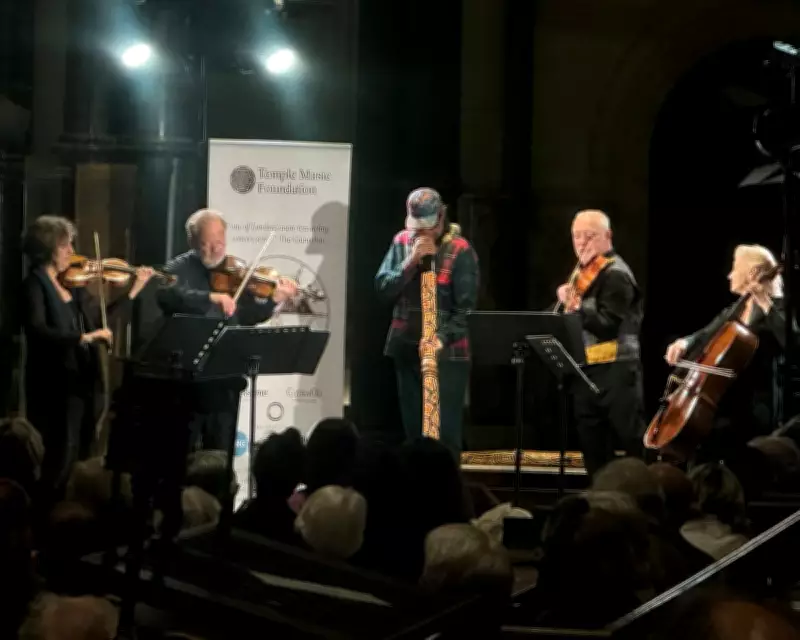
The enduringly experimental Brodsky Quartet joined forces with celebrated didgeridoo player William Barton for a remarkable performance at Temple Church in London, creating a captivating fusion of musical traditions from two hemispheres. This unlikely alliance proved both eclectic and beautiful, cutting a swathe through folk songs, Janáček, and contemporary works from Australia and New Zealand.
An Unlikely Yet Harmonious Collaboration
Many musical instruments are fundamentally constructed from hollowed-out wood, and when viewed through this lens, the violin, viola, cello, and yiḏaki (didgeridoo) performed by the Brodsky Quartet and Barton do not seem such distant cousins after all. This well-travelled programme, extensively toured outside the UK, faced a last-minute hurdle when Barton's didgeridoo was delayed in airport baggage control, arriving at the venue merely thirty minutes before the concert commenced.
The evening opened with Barton delivering a powerful didgeridoo monologue from offstage, his instrument producing a soundscape of whistles and pulsing low notes that conjured an immense sense of vastness, perfectly complementing the spacious arches of Temple Church. This seamlessly transitioned into a Purcell Fantasia, setting the tone for a night of bold musical juxtapositions.

A Rich Tapestry of Musical Influences
The programme masterfully interwove diverse influences. Robert Davidson's Minjerribah, a lyrical evocation of place, featured the didgeridoo as an essential and persuasive voice, despite being a later addition by the composer. This contrasted sharply with the yearning spikiness of Janáček's String Quartet No 1, though the church's warm acoustic rendered even its harsher moments with a certain beauty.
Viola player Paul Cassidy contributed his own arrangement of the folk song She Moved Through the Fair, his voice carried by the resonant acoustics as the other performers wove atmospheric detail around him. This established a fitting context for Barton's own composition, Square Circles Beneath the Red Desert Sand, which followed with Barton serving as both vocalist and player.
Celebrating Australian and New Zealand Voices
Barton's long and fruitful association with Peter Sculthorpe, a pivotal figure in developing an Australian concert hall idiom, was highlighted through a performance of Sculthorpe's Jabiru Dreaming. Barton's contributions subtly emphasised and deepened the piece's restless propulsion, making it a standout moment of the evening.
New Zealand composer Salina Fisher's Tōrino, performed by the quartet alone, offered a skilfully textured recreation of the sounds of the pūtōrino, a traditional Māori wind instrument. Andrew Ford's Eden Ablaze, written specifically for these performers, lamented the devastating 2019-20 Australian bushfires. It began with an otherworldly quotation of Handel's Ombra mai fù—an aria praising the shade of a tree—progressed through scurrying, spark-like phrases, and concluded with sounds evoking stillness and absence.
A Breezy and Beautiful Encore
The encore returned to Sculthorpe with his song-like piece From Nourlangie. Here, Cassidy, Barton, and cellist Jacqueline Thomas provided the ethereal swoops that Sculthorpe famously used to evoke bird cries, wheeling elegantly around the violin melody. The result was brief, breezy, and utterly beautiful, providing a perfect conclusion to an evening that demonstrated the powerful, unifying language of music across cultures and continents.