The Uncompromising Voice of Big Mama Thornton
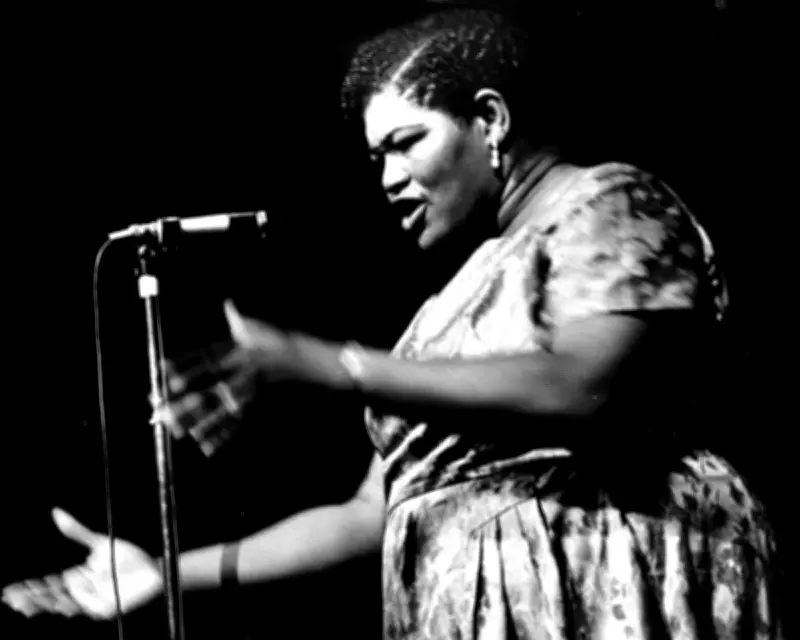
Willie Mae "Big Mama" Thornton stood as a towering figure in American music, both literally at 6 feet 2 inches tall and figuratively through her raw, defiant artistry. Born in 1926 in Alabama, Thornton's voice conveyed a depth of struggle, fury, and hurt that few could match, yet her story remains largely overshadowed by the stars who later popularized her songs.
A Life of Hardship and Resilience
Thornton's early life was marked by tragedy and poverty. Her mother died when she was just three years old, and her preacher father moved the family frequently. With only a piecemeal education that ended at age 12, Thornton worked cleaning bars and collecting garbage before being discovered by blues singer "Diamond Teeth" Mary McClain at 14. She joined the touring Hot Harlem Revue, a predominantly gay and lesbian troupe that included a young Little Richard, but the pay was so meager she often had to shine shoes before performances.
In 1948, she settled in Houston, Texas, where she caught the attention of Don Robey, an African American entrepreneur and gangster who owned Duke and Peacock Records. Robey signed her in 1950, and when bandleader Johnny Otis came to town, he gave her the stage name "Big Mama" and commissioned songwriters Mike Stoller and Jerry Leiber to write a song for her.

The Hound Dog Controversy
Stoller and Leiber wrote Hound Dog specifically for Thornton, describing her as "the biggest, baddest, saltiest chick you would ever see." Her 1953 recording topped the Billboard R&B charts for nearly two months, but financial exploitation followed. Thornton claimed Robey paid her only $500 for the hit, while Leiber and Stoller also received nothing. Later, when she asked Robey for $50 to prevent her car from being repossessed, he refused, forcing her back to shining shoes outside clubs.
The injustice deepened when Elvis Presley's sanitized 1956 version of Hound Dog spent 11 weeks at number one, earning him fame and fortune while Thornton received nothing. "I never got a dime," she said in 1968, holding a lifelong grudge against Presley for refusing to perform with her after his rise to stardom.
Rediscovery and European Acclaim
By the 1960s, Thornton's career had faltered, and she performed as a one-woman band in Oakland, California bars, singing while playing drums and harmonica. However, white jazz and blues fans in the Bay Area took notice. Music journalist Ralph Gleason secured her a spot at the 1964 Monterey Jazz Festival, and Chris Strachwitz, founder of Arhoolie Records, persuaded her to join the 1965 American Folk Blues Festival tour in Europe.
Sharing stages with legends like Buddy Guy and John Lee Hooker, Thornton captivated European audiences. "We make a bigger hit over there in Europe," she told historian Studs Terkel in 1970. Her manager at the time, Jim Moore, recalled her emotional response to the reception: "Big Mama cried, really cried." Strachwitz recorded her in London, resulting in the masterful 1966 album In Europe and 1967's Big Mama Thornton With the Muddy Waters Blues Band.
Influence on Janis Joplin and Later Years
Janis Joplin, a regular at Thornton's Bay Area shows, sought permission to record Ball and Chain, a song Thornton had written but not released. Thornton's advice was blunt: "don't fuck it up." Joplin's version on Big Brother and the Holding Company's 1968 album Cheap Thrills became a psych-rock anthem, and unlike Elvis, Joplin ensured Thornton received royalties. "When I got a check for Ball and Chain off Janis, I got a ball and chain off me," Thornton said.
This connection won Thornton a hippie audience, with bookings at San Francisco's Fillmore theatre and rock festivals, sometimes backed by members of the Grateful Dead. Yet her confrontational nature—including punching promoters and musicians who disrespected or underpaid her—often led to self-sabotage. She rejected work offers from icons like Duke Ellington and George Benson, dismissing Ellington as "not blues," and clashed with producer John Hammond.

From 1970 onward, Thornton lived a nomadic life, recording sporadically and relying on whiskey as a constant companion. A 1976 car crash hospitalized her for months, and by the 1980s, cancer had stripped her of her imposing physique. In 1980, Aretha Franklin invited her to duet on Bessie Smith's Nobody Knows You When You're Down and Out for a TV special, showcasing Thornton's enduring power despite her declining health.
Legacy and Resurrection
Thornton died in 1984 at age 57 and was buried in a shared pauper's grave, her death barely noted by the music industry. However, a new documentary, Big Mama Thornton: I Can't Be Anyone But Me, aims to resurrect her legacy on the centenary of her birth. Director Robert Clem describes her as "unique" and "fearless," a Black, gay artist who lived by her own rules in a reactionary era.
Today, Thornton inspires generations of Black female singers. Jazz vocalist Dee Dee Bridgewater recalls being inspired by Thornton as a child because "she was Black and beautiful and strong." Artist Valerie June sees her as an ancestor, noting initiatives like the Willie Mae Rock Camp for Girls in Austin, Texas, which teaches instruments in Thornton's name.
Her pride, musicianship, and determination to forge her own path define her legacy. As Clem notes, "Blues was music made by people who came from the very bottom of American society." Through this documentary and renewed appreciation, Big Mama Thornton's voice—once forgotten—now resonates as a testament to resilience and artistic integrity.