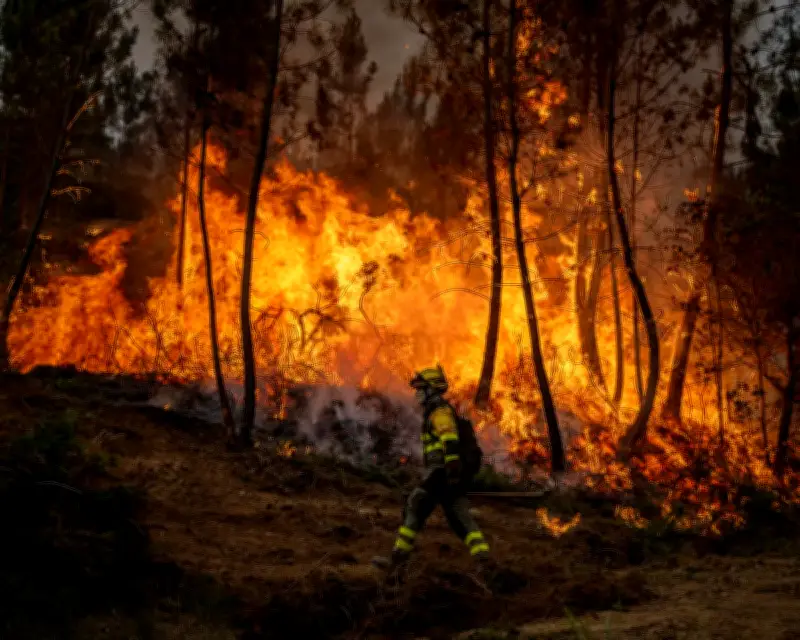
As wildfires rage across Europe and Britain endures its hottest summer on record, literary fiction has a vital role in capturing the severe consequences of the climate crisis, argues author Tara Menon. In a new essay, Menon reflects on her book tour through Europe, where record heat and devastating fires underscored that the disaster is already here, not a future certainty.
Record Heat and Wildfires Across Europe
Earlier this summer, Menon traveled through Europe on a book tour, and everywhere she went, the heat broke records. In Italy, Germany, and Spain, she sought refuge in air-conditioned hotels. In normally temperate Zurich, temperatures averaged 37 degrees, prompting her to jump into the Limmat River for relief. On her final day in Warsaw, Poland recorded its hottest day ever, one of 14 countries to hit historic highs. By late July, Europe was burning.
Since the heatwaves began, there have been more than 10,000 excess deaths. Yet for many, including Menon, the high temperatures brought only inconvenience—uncomfortable commutes, heat rash, and less time outdoors. This disparity, she notes, is a defining feature of today's climate crisis: deadly for some, banal for others. Even when the world is on fire, it doesn't feel like an emergency for everyone.
Hurricane Sandy: A Tale of Two Cities
This disparity reminded Menon of Hurricane Sandy in 2012, when she lived in New York. She was one of millions ordered to shelter in place, while hundreds of thousands were evacuated. She stayed in her warm, dry apartment on the Upper West Side, watching trees sway violently. The next morning, the sun was out, the power was on, and her neighborhood was jovial, with brunch on. But in other parts of the city, the story was different: taxi cabs submerged in water, a midtown crane snapped in half, and a power plant exploding. Half a million people, including most of lower Manhattan, were without electricity. Sandy killed 233 people in eight countries and caused $70bn in damage.
Days later, Menon volunteered in Chinatown, distributing basic goods to elderly residents in public housing who hadn't ventured outside. The apartments smelled of rotting food and unflushed toilets. The national guard rolled through in tanks, and rats stalked the pavements. Research labs at NYU lost lab animals, and rumors spread that the city's rodent population had grown by 10,000 transgenic mice and rats.
New rules governed downtown life: bars served free drinks by candlelight, neighbors offered water with handmade signs, and shops provided free charging stations. The roads around Ground Zero stayed flooded for weeks. Amid the darkness, one building stayed lit—Goldman Sachs. Menon was struck by disparities: between downtown darkness and uptown light, between those who could escape to second homes and those with nowhere to go, and between countries with organized disaster responses and those relying on community help.
The Failure of Literary Fiction
Menon also thought about natural disasters from her childhood in Singapore: the 1999 Odisha cyclone, the 2003 heatwave across India, the 2004 Indian Ocean tsunami, the 2006 Southern Leyte mudslide, and the 2007 cyclone in Bangladesh—disasters with much higher death tolls that many people had never heard of.
When Sandy made landfall, Menon had just begun her PhD in English literature. She searched for novels about the environment but was often disappointed. In many, the severe consequences of the climate crisis were packaged as a future possibility. But the climate crisis is not only a future certainty; it is past and present truth. The disaster is already here.
Years later, reading Amitav Ghosh's The Great Derangement, Menon found her disappointment articulated. Ghosh argued that literary fiction has failed us, listing reasons the modern novel is unsuited to representing the climate crisis: novels are centred on the individual psyche, can't range freely over space and time, are radically centred on the human, and are twins with probability, while the climate crisis is defined by improbable events.
Writing Under Water as a Riposte
Menon agreed with Ghosh that "the climate crisis is also a crisis of culture, and thus of the imagination," but wondered if it was possible to write serious literary fiction that captures both the freak event and the mundane truth. Over eight years, she wrote Under Water, a novel that moves towards two cataclysmic events—Hurricane Sandy and the 2004 Indian Ocean tsunami—while documenting slow violence in New York and Thailand. The novel is a riposte to Ghosh's claim that the contemporary realist novel is destined to fail us.
Menon argues that a realist novel centred on a bourgeois subject in today's globalised world can move across space and time, as her protagonist Marissa does, growing up on a barely inhabited island in south-east Asia and later living in a large US metropolis. She also responds to Ghosh's claim about the improbable, imbuing Sandy with expectation through Marissa's past. A single novel cannot show everything, everywhere, all at once, but it can wield what Menon calls our best weapon: the determination to pay close, careful attention to the people and places we are losing every day.