Fiction
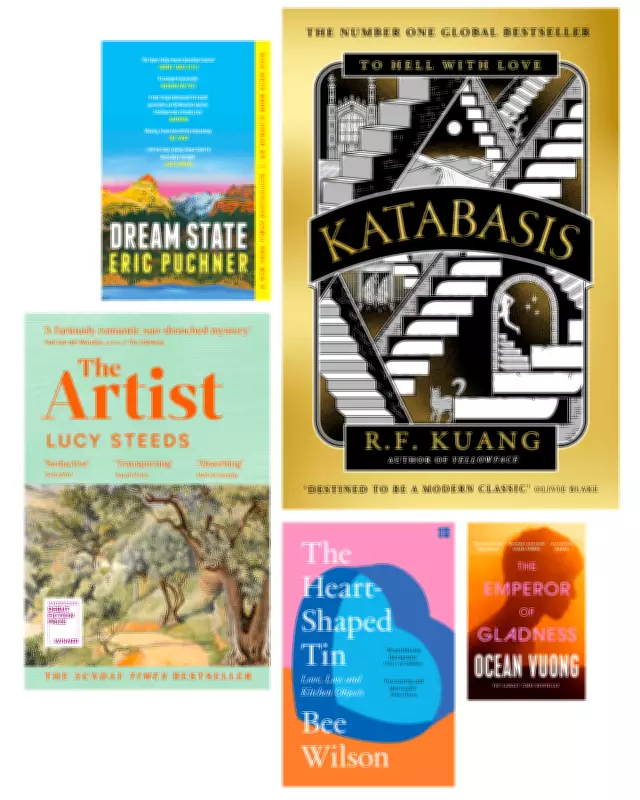
The Emperor of Gladness by Ocean Vuong
Ocean Vuong’s second novel is a 416-page tour of the edgeland between aspirational fantasy and self-deception. It opens with a long slow pan over the fictional small town of East Gladness, Connecticut, beginning with ghosts that rise “as mist over the rye across the tracks” and ending on a bridge where the camera finds a young man called Hai – “19, in the midnight of his childhood and a lifetime from first light” – preparing to drown himself.
Instead of jumping from the bridge, Hai crosses it, to be adopted on the other side by 82-year-old Grazina, a woman suffering mid-stage prefrontal lobe dementia. He will become her proxy grandson; they will be each other’s support in a crap world. It will be a disordered but productive relationship.
Grazina, born in Lithuania, “an old country, far away”, lives on a street known locally as the Devil’s Armpit, takes 14 pills a day, and always eats Stouffer’s Salisbury Steak for dinner. She needs a carer; Hai, a pillhead in remission but longing to be back in the arms of opioids, needs a more constructive narrative of himself. Between them they invent a role-playing game to bring her down from the destabilising hallucinations and insomniac panics of her disease. Then, as she sleeps, he quietly ransacks her cupboards for prescription medicines.

This is a huge novel in terms of where it directs our attention: from gay self-discovery to the uses of fiction; from the industrial farming of animals to the drive to write yourself free of the parental experience. It’s heartbreaking, heartwarming yet unsentimental, and savagely comic all at the same time. M John Harrison
Katabasis by RF Kuang
In Katabasis, hell is not a roiling pit of fire, it’s worse: “Hell is a campus.” Cambridge postgrads Alice Law and Peter Murdoch are here on a quest. They’re searching for their thesis supervisor, the recently deceased Professor Jacob Grimes. The victim of a grisly lab accident, Grimes has exploded, and not just in rage. His body is in bits, and his soul is in the queue for judgment. Without him, Alice and Peter’s academic futures are equally damned. Their plan is simple: sneak into the underworld and haul him back. It worked so well for Orpheus.
This is the 1980s: post-structuralism is eating meaning and theory is eating itself. Our dauntless duo are scholars in “analytic magick”, an archaic and volatile branch of the humanities where philosophy is actually useful (that’s Kuang’s joke, not mine; don’t sic the Nietzscheans on me).
The real dark magic in this book is self-delusion. As Alice and Peter wander the “eight courts of hell”, they come to realise how deeply they’ve internalised the extractive logic of the academy. They’ve been taught to mistake rivalry for strength, exploitation for meritocracy, privilege for prestige, and endurance for resilience. To thank the system that feeds on them. The lie was so simple: you can be the exception, if you’re willing to be exceptional.
The heretical glee of this novel is irrepressible. I escaped from my PhD 14 years ago, and it really did feel like an escape; it still does. This book reminded me why. It also reminded me how it felt to ascend from a hell of my own making and not look back. I read Katabasis in a single sitting and then slept the deep, unburdened sleep of someone who’d never even heard of Foucault. Beejay Silcox
Dream State by Eric Puchner
American author Eric Puchner’s latest novel is a colossus: a vast, bright behemoth of a book, panoramic as the Montana skyline. Dream State opens in 2004 with the image of a young woman, a month before her wedding, diving into a perfect lake whose “blue expanse of water” reflects the “overlapping peaks of the Salish range”. From this Edenic outset, it traverses decades, barrelling through our present day into a projected future: dipping in and out of the lives of a tight cast of characters as they succeed and fail; love and fall out of love; change and stay the same.

The young woman is Cece. She has stepped out of the lakeshore family home of Charlie Margolis, a cardiac anaesthesiologist to whom she’s engaged. She’s come to Montana early to put the finishing touches to the wedding plans before the guests, or even Charlie, arrive. In his absence, Charlie has deputed his best friend, Garrett, to lend a hand. Garrett appears on the lakeshore as Cece is swimming – and from there, events unfold more or less as we’d expect. Cece and Garrett move rapidly through antagonism into fascination; the wedding looms; and decisions taken in the heat of the moment profoundly shape the lives of all three characters from that point on.
Puchner tells his tale so compellingly, so engagingly, with such warmth and humour, that it’s not until you set the book down that you can appreciate the breadth and brilliance of what he’s done. Sarah Crown
Ripeness by Sarah Moss
Ripeness is structured in alternating narrative strands, both following an English woman called Edith: one as a septuagenarian living comfortably in the west of Ireland in the post-pandemic present, and another as a bookish, Oxford-bound 17-year-old travelling to Italy in the late 60s. These strands are initially connected by stories of babies given up. In the present, Edith’s best friend Méabh is contacted by an unknown older brother who was adopted and raised in America and now wants to “see where he comes from”. In the historical strand, Edith is travelling to help her older sister, a professional ballerina, pregnant with a child she will almost immediately relinquish. Together, a textured and affecting story about place and identity emerges.
Early on we learn that Edith has four passports – English, Irish, French and Israeli – and that her French-Jewish mother was granted refuge in England in 1941 while her grandparents and aunt were murdered in Nazi concentration camps. While her mother’s migration was driven by genocide and trauma, and her grandparents before had fled Ukraine for France, she and her sister were able to travel freely around Europe. But in the novel’s present, military aggression is again forcing migration. Edith reflects on the cyclical nature of conflict, noting that the “great grandparents of the people now fleeing Russian invasion and taking refuge here in the west of Ireland were the aggressors from whom her great-grandparents fled Ukraine”.
A central tension is established when Edith discovers that while Méabh is sympathetic to their village’s Ukrainian refugees, she is actively protesting at the use of a local hotel as emergency housing for African refugees. Edith is sickened and wonders briefly if she can remain friends with “someone who thinks the problem is refugees”. Quickly she decides she can; despite her personal connection to histories of genocide and displacement, her dismay at Méabh’s position fades.
The anger of Ripeness wanes too. But while its critiques of contemporary attitudes towards migration, and failures in historical thinking, and the ways some refugees are accepted while others are not, do lose some force, it remains a powerful and beautifully written story of family, friendship and identity. Arin Keeble
The Artist by Lucy Steeds
A love story wrapped in a mystery, Lucy Steeds’s vividly poetic debut novel begins cinematically and with a prophetic hint of myth: the arrival of a stranger on a dusty road, in his pocket a paper bearing the single-word summons, “Venez”. The year is 1920, in a Europe that is still under the pall of the war that should have ended all wars, and Steeds’s stranger is approaching a remote farmhouse in the Provençal village of Saint-Auguste where fabled painter Edouard Tartuffe – Tata, “the Master of Light” – lives with only his niece Ettie for company.
The newcomer is young Englishman Joseph Adelaide. Hoping to begin a new career as a writer on art, Joseph has petitioned Tartuffe for an interview. He asks more in hope than expectation, as Tartuffe is an enigma around whom myths swirl, and has shut himself away from the world for decades. But then the summons comes, and it seems that Joseph may begin his new life.
It soon becomes clear, however, that whoever scrawled that word of invitation, it was not Edouard Tartuffe. Joseph is far from welcome: the old painter, half-blind, monosyllabic and uncooperative, is at best indifferent and at worst violently hostile.
As Joseph makes a place for himself in the claustrophobic menage, he finds his attention turning to the increasingly insistent questions the household poses: not so much on art, but about the most private secrets of its inhabitants. Where does Ettie go at night? Why did Tata withdraw from the world? Coaxing the characters’ many secrets into the light, with each revelation Steeds brings just the right amount of new tension to bear on the narrative. Christobel Kent
History
Some Men in London edited by Peter Parker
In May 1945, the British photographer John S Barrington was celebrating the end of the second world war in his own way. He pushed through “the crush in Piccadilly Circus, kissing every soldier, sailor and airman I could meet”, before rounding things off by deciding to “pick up superb sailor, take him to office and fuck him ‘silly’”.
This is the striking start to the lively first volume of Some Men in London, an anthology of gay men’s experiences in the mid-20th century collated by Peter Parker, whose previous books include biographies of Christopher Isherwood and JR Ackerley.
It comprises diary entries, letters, newspaper reports, extracts from novels and more, on a subject so alien at the time to polite society that many couldn’t even agree on what to call it. Conservative peer Earl Winterton said “homosexualism”, an internal Metropolitan police report applied the dainty tongs of a hyphen (“homo-sexuals”), while others opted for “pansies”. Winterton, a few years later, thought better of his linguistic liberalism: “I prefer the word ‘pervert’ to ‘homosexual’,” he said in the Lords in 1959, “because ‘homosexual’ is too friendly a word for these horrible people.”
Two qualities make an anthology stand out. The first is the quality of the extracts. There is exceptionally good writing here from, among others, Denton Welch, James Lees-Milne and JR Ackerley, lover of rough trade and the only writer who could create beauty from a diary account of his jailbird lover masturbating his beloved alsatian, Queenie.
The other key quality is the editing. Some Men in London is skilfully sequenced, juxtaposing Henry “Chips” Channon’s casual ledger-card accounting of his conquests with sobering reports on arrests of working-class gay men, or following an extract from William Douglas Home’s 1947 play Now Barabbas… with the Evening Standard’s hostile review (“the normal section of the audience giggled with embarrassment”). In all, this is one of the best anthologies I have ever read. John Self
Food
The Heart-Shaped Tin by Bee Wilson
Two months after her husband left in 2020, Bee Wilson was startled by the clatter of a baking tin falling on to the kitchen floor. In one way this doesn’t seem particularly remarkable: Wilson is an esteemed food writer who presumably has a surplus of kitchen utensils crammed into her bulging cupboards. This tin, though, was different. For one thing it was heart-shaped. For another, Wilson had used it to bake her wedding cake 23 years earlier, taking care to leave out the cherries because her husband-to-be loathed them. (This now strikes her as ominous: “Maybe a man who was so fussy about cherries was not the man for me.”) Lurking at the back of Wilson’s mind had been the thought that she would soon be using the heart-shaped tin to bake a cake for their silver wedding anniversary. But now here it was, lying dejectedly at her feet and, she couldn’t help noticing, spotted with rust.
In this delightful book, part memoir, part anthropological investigation, food writer Wilson explores the way that kitchen objects have the power to move, soothe and even reproach us. There’s the plate you feel compelled to eat off because it makes everything taste nicer, or that bowl you keep but can’t bear to use because it reminds you too much of the person who gave it to you.
It turns out that Wilson need not have worried that she was, in her words, going “mad” by ascribing personalities and human meaning to bits of wood and stainless steel. Magical thinking, the textbooks reassure her, is a universal aspect of human cultures. It also provides the propulsion for this engaging collection of 30-odd short essays organised around ordinary people’s complicated feelings for egg whisks and apple corers. Kathryn Hughes
Music
Bless Me Father by Kevin Rowland
In the summer of 1979, Dexys Midnight Runners were a band you would have been hard-pushed to describe as anything other than unique. Their sound was a pugilistic update of classic 60s soul, topped with frontman Kevin Rowland’s extraordinary vocals, impassioned to the point that he permanently sounded on the verge of tears.
Yet Rowland really doesn’t appear to have enjoyed being the mastermind of Dexys Midnight Runners at all during their 80s heyday. There were some standard problems: poor management, terrible contracts and intra-band turbulence. But there’s also the sense that Rowland was hellbent on snatching defeat from the jaws of victory. The success of the 1982 single Come on Eileen – a transatlantic No 1 – is marred by his belief that he’s stolen its soul-meets-Irish-folk sound from a former Dexys member’s new band. When their ambitious next album, Don’t Stand Me Down, fails commercially, Rowland seems utterly crushed. He descends into a ruinous cocaine addiction, which is recounted in harrowing detail. By the early 90s, he’s effectively squatting in a bedsit: unable to pay his rent, his landlord has turned off the electricity and gas.
If anything, the reader could do with hearing more about what Rowland got right: the actual music Dexys released is almost uniformly magnificent, but here it often feels a little overshadowed, drowned out by the ructions surrounding its making, or by the author’s nagging sense of “what if?” But Bless Me Father is still powerful and oddly persuasive. Even as he seems to despair of himself, you wind up rooting for Rowland, never more so than when he conquers his addictions and releases his 1999 comeback album, My Beauty. A collection of cover versions, he promotes it while exploring his “feminine side”, in makeup, dresses and heels. The incredulity and hostility this provokes makes for sobering reading: a useful corrective to the current wave of rosy-hued 90s nostalgia. The album itself was reissued in 2020 to widespread acclaim, part of a fresh, if intermittent, wave of Dexys activity that sober and reflective Rowland seems less minded to find fault with: he ends Bless Me Father as content as you expect he’s ever going to be. Alexis Petridis
Technology
How to Save the Internet by Nick Clegg
Clegg served as Meta’s vice-president and then president of global affairs from 2018 until January 2025, where he was responsible for bridging the very different worlds of Silicon Valley and Washington DC (as well as other governments). How to Save the Internet is his report on how he handled that Herculean task, along with his ideas for how to make the relationships between tech companies and regulators more cooperative and effective in the future.
The main threat that Clegg addresses in the book is not one caused by the internet; it is the threat to the internet from those who would regulate it. As he puts it: “The real purpose of this book is not to defend myself or Meta or big tech. It is to raise the alarm about what I believe are the truly profound stakes for the future of the internet and for who gets to benefit from these revolutionary new technologies.”
But in fact, a great deal of the book is devoted to a defence of Meta and big tech. In the first chapter he addresses the twin charges that social media has damaged global democracy and teen mental health. He acknowledges that both declined in the 2010s, but he claims that the declines merely correlate with the rise to dominance of social media, and are not caused by it.
Turning to his proposals for how to save the internet, Clegg lays out two pillars: “radical transparency” and collaboration. Transparency is great in theory, but I fear that it may be too late to apply these principles to the powerful companies that now control much of the internet. As for collaboration, it’s hard to imagine companies like Meta giving up their data or their sovereignty.
The great biologist and ant expert EO Wilson once said about Marxism: “Good ideology. Wrong species.” After reading this, plus several of the many books about Meta’s unethical, careless, “break things” culture, I suggest we might say something similar about Clegg’s proposals: “Good plan. Wrong industry.” Jonathan Haidt
Linguistics
Proto by Laura Spinney
How did the language you’re reading this in come to exist? The Indo-European family of languages covers most of Europe, the Iranian plateau, northern India and parts of Asia. Its members are spoken by almost half of all living people, and they all stem from a common source. English, Hindustani, Spanish, Russian, Sanskrit, Greek, Latin, Norse and many others (more than 400 still exist) can all be traced back to this starting point: Proto-Indo-European (PIE). Laura Spinney’s new book tells the story of how a language that may initially have been spoken as a kind of lingua franca by only a few dozen people evolved into the mother tongues of billions.
Spinney draws on a wealth of recent evidence to tell this story, combining linguistics, archaeology and genetic research to trace the movement of people and their language. Making these links is not straightforward. PIE was not written down; it has been reconstructed by comparing the languages that evolved from it.
There are between 1,000 and 2,000 PIE words, and Spinney’s book is at its most interesting when dealing with them. The word *h2ster has become “star”. *kerd is the root of “cardio” and “heart”. The phrase *kerd dheh meant “to put your heart”, which became śraddhā in Sanskrit (believe) and crēdo in Latin; *ghostis is “guest-friendship”, a mutual obligation of guest and host. As humans travelled and traded, *ghostis was probably the concept that gave them safe passage. It echoes another word *ghes, “to eat”. Safe passage meant good eating.
As we face the dominance of global English, the potential erosion of languages around the world, and linguistic nationalism, PIE is in some ways a mirror of humanity. The language you’re reading this in will change. It will change as it has always done. When PIE came back to Europe around 2000BC there were about 7 million people living there. That it took over is extraordinary. Spinney says it is as if Italian had taken over New York in the early 20th century. However scary we might find such a future, one in which languages rise and fall, cultures come and go, our past suggests it is inevitable. Henry Oliver