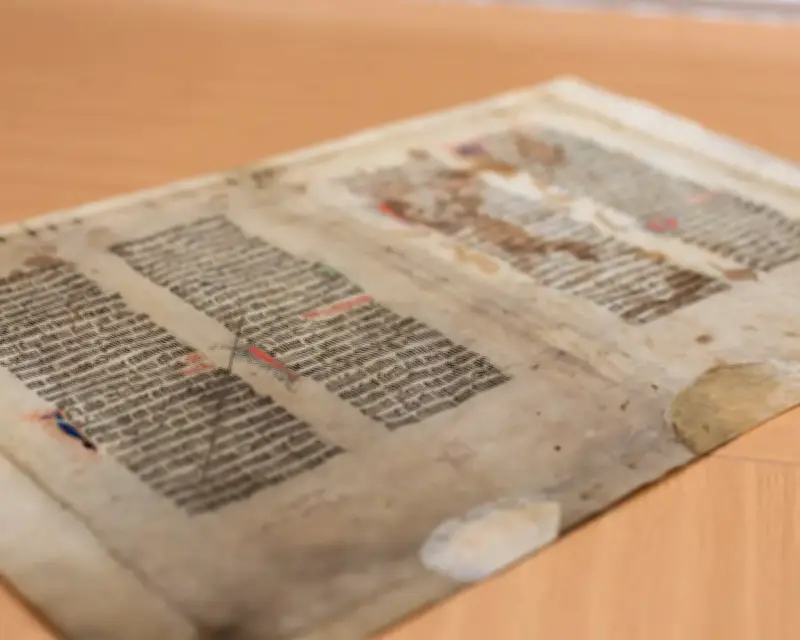
Seventeen medieval manuscript fragments, dating from the 12th to 15th centuries, have been discovered in Guernsey, shedding unprecedented light on the island's literary and intellectual life during the Middle Ages. The fragments, which include extracts from a play, an Ovid poem, passages from the Bible, and a travel text, offer evidence of wide-ranging reading tastes among the island's medieval citizens.
Discovery of the Fragments
The fragments were identified by staff at the Island Archives, working alongside Dr David Rundle, a manuscript expert at the University of Kent's Centre for Medieval and Early Modern Studies, and Prof Tamara Atkin, a book historian at the University of Oxford. They had been hiding in plain sight, having been cut up and recycled into practical bindings for rent books and other administrative records during the 16th and 17th centuries.
Research by Callum Tostevin-Hall, an archives assistant at Island Archives, led to the discoveries. He said: "This first began when I was asked to track down a 16th-century copy of Edward III's 1331 Extente of Guernsey and I noticed that the shelf mark contained reference to a vellum cover with Latin text that had been removed from the notebook in a previous round of conservation. I checked this cover and was astonished to find that it was clearly a reused bifolium from a medieval manuscript."
Significance of the Find
Until now, medieval Guernsey's literary culture had been a blank page in the history books. Little was known about its books and libraries, let alone whether the islanders read for pleasure. These sizeable fragments are significant evidence of volumes that were once found on the Channel island, a British crown dependency 30 miles west of Normandy.
The fragments reveal that Guernsey's medieval citizens had broad literary tastes and that when they read for pleasure, they did so not in English but in French – a clue to where their intellectual interests lay at that time. Rundle told the Guardian: "Why Guernsey is exciting is [that] nobody's known of anything here. Elsewhere, the Reformation in England, the dissolution of the monasteries, often involved the breaking up of manuscripts. Quite a lot of those manuscripts were liturgical. There are many more non-religious fragments in this Guernsey collection than you would expect."
Notable Fragments and Their Implications
Fragments from French literature include a dramatic poem from L'Estoire de Griseldis, a secular play thought to have been written around 1395 by Philippe de Mézières. The poem reworks the story of Griselda, first told by the Italian writer Giovanni Boccaccio in The Decameron in 1353. The Griselda story was a medieval blockbuster across Europe, but this version is exceptionally rare. Crucially, this fragment reveals that the manuscript play was being read beyond the French royal court circles, where it probably first circulated.
The Bible fragments include one in Latin that dates from the late 12th century and bears an early 15th-century annotation, possibly by a priest. Rundle added: "Although French was available in England throughout the middle ages as a literary language, it was declining at the end of the middle ages. But it looks to be continuing to be significant on Guernsey."
Future Research and Public Engagement
The academics believe further fragments are waiting to be found in the Guernsey archives and elsewhere. Rundle said: "This collection is exciting in its variety, of subjects and of dates, and hint at a culture which has not even been imagined."
Island Archives will host an academic study day on 10 September, supported by the University of Kent, involving academics from the UK and France. Tickets will be available through Eventbrite. The fragments are held in the public collections of the Island Archives and His Majesty's greffier's strongroom.