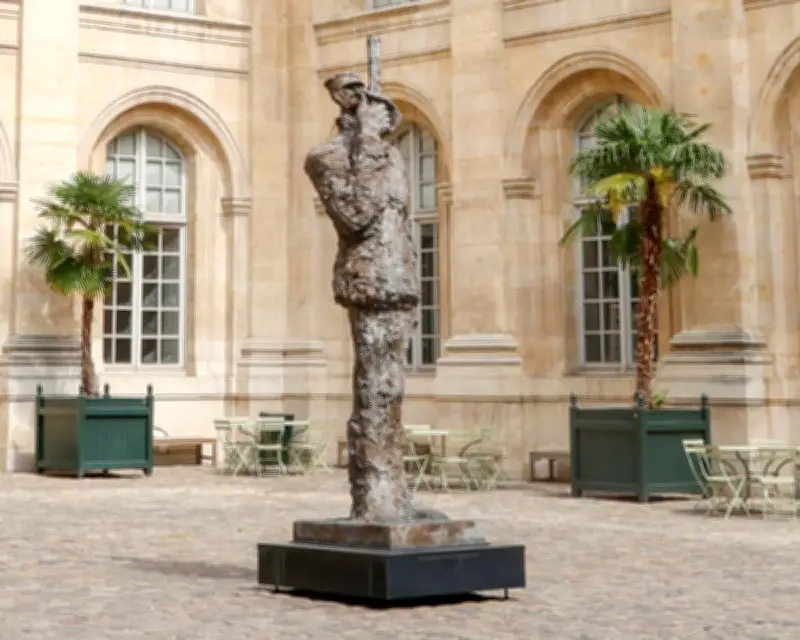
After 40 years of being moved around Paris without a permanent home, a statue of Captain Alfred Dreyfus will finally be installed in a prominent location in central Paris. The 3.5-meter (12-foot) bronze sculpture will be unveiled on July 12, a national Dreyfus commemoration day, by President Emmanuel Macron and Paris Mayor Emmanuel Grégoire. It will stand in Rue de Harlay on the Île de la Cité, in front of the Cour de Cassation, France's highest civil court, which exonerated Dreyfus on July 12, 1906.
History of the statue's displacement
Created in 1985 by Louis Mitelberg, known as Tim, the statue was originally intended for the courtyard of l'École Militaire, where Dreyfus was stripped of his rank in a humiliating public ceremony in 1895. However, the French army twice refused to allow it there. Other proposed sites, including a spot opposite the Palais de Justice, were also rejected. For want of a better place, the statue was placed in the Tuileries Garden for six years, then moved in 1994 to Place Pierre Lafue in the 6th arrondissement, where it remained largely unnoticed.
Significance of the new location
Ariel Weil, mayor of Paris Central and a descendant of the Dreyfus family, has been a key advocate for the statue's relocation. He stated: "It's been wandering around Paris for years. The general idea seemed to be: we'll put it in a corner of Paris where it won't embarrass anyone and won't be seen and we can forget about it." Weil added that the new location outside the Cour de Cassation is fitting, as it "puts right a final injustice."
The Dreyfus affair and its legacy
The Dreyfus affair, which almost brought down the Third Republic, began in 1894 when Dreyfus, a Jewish army officer, was wrongly accused of passing military secrets to Germany. He was convicted in a secret court-martial, publicly cashiered, and sentenced to life in solitary confinement on Devil's Island. After evidence of a cover-up emerged, novelist Émile Zola published his famous open letter "J'accuse" in 1898. Dreyfus was eventually exonerated by the Cour de Cassation in 1906, readmitted to the army, and awarded the Légion d'honneur. He served in World War I and died in Paris in 1935.
Commemoration and future ceremonies
President Macron wrote last year: "From now on, every July 12, a commemorative ceremony will be held for Dreyfus, celebrating the victory of justice and truth over hatred and antisemitism." The statue's pedestal bears the inscription: "If you want me to live, help me regain my honour," taken from a letter Dreyfus wrote to his wife, Lucie. Resin copies of the statue exist at the Museum of Jewish Art and History in Paris and in Tel Aviv. In 2002, vandals painted a Star of David and the words "dirty Jew" on the original statue, highlighting the enduring antisemitism the affair represents.