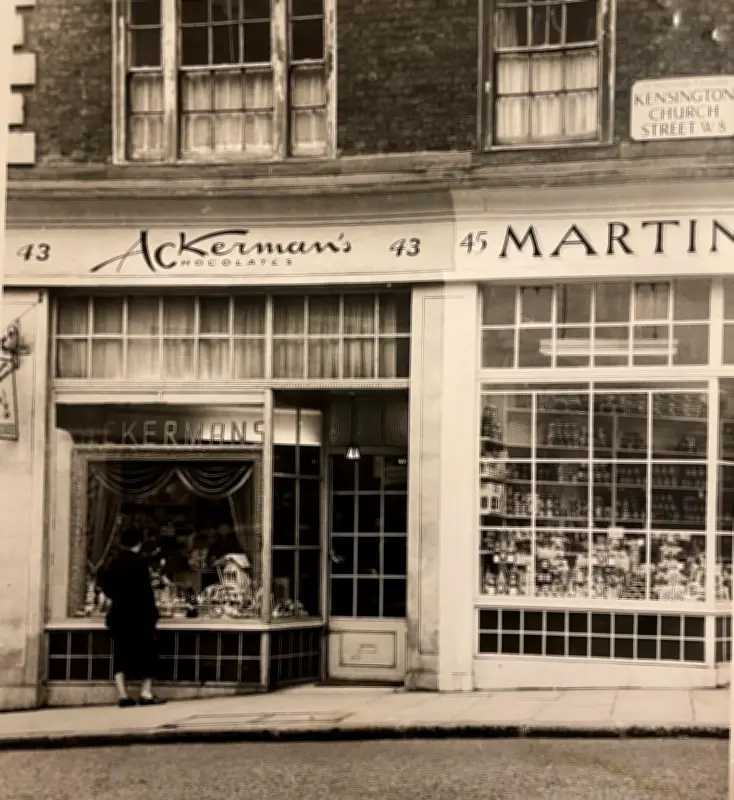
Ackermans Chocolates, a north London chocolate shop founded by Jewish émigrés Werner and Lotte Ackerman, earned a Royal Warrant in 1968 for supplying the Queen Mother, and operated for 50 years before closing in the early 2000s. The couple, who fled Nazi Germany in the 1930s, built a business that attracted royal customers including Princess Alexandra, Princess Margaret, and the Queen Mother, according to grandson Nicholas Rose, author of From Berlin to Bittermints.
Escape from Nazi Germany
Werner Ackerman was a lawyer in pre-war Berlin, while his wife Lotte was a trained pianist. As Hitler rose to power in the 1930s, their future in Germany became precarious. A vital lifeline came from Lotte's Kempinski relatives, whose catering and wine empire served thousands of Berliners across numerous establishments.
Co-owner Hans Kempinski had researched escape routes abroad as Hitler came to power. In 1935, he obtained a permit from the UK Home Office to open a restaurant in Swallow Street, Piccadilly, serving German specialities. This allowed him to bring staff from Germany, including his son Gerhard and daughter-in-law Mela. The Ackermans were offered employment in the London restaurant, and with it, a chance to escape.
According to Nicholas Rose, the couple had to demonstrate catering skills to qualify. "This is how both Lotte and Werner – who had hitherto been incapable of more than boiling an egg – came to spend a year in the Kempinski kitchens on Kurfürstendamm from April 1935," he says. "Lotte trained as a pastry cook making after-dinner chocolates and petits fours, while Werner was taught how to produce Baumkuchen."
Building a Chocolate Business in Hampstead
The following year, the Ackermans moved to a flat in Thurlow Road, Hampstead, with the Kempinskis living above them. Lotte worked in the restaurant, while Werner started making Baumkuchen in their flat using a bulky machine brought from Germany. However, lower gas pressure in Britain affected the moisture levels of his cakes, and there were few takers for his upmarket product.
At the outbreak of war in 1940, Werner was interned on the Isle of Man as an "enemy alien." He was released after signing up for the Pioneer Corps. While he was away at war, Lotte started a side business making chocolates. Although sugar and cocoa were rationed, fellow-refugee Max Weldon, who was in the cocoa trade, had contacts with Caxton, a firm specialising in industrial chocolate or "couverture." Lotte began production on her kitchen table, assisted by other refugee women, and sold the finished product around their community.
After Werner was demobilised in August 1945, the couple devoted themselves to the business full-time, exploiting the gap in the market for continental dark chocolate confectionery. They produced chocolates in a room in Fairfax Mews off Finchley Road, with a 'dipper' helping Lotte full-time while Werner served customers.
Royal Patronage and Expansion
In 1952, the Ackermans opened their first proper shop in Kensington Church Street, just in time for the lifting of chocolate rationing in 1953. Werner ensured the store caught the eye with a theatrical shop window, drawing a discerning clientele. In 1956, they opened a second shop at 9 Goldhurst Terrace off Finchley Road, transferring production to the basement.
Their focus on dark chocolate (the English traditionally preferred milk) and continental specialities like marzipan helped them stand out. Princess Alexandra, the Queen's cousin who lived in Kensington Palace, was the first royal to discover Ackermans, often shopping at the Kensington store in person. Later, Princess Margaret and the Queen Mother became regular customers.
Nicholas Rose recounts: "Chocolate assortments would be hand-delivered to both Kensington Palace and Clarence House on request and as a result, the Ackermans were awarded the Royal Warrant in 1968. Packaging could now proudly carry the royal crest and inscription 'Confectioners by Appointment to HM Queen Elizabeth the Queen Mother'."
At peak times, long queues formed outside the Goldhurst Terrace shop, which became a magnet for the émigré community. Nicholas adds: "Lotte was an outstanding chocolatier who knew how to achieve the slightly glossy appearance and full bouquet that marks out the best chocolate. Werner, who loved meeting his customers, was hopeless at wrapping and wisely assembled a team of refugee assistants to serve behind the counter."
Legacy and Closure
By 1978, the Ackermans, both over 70 and with heart conditions, retired and sold the business to a young Swiss patissier, Werner Krattiger, whom they had trained. Krattiger expanded production to an industrial estate in Camden, producing 4,000 kilos of chocolates a week, compared to the roughly hundred kilos Lotte and her team made. Tragically, Krattiger contracted Aids and died in 1992 aged 42; his will established a trust to continue Ackermans, with part of the profits going to Aids research.
The business developed overseas partnerships, leading to Ackermans being sold in Berlin's KaDeWe. In 1996, the future King Charles visited the revamped Selfridges Food Hall, where Ackermans had a concession. They were awarded a contract to supply his Duchy Originals range with their signature mint thins, a confection Lotte created and which Nicholas calls "her greatest legacy to the British chocolate industry."
In the late 1990s, Charbonnel et Walker bought a majority stake, retaining the Ackermans name for a time. After the Queen Mother's death in 2002, the Royal Warrant was withdrawn, and the brand and Goldhurst Terrace shop disappeared. Nicholas adds: "My brother Michael had the presence of mind to go when the premises were being refurbished and salvage the Ackermans shop sign that hung over the door. It now has pride of place in his kitchen, bringing back sweet memories of our grandparents and their achievements."