On a back street in Waterloo, the huge eyes of Anthony Bourdain stare down at the pavement. A massive mural of the cult chef-turned-food writer and documentary maker is painted on the wall of pan-Asian restaurant Sticky Mango on Coin Street, SE1. Hundreds of people continue to pilgrimage to this spot to remember the culinary figure and have their picture taken. Commissioned by the restaurant’s chef-owner Peter Lloyd, who met Bourdain in various corners of the world as part of the World Street Food Congress, it depicts Bourdain as the legendary figure we know today: the swaggeringly charismatic, intrepid eater, who interviewed Barack Obama over a $6 bowl of pork broth in Hanoi, cooked jungle-style chicken along the Congo River, and joined meals with Namibian villagers and Arctic hunters, all in the effort to radically understand how food impacts our lives.
A New Film Explores a Different Bourdain
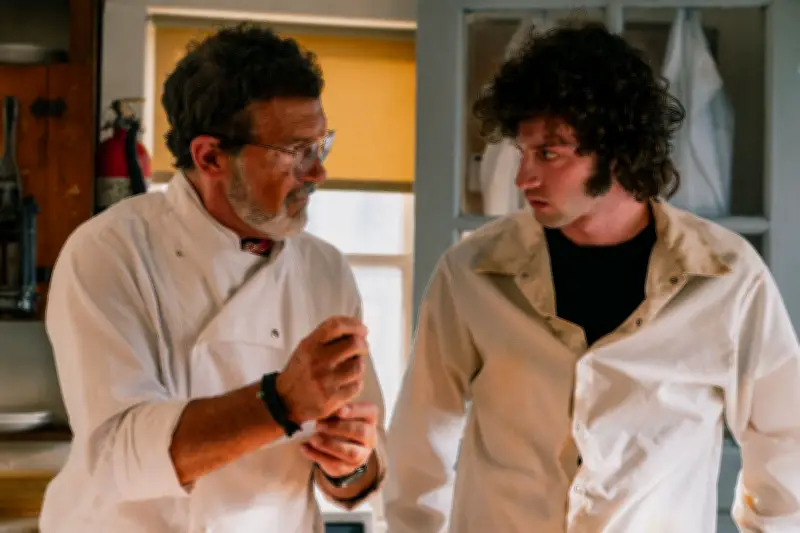
However, in a new film about the food hero, we’re introduced to an entirely different Bourdain. Tony, directed by Matt Johnson, is set over one formative summer in 1975, when a 19-year-old Bourdain flees his family home in New Jersey after failing to win a summer writing fellowship and follows a high-school crush to Cape Cod. After a drunken night, he meets the owner of local seafood restaurant The Lobster Pot, known only as ‘chef’ (Antonio Banderas), who gives him a place to stay in return for becoming his pot washer. It’s in this humble kitchen, among flying seafood shells and a bravado-filled crew of chefs and shuckers, that the fire is lit beneath Bourdain’s own culinary passions.
Loosely based on a few pages of Bourdain’s seminal memoir Kitchen Confidential and an episode of his TV series Parts Unknown that sees him travel back to Cape Cod, the film flashes by in a dreamy haze just like a remembered summer from someone’s youth, slathered in nostalgia. Yet the teenager we see here is awkward, angry, vulnerable and still learning how to move through the world. A quote from Bourdain describing himself at this age aptly flashes on screen at the start: ‘I was – to be frank – a spoiled, miserable, narcissistic, self-destructive, thoughtless young lout who needed a good ass-kicking.’
Oysters as a Symbol of Growth
As the sun-soaked summer drifts on, we slowly see the young Bourdain hatch out of his awkward teenage skin under the tutelage of Chef, whose shelves of old-school French cookbooks show him the sanctity of food and the art of a perfectly considered recipe. Crafting the perfect Lobster Thermidor and perfecting the correct colour of a seemingly burnt fish skin become didactic, spiritual experiences.
One particularly prescient gastronomic symbol throughout the film is oysters. Even before Bourdain enters the kitchen, he has a penchant for the saline delicacies, and he recalls the moment he tasted his first on a childhood holiday to France: ‘It tasted of seawater, of brine and flesh, and somehow… of the future.’ While the young Bourdain can easily eat oysters, shucking them – the tricky process of cracking into the tough corners of the outer shell and splitting it open with a thin blade to reveal the tidbit within – is a different matter. While his louche workmate Sal (Leo Woodall) can splinter them open with ease in the kitchen, as well as at parties to impress girls – they are famous aphrodisiacs after all – Bourdain struggles. As we watch him try, fail, and try again at mastering the technique, we watch his humility, confidence and love of food blossom at the same time.
Bourdain's London Favorites
The adult Bourdain famously loved London’s food scene. Referring to the city as his ‘second home’, he visited many times on and off the screen, filming episodes of his documentary food series A Cook’s Tour, No Reservations, The Layover and Parts Unknown in the UK capital. This means there are plenty of places where you can taste the food that made Bourdain fall in love with London. Bourdain called Fergus Henderson’s legendary nose-to-tail eatery St. John his ‘favourite restaurant in the universe’. He devoured lunches in the old-school fish restaurant Sweetings, was known to be partial to an espresso chased by shots of the herbaceous Italian liquor Fernet-Branca at Soho institution Bar Italia, and propped up the tables at old Soho haunt Trisha’s.
But, for a taste of the seafood-filled Massachusetts coast where Bourdain earns his stripes in the film, there’s only one place in London to visit: Wright Brothers Seafood Restaurant and Bar. Opened in 2002 by the titular Wright brothers Ben and Robin, the business became the first oyster merchant to open in London since 1970. Much like Bourdain, Robin discovered his passion for the molluscs on a childhood holiday to France, and many years later quit his job to pursue his passion for seafood.
I join Robin in the flagship branch of the seafood restaurant in Borough Market – a dinky spot with a bustling open-plan kitchen where chefs furiously shuck shells and griddle fish. He brings platters of crushed ice and oysters. We sit on high-backed stools and watch the restaurant’s very own Oyster Master, Luke Rees-Oliviere, explain how to clasp a closed shell carefully in your palm, tentatively dig the tip of a shucking knife where the two oyster shells meet, and then jostle them apart with the blade.
Eagerly, we throw back each of the opened oysters sourced by the restaurant’s specialist wholesale company. Rees-Oliviere explains how oysters have a merroir, or a specific marine environment, which includes everything from water salinity, temperature, tides, algae, and mineral content that shapes each one’s unique flavour, texture, and character. We slurp down flinty, mineral Jersey Rock Oysters, briny, earthy Achill Island oysters from County Mayo in Ireland, and umami Louët-Feisser oysters from County Lough.
Oysters' Storied History in London
While nowadays we might equate oysters with luxury, and think of eating them in white-table-clothed restaurants, chugged back with glasses of champagne, it hasn’t always been this way. Just as Bourdain has a strong personal connection to shellfish, oysters also have a storied and surprising connection to London.
As Robin explains, humanity’s reliance on oysters stretches back millennia, with the molluscs being a plentiful and easy-to-access food source throughout history. It’s no wonder then that the UK’s most populous metropolis has continually relied on the salty morsels for sustenance. Two hundred years ago, London’s streets were filled with the cries of oyster sellers, with people shucking on every street corner. In 1865, records state that 500 million native oysters passed through London’s main fish market, Old Billingsgate, in a single year. They were eaten in vast quantities by both rich and poor, and unlike other fish, they were deliberately untaxed to keep them affordable. They were often given out for free, especially by pubs to lure in potential customers.
London’s love of oysters sums up exactly what Bourdain found so fascinating about food. He eschewed the usual trappings of celebrity chefs and the domination of Michelin-star clout to seek out the unknown and unusual dishes of the world with rich histories. He explored how food from humble origins could shine a light on local ingredients and bring communities together. He championed the shuckers and street food vendors of the world who create full-bodied dishes from eccentric and affordable ingredients. In Tony, we see exactly where this passion began.
Tony is in UK and Ireland cinemas now.