David Robert Mitchell's first film in eight years, The End of Oak Street, produced by JJ Abrams, is a Spielbergian mashup about dinosaurs in suburbia that feels less like homage and more like a pastiche generated by an AI Spielbergbot. The film, which lands in UK cinemas on 14 August, is initially amusing but oddly inert, contrived, derivative, commercially driven, and weirdly inconsequential.
Mitchell, known for the horror masterpiece It Follows and the divisive Under the Silver Lake, returns with a story set in late-1980s small-town America. Ewan McGregor and Anne Hathaway star as Greg and Denise Platt, an unhappy couple living on Oak Street with their two children, Brian (Christian Convery) and Audrey (Maisy Stella). Greg, ashamed of his failure as a breadwinner, works a humiliating side-job delivering pizzas, while Denise secretly writes an autobiographical novel about a woman planning to abandon her family.
A Sudden Shift in the Atmosphere
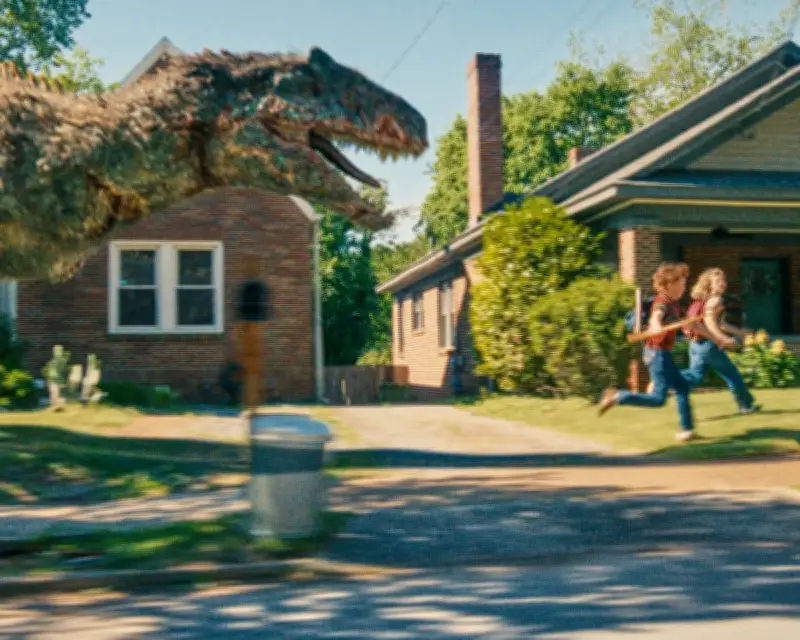
At the height of their discontent, the family notices a sudden change in the atmosphere. It becomes unbearably hot and humid; a plant thought extinct for millennia springs up in a garden; a pile of mysterious ordure appears in the mean neighbour's yard. Then, glimpses of alien-looking scales and claws vanish behind fences. It appears that a dinosaur-infested part of the prehistoric era has landed in the Platts' neighbourhood—or that their part of modernity has been transported back to that time.
The key to this mystery seems to be a glowing ball of light that vanishes and reappears in various locations. "Maybe this will take us home!" says Greg, presciently.
Symbolism and Directorial Choices
The dinosaurs might be symbolic of the family's suppressed passions and concealed rage, or the displaced seismic eruption of their domestic frustrations. However, these emotions feel less real than the dinosaurs themselves. Mitchell can hardly resist shooting a shocking moment without cutting to a framed family photo showing a happier time, and he has a weakness for the eerie "split diopter" shot, beloved of Brian De Palma, which depicts a foregrounded face and background detail in the same dreamlike sharp focus.
There is a moment of fatal violence that is rather tamely cancelled out, and the element of jeopardy is missing. The film is fun at first, but it feels like Mitchell doesn't really believe in any of it.
A Disappointing Return
Mitchell's previous film, Under the Silver Lake, was a madly indulgent LA fantasy-noir that many found to be a giant disappointment compared with It Follows. But at least it had ambition and chutzpah. The End of Oak Street, by contrast, feels as if Mitchell is going through the motions—someone else's motions.
The film's only moment of genuine surprise comes when two dinosaurs enjoy the full, physical flowering of romantic intimacy—something Spielberg would not feel comfortable showing, for dinosaurs nor, indeed, humans. But this quirk does not compensate for the overall lack of conviction. The End of Oak Street is in UK cinemas from 14 August.