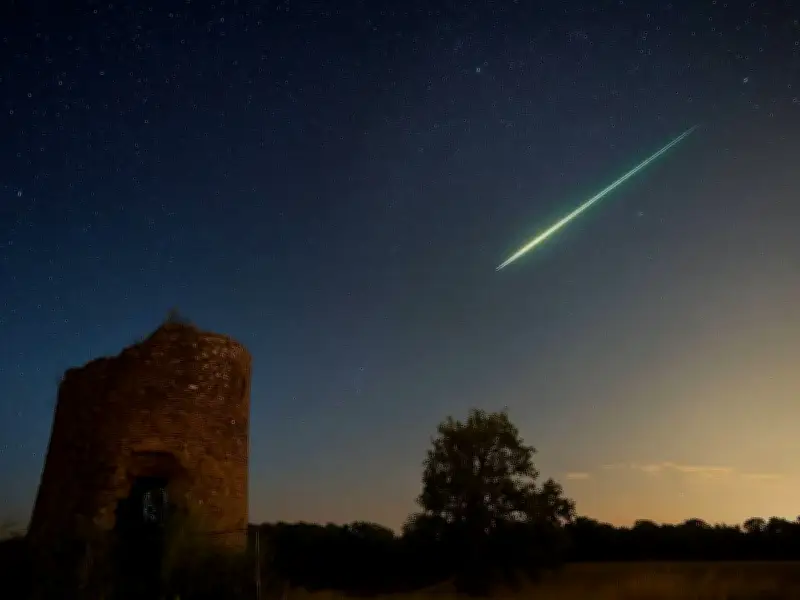
The Perseid meteor shower reaches its peak in the early hours of Thursday, 13 August 2026, just hours after a solar eclipse captivated millions. Sky-watchers in England and Wales could see up to 100 shooting stars per hour, according to experts.
Historic Alignment of Eclipse and Meteor Shower
This year marks a rare celestial coincidence: the peak of a major meteor shower occurring on the same day as a solar eclipse. Alfredo Carpineti, space and physics editor at IFL Science and author of Invisible Rainbows, told the publication: "It's so exciting to have these two events happening on the same day." He added that after reviewing 5,000 years of NASA eclipse data, "it looks like Wednesday will be the first time there's an eclipse happening on the same day as the peak of a major meteor shower."
The Perseid shower is caused by debris from the Swift-Tuttle comet, which the Natural History Museum notes is the largest object to regularly pass Earth, measuring 16 miles in diameter. As Earth travels through this debris field, particles burn up in the atmosphere, creating visible streaks of light.
Viewing Conditions and Best Practices
The Met Office forecasts clear skies only for England and Wales, meaning observers in Northern Ireland and Scotland may face limited visibility due to cloud cover. For optimal viewing, experts recommend finding a rural hilltop with minimal light pollution and looking at the sky at a 60-degree angle.
Dr. Ashley King, speaking to the Natural History Museum, emphasized the importance of dark skies: "The darker the skies, the better your chances of seeing the really faint meteors as well. You could go to the coast or stand on a hill in the middle of the countryside somewhere."
Patience and Preparation
Dr. King also stressed patience, noting that "you might not be able to see anything for the first 10 minutes while your eyes adjust to the dark. Once you get used to the low light levels you'll begin to notice more and more. So don't give up too quickly." Experts suggest full dark adaptation can take up to 40 minutes.
Given that summer nights can be chilly, viewers are advised to dress warmly and use a chair to avoid neck strain from looking upward for extended periods.
At its peak, the shower could produce up to 100 meteors per hour, offering a spectacular end to a day of celestial wonder.