London is preparing for its most significant solar eclipse in 27 years, with crowds expected to gather at the capital's scenic viewpoints. Throughout the week, queues have formed outside corner shops as Londoners rush to buy solar eclipse glasses. However, while excitement builds for the event on Wednesday, August 12, many are unaware of the lunar eclipse that will follow 16 days later.
Lunar Eclipse Details
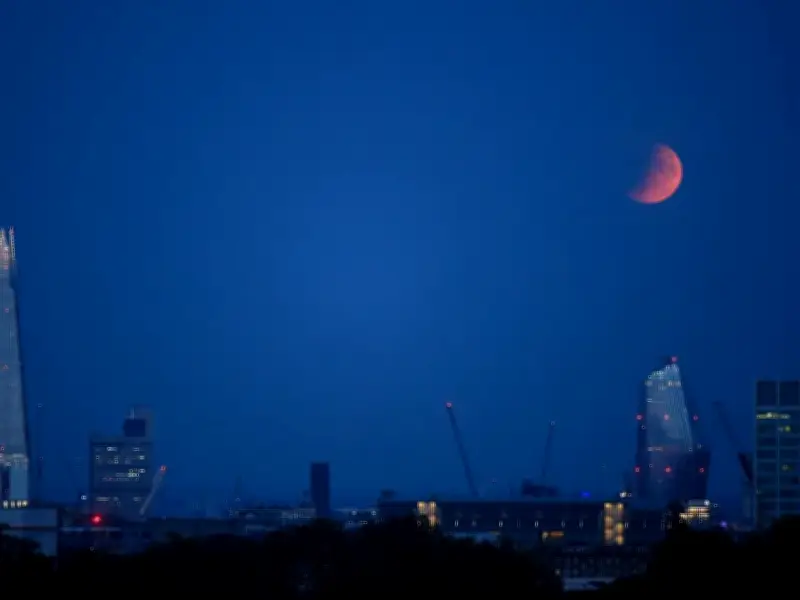
During the early hours of Friday, August 28, the Moon will appear to vanish from the sky as Earth completely blocks its view of the Sun. As the lunar eclipse peaks at 5.12am, about 90 per cent of the Moon will be in Earth's shadow, turning it a dark red. This occurs because Earth's atmosphere scatters blue light, allowing only red light to reach the Moon.
The partial lunar eclipse will begin at 3.33am and end at approximately 6.15am when dawn arrives. Keen astronomers are advised to find a high point with a clear view to the southwest.
How Solar and Lunar Eclipses Differ
Solar and lunar eclipses can only happen during an 'eclipse season' – when Earth's orbit is closest to the Sun. This period lasts between 31 and 37 days and occurs twice a year. When a new Moon falls during this period, its shadow can fall on Earth to create a solar eclipse. This new Moon can then pass into the Sun's shadow, causing a lunar eclipse. But to achieve a full or partial solar or lunar eclipse, another key factor must align.
The Moon orbits Earth at an angle of about five degrees. This means most eclipses during eclipse season are missed because new moons pass above or below the Sun from our perspective. However, there are brief windows in the Moon's trajectory when it matches Earth's alignment with the Sun. When this happens during eclipse season and a new Moon falls, parts of Earth experience a solar eclipse. Then, two weeks later (if still in the eclipse window), a full Moon leads to a lunar eclipse.
Perseid Meteor Shower
Hobby astronomers are in for a treat this August, with a dazzling meteor shower accompanying the two eclipses. The Perseid meteor shower is visible at night throughout this week, with thousands of bright streaks dashing through the darkness. Peaking on Wednesday and Thursday, the shower can feature more than 100 meteors and fireballs every hour. Clear skies are expected on both nights, so stargazers should be able to enjoy plenty of activity.
Meteor showers occur when Earth passes through streams of tiny pieces of debris left behind by comets and asteroids. The Perseids are caused by the planet slamming into meteoroids from comet 109P/Swift-Tuttle. This is the largest solar system object to regularly pass close to Earth and takes 133 years to complete a full orbit. It is thought to be bigger than the asteroid that wiped out the dinosaurs.
The peak of a meteor shower occurs as we pass through the densest part of the debris. Despite the large amount of light produced, nearly all meteors are nothing more than minuscule dust particles.