The death of French screen legend Brigitte Bardot at the age of 91 marks the end of an era, but her seismic impact on global fashion and culture remains vibrantly alive. More than just a film star, Bardot became an icon of a specific, intoxicating brand of post-war femininity: one that was instinctive, sensual, and unapologetically free.
The Birth of an Icon: From Ballerina to Bombshell
Long before she captivated the world in films like And God Created Woman in 1956, Bardot trained as a ballerina. This early discipline gave her a poised, almost regal posture that she carried onto the screen. Elements of her dance background persisted in her personal style, notably in her love for the ballet flat. In the 1950s, she famously commissioned Repetto, the esteemed maker of ballet shoes, to create a street-ready version with a toughened sole. The resulting 'Cendrillon' flat, launched in 1956, became an instant classic and a cornerstone of French-girl chic.
Her transition from brunette model, seen on early covers of French Elle, to the world's ultimate blonde was a masterstroke. She perfected her own signature hairstyle, the 'choucroute', a tousled half-up, half-down look she claimed to do better than any Hollywood stylist. It was the perfect symbol of her allure: sophisticated yet seemingly effortless, glamorous yet approachable.
Defining the Look: Gingham, Leopard and the Daring Bardot Top
Bardot's style genius lay in mixing innocent nostalgia with untamed sexuality. She embraced gingham, most memorably in a pink gingham wedding dress for her 1959 marriage, channelling a sweet, Dior-esque femininity. Simultaneously, she embodied a wilder spirit, often described as feline, which she expressed through a love of leopard print. She wore it on screen, as in a memorable 1971 scene from Boulevard du Rhum, and off-duty in chic car coats around Paris.
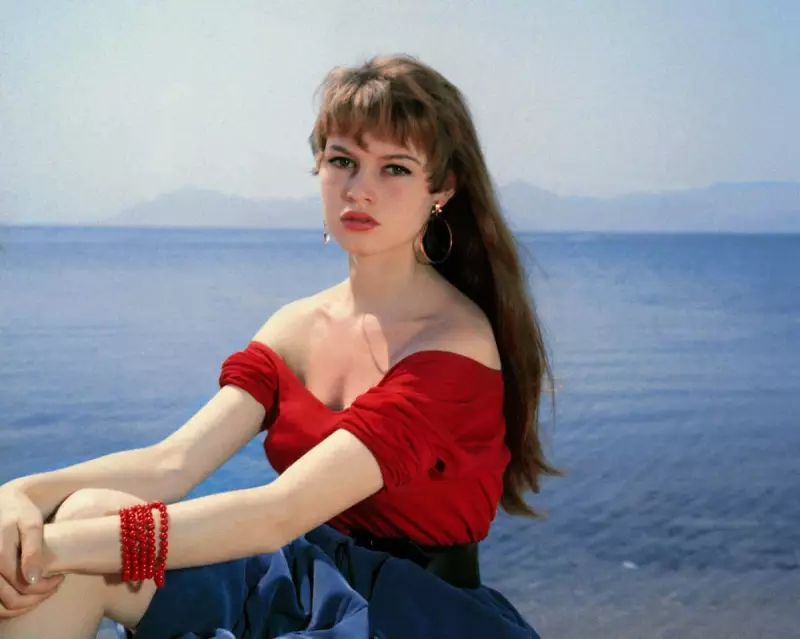
However, her most enduring sartorial gift is undoubtedly the Bardot top. This clavicle-baring, off-the-shoulder style, which she popularised in the 1950s, was considered daring at the time. A photograph from the Cannes Film Festival in 1953 shows her in a rakishly loose blood-red version, styled simply with gold hoop earrings. It looked as if she was wrapped in a towel or bedsheet, revolutionising the idea of casual glamour and bringing the sun-soaked ease of Saint-Tropez into the mainstream.
A Lasting Legacy: The Bikini and Timeless Freedom
Bardot played a pivotal role in making the bikini a global phenomenon. Although designed by Louis Réard in 1946, it was Bardot's appearance in one for the 1952 film Manina, the Girl in the Bikini that propelled the two-piece into an international sensation. She embodied the confidence and bodily freedom it represented.
By walking away from cinema at the age of 39, Bardot froze her image in time. Her style legacy is not one of haute couture complexity, but of intuitive, powerful choices. She championed a vision of femininity that was natural, bold, and entirely on her own terms. From the ballet flat to the bikini, and most famously the top that bears her name, Brigitte Bardot's influence on fashion remains as potent and liberating today as it was in postwar France.