Lisl Ponger's Danse Macabre: A Pandemic-Themed Photographic Masterpiece
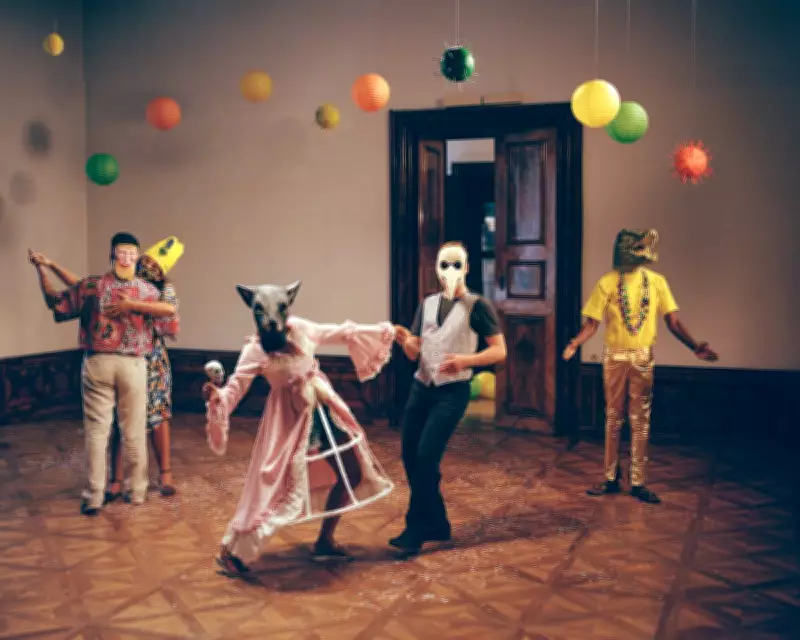
When the Covid-19 pandemic began sweeping across the globe, Austrian artist Lisl Ponger found herself captivated by the universal conversation about masks. This fascination sparked an extensive research journey into the history of masked balls, carnival traditions, and historical pandemics, particularly the plague outbreaks that ravaged Venice starting in the 14th century. The culmination of this exploration is her remarkable photograph Danse Macabre, a meticulously staged visual commentary on our pandemic reality.
Symbolism and Historical References
At the center of Danse Macabre, a plague doctor wearing a traditional Venetian carnival mask dances with the rat historically blamed for spreading plague. This central couple represents the direct connection between historical pandemics and our contemporary crisis. Ponger has even hidden subtle Covid-19 virus shapes among the paper lamps hanging from the ceiling, creating layers of meaning that reward close inspection.
The photograph contains powerful political commentary through its other characters. The couple on the left directly references accusations against Brazil's Bolsonaro government during the pandemic, which faced criticism for allegedly allowing unnecessary Indigenous deaths. The woman in the yellow hat represents Indigenous peoples, while her dance partner wears a mask depicting Pedro de Alvarado, the 16th-century Spanish conquistador responsible for massacring Indigenous populations in Guatemala.
Global Social Distancing as Dance
One of the photograph's most innovative aspects is how it transforms pandemic safety measures into artistic expression. Ponger discovered that different countries used creative analogies to explain social distancing requirements. While Austrians were told to maintain "the length of a baby elephant" between people, Floridians received guidance to visualize "a baby alligator."
The artist incorporated this discovery by including a character wearing an alligator mask, effectively turning a public health guideline into a dance gesture. Another dancer wears a custom-designed face mask featuring the Covid-19 virus pattern, which Ponger created herself using an online platform that later asked permission to use her design commercially.
Production Challenges and Artistic Philosophy
The photograph was created during one of Europe's hottest summers on record in 2021 at Vienna's University of Applied Arts. Ponger specifically chose the location for its beautiful floor, essential for evoking the atmosphere of masked balls. The production faced multiple challenges, including extreme heat exacerbated by photographic lighting equipment and a noise complaint from a neighbor about their generator-powered setup.
"It was quite exhausting, especially for the woman playing the rat," Ponger recalls of the demanding shoot. When police responded to the noise complaint, they simply suggested moving the generator around the corner, demonstrating the unusual circumstances of creating art during pandemic restrictions.
Ponger has shifted from using friends to professional actors and dancers in her staged photography, finding they bring superior body awareness and ability to hold positions during lengthy shoots. This technical precision supports her artistic philosophy that photographs must be both intellectually engaging and visually compelling.
Broader Context and Artistic Legacy
Danse Macabre forms one half of Ponger's Masquerade diptych, with its companion piece Hidden Transcript featuring carnival characters from Peru, New Orleans, Andalusia, and Trinidad. Both works reflect Ponger's longstanding interest in colonialism and postcolonialism, themes that permeate much of her photographic practice.
The artist acknowledges that viewers cannot immediately decipher all the research and symbolism embedded in her work. Instead, she creates visually arresting surfaces with titles that "open some doors" for deeper investigation. "To catch people, the work can't just be clever," Ponger explains. "The trick is to make the pictures beautiful and clever."
Now recognized as part of Hundred Heroines, the United Kingdom's only charity dedicated exclusively to women in photography, Ponger continues to produce work that bridges historical research with contemporary commentary. Her approach combines meticulous preparation with spontaneous creativity, resulting in photographs that serve as both artistic statements and historical documents of our pandemic era.