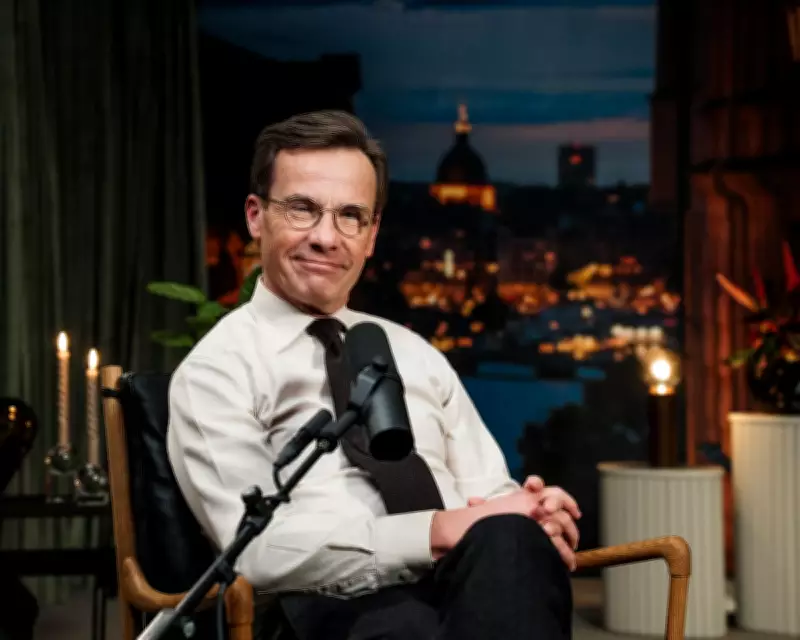
Swedish Prime Minister Ulf Kristersson's centre-right Moderates party has launched a novel political communication initiative this week with the podcast Ring statsministern! (Call the Prime Minister!). This informal weekly show invites voters to directly phone in with questions, ideas, and experiences, creating a conversational platform ahead of the crucial general election scheduled for September.
A Direct Line to the Prime Minister
Available on Spotify and YouTube, the podcast features Kristersson answering pre-recorded voicemails and emails from Swedish citizens. In the debut episode, callers posed a diverse range of queries, from light-hearted personal questions to serious policy discussions. One male caller inquired about the Prime Minister's Saturday night beer consumption habits, to which Kristersson responded with humour, stating he would "probably drink one. Possibly two" and praising a specific Swedish IPA brewery.
More substantive questions addressed pressing national issues. A caller asked about the government's controversial decision to allow 13-year-olds to be sent to prison, while another raised concerns about violence against women. The podcast also touched on political dynamics, with one participant questioning Kristersson's relationship with Jimmie Åkesson, leader of the far-right Sweden Democrats party that supports his minority coalition government while remaining an electoral rival.
Political Strategy in a Relaxed Setting
The Moderates party describes the podcast's objective as creating "an environment for good conversation with Sweden's prime minister – genuine, curious and straight talk about people's reality." Visually, the production presents Kristersson in a shirt and tie, seated in a candlelit room with a leather armchair, aiming to project a more accessible and relaxed image than traditional political interviews.
According to the party, initial public interest was overwhelming, with so many calls before the first episode that the answering system temporarily broke. Participants can either phone during recording for live interaction or submit questions in advance via voicemail or email.
Election Context and Critical Perspectives
This communication initiative arrives as Kristersson approaches four years leading a minority coalition government that relies on Sweden Democrats support. Recent polling indicates challenging political terrain for the Prime Minister. A December survey revealed narrowing trust levels between Kristersson and Åkesson, while opposition Social Democrats leader Magdalena Andersson maintains significantly higher confidence ratings.
Political analysts have offered mixed assessments of the podcast's potential impact. Parisa Höglund, presenter of Sveriges Radio's Det politiska spelet podcast, commented that "Ulf Kristersson is having a difficult time with his confidence poll numbers and I don't think populist beer drinking is going to help him." She identified the Sweden Democrats as Kristersson's "biggest headache" because they outperform his party on traditional Moderate issues like law, justice, and migration.
Controlled Narrative or Genuine Engagement?
While acknowledging the podcast's more fast-paced and varied format compared to Kristersson's usual interviews, Höglund suggested it primarily represents "a new way of delivering the same politics and talking points." She further noted that such controlled environments allow politicians to "avoid difficult questions from journalists" while carefully managing their public narrative ahead of elections.
Fredrik Furtenbach, a political commentator for Sveriges Radio Ekot, expressed scepticism about the initiative's broader impact: "I doubt this will have any meaning. Firstly, the parties' own communication is generally too boring, and secondly, there is a great risk that it will only reach those who already like Kristersson."
Additional Questions and Personal Touch
The inaugural episode addressed various other topics, including a proposal to legally shorten the working week and a woman seeking reasons to vote for the Moderates party. When a caller asked about proper address protocol, Kristersson encouraged informality with his response: "Ulf works really well."
As Sweden's political landscape intensifies ahead of the September election, this podcast experiment represents an innovative attempt at direct voter engagement. Whether it will meaningfully influence public opinion or simply reinforce existing political divides remains an open question that will unfold throughout the campaign season.