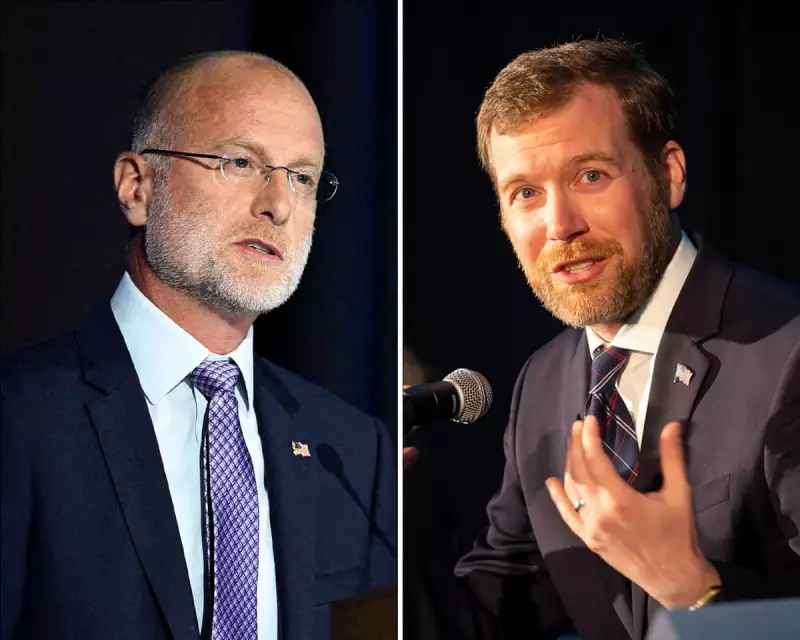
In a remarkable ascent through American regulatory circles, conservative lawyer Daniel Suhr has established himself as a significant force challenging major US broadcast networks through strategic legal complaints to the Federal Communications Commission.
Rapid Rise to Influence
Daniel Suhr, the 40-year-old president of the Chicago-based Center for American Rights, has achieved substantial influence within just 14 months of filing his first media complaint. His two-person legal organisation has become a persistent challenge to major broadcasters during a period when networks face both financial pressures and political vulnerabilities.
Suhr found a crucial ally in FCC chairman Brendan Carr, who was appointed by former President Donald Trump. Under Carr's leadership, the FCC has revived several complaints initially filed by Suhr that had been dismissed at the end of Joe Biden's administration. The commission has also appeared to incorporate Suhr's suggestions when reviewing significant media mergers.
Landmark Cases and Victories
One of Suhr's most notable interventions came in October 2024 concerning the editing of a 60 Minutes interview with then Vice-President Kamala Harris. This complaint preceded by approximately two weeks a $10 billion lawsuit filed by Trump against CBS that made similar allegations, creating political and media turmoil for the subsequent nine months.
The pressure from Carr's FCC led to an unprecedented decision by CBS to release the complete, unedited transcript and video library from the Harris interview. When the FCC ultimately approved Paramount's long-delayed merger with Skydance Media in July, it included conditions that Suhr had specifically requested.
These conditions mandated the appointment of an ombudsman to handle bias complaints at CBS News and the elimination of all diversity, equity and inclusion initiatives within the organisation.
"I think the commission did a great job in the final order," Suhr commented during a recent interview. "The commission's order said that Paramount committed to news that was 'fair, unbiased, and fact-based.' I think those are great words."
Questions About Influence
Critics have raised concerns about Suhr's sudden emergence as a key player in the administration's regulatory framework and his apparent coordination with Chairman Carr. Gigi Sohn, a longtime consumer advocate nominated by President Biden for an FCC position, noted the unusual nature of Suhr's rapid ascent.
"When you talk to him, he seems like a very reasonable, very articulate, smart guy," Sohn observed. "It's just kind of curious that this person has come out of nowhere and is so active and is so tied with the chair. I think it raises questions that should be answered."
Despite these concerns, Suhr maintains his independence from the FCC chairman. "I don't run my complaints by [Carr] ahead of time," he stated. "I don't run my complaints by his staff ahead of time."
Nevertheless, their relationship became visibly apparent when Carr posted a photograph of the two men meeting at the FCC on social media platform X, describing Suhr as "doing fantastic work advancing the public interest in media policy."
Expanding Media Challenges
Suhr's complaints have extended beyond CBS to other major networks. In late September 2024, he filed a complaint against ABC regarding its handling of a presidential debate between Trump and Harris. Another complaint targeted NBC over a pre-election appearance by Harris on Saturday Night Live, which Suhr argued violated the equal time rule.
Both complaints were initially closed under the previous FCC leadership but were reopened under Carr's chairmanship. However, the chairman chose not to revive a petition to deny a local Fox station its license based on Fox News Channel's coverage of the 2020 election.
Robert Corn-Revere, a first amendment litigator for the Foundation for Individual Rights and Expression, expressed scepticism about the legal basis for Suhr's complaints. "The dismissals by the FCC were so obviously correct under established precedent that I became a little curious about who would be dumb enough to file these things," he remarked.
When ABC indefinitely suspended late-night host Jimmy Kimmel's show on September 17, Suhr had already filed a complaint with the FCC that same day seeking consequences for the network unless Kimmel's programme was removed from broadcast.
Political Background and Mission
Though relatively new to media regulation battles, Suhr brings substantial political experience to his current work. After earning his law degree in 2008, he managed the Federalist Society's law school chapters before joining the administration of Republican former Wisconsin governor Scott Walker.
He later transitioned to public interest law, working for the Liberty Justice Center before establishing the Center for American Rights with partner Patrick Hughes. Hughes, who leads CAR's board, initially suggested that Suhr explore ways to combat what they perceived as mainstream media misinformation after watching the ABC News-hosted presidential debate in September.
"It was an unfair debate – the moderators were clearly in favor of the Democrats – and it made me think: 'How can this be?'" Hughes recalled. "And so I said to Daniel: 'We've got to do something about this.'"
Despite ongoing criticism about the legitimacy of his complaints, Suhr's complaint against CBS remains active with the FCC, even though his primary demand – the release of the 60 Minutes transcript – was fulfilled months ago. Chairman Carr has stated that these complaints continue under investigation.
Suhr expresses satisfaction with recent changes at CBS News, particularly following the appointment of Bari Weiss as editor-in-chief and conservative Washington figure Kenneth R Weinstein as ombudsman.
"We appreciate the change that is happening. We applaud it," Suhr said. "We're going to continue to be vigilant for consumers, but so far I've been thrilled. We just want journalists to be better journalists."