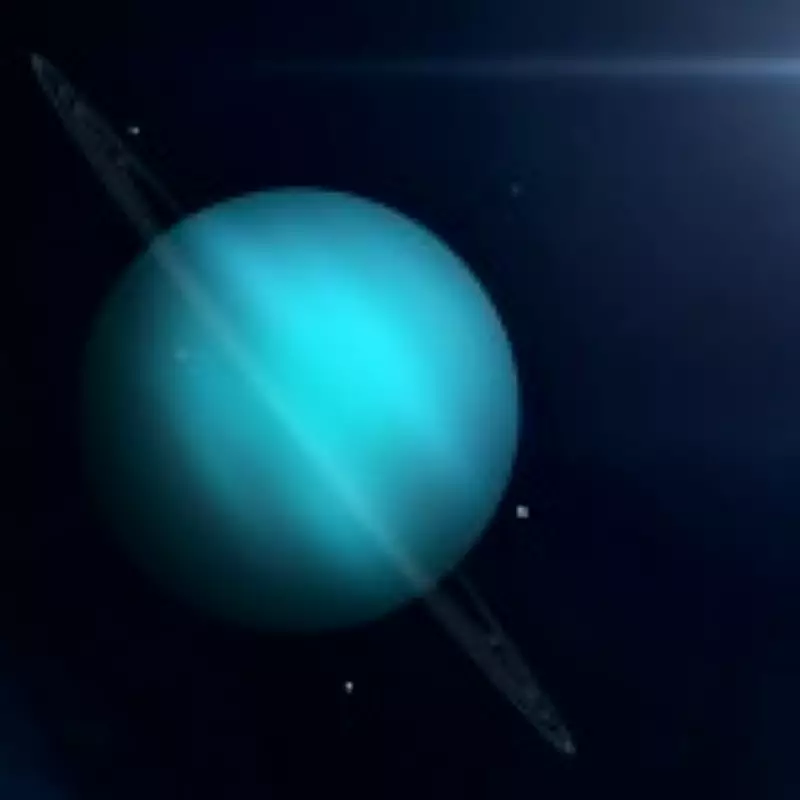
In a groundbreaking astronomical achievement, the James Webb Space Telescope has peered deep inside Uranus, mapping its version of the northern lights in three dimensions for the very first time. This unprecedented observation sheds new light on one of the solar system's most peculiar planets, known for its pale turquoise hue and gaseous composition.
Unveiling Uranus's Strange Magnetosphere
Uranus orbits the sun at a tilted angle of 98 degrees, causing its magnetic poles to face the star directly. Adding to its oddities, the planet's magnetic field is misaligned at a 60-degree angle, creating a unique and complex magnetosphere. For 15 hours, nearly equivalent to one Uranian day, the European Space Agency used the James Webb Telescope to observe Uranus rotating, aiming to decode the mysteries of this 'strange' magnetosphere.
Discovering the Ionosphere's Secrets
The telescope's observations revealed that Uranus's ionosphere, the outer layer of its atmosphere, is densely populated with ions. These are electrically charged atoms, formed when solar radiation and plasma from the sun interact with atmospheric particles. On Earth, similar processes generate the northern and southern lights, and now, scientists have identified analogous auroral bands on Uranus's eastern and western sides.

Paola Tiranti, the lead author of the study published in Geophysical Research Letters, emphasized the significance of this discovery. "By revealing Uranus's vertical structure in such detail, Webb is helping us understand the energy balance of the ice giants," she stated. "This is a crucial step towards characterising giant planets beyond our solar system."
Intriguing Atmospheric Dynamics
The data showed that ionised particles hover approximately 5,000 kilometers above Uranus's cloud tops. Interestingly, the temperature and density of these ions do not peak at the same altitude. Ions are warmest between 4,000 and 5,000 kilometers high, while they are densest at just 1,000 kilometers, a disparity attributed to the planet's lopsided magnetic field.
Unlike Earth's more stable atmosphere, Uranus's ionosphere is dynamic and not fixed in place, making it challenging to predict its location at any given time. Tiranti, a researcher at Northumbria University, highlighted the importance of this detailed data. "This is the first time we've been able to see Uranus's upper atmosphere in three dimensions," she said. "With Webb's sensitivity, we can trace how energy moves upward through the planet's atmosphere and even see the influence of its lopsided magnetic field."
Confirming Cooling Trends
In addition to mapping the auroras, the research team reaffirmed earlier findings that Uranus is cooling down. The planet, which consists primarily of water, methane, and ammonia, has an average temperature of -153 degrees Celsius, significantly lower than previously anticipated. This cooling trend adds another layer to our understanding of Uranus's atmospheric behavior and evolution.
The James Webb Space Telescope's advanced capabilities continue to revolutionize planetary science, offering insights that were once beyond reach. As scientists analyze this new data, they hope to unlock further secrets of Uranus and other distant worlds, paving the way for future explorations of exoplanets.