
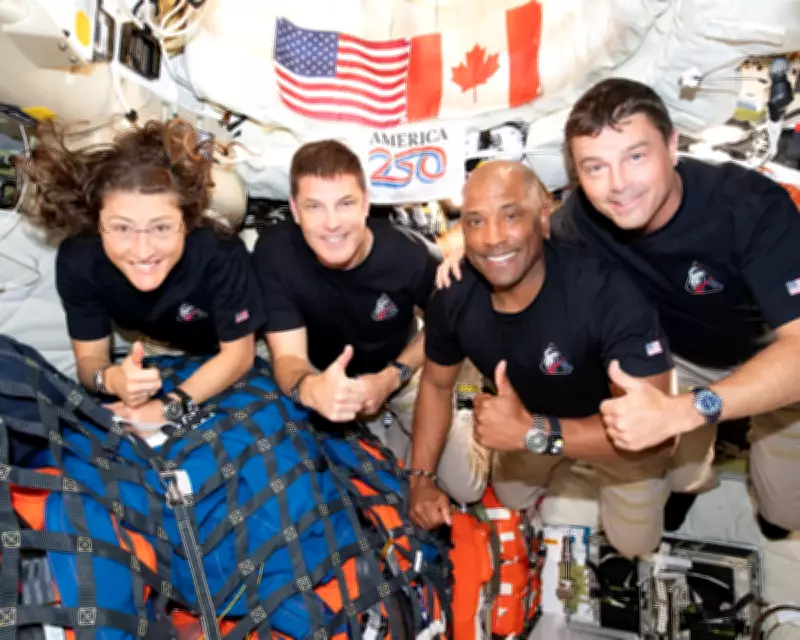
Artemis II Crew Completes Historic Lunar Mission Amid Growing Debate Over Human Spaceflight
The four-member Artemis II crew – astronauts Christina Koch, Jeremy Hansen, Victor Glover, and Reid Wiseman – successfully returned to Earth on April 8, 2026, concluding a groundbreaking 10-day journey that looped around the moon inside NASA's Orion spacecraft. This mission represents the second launch of the Artemis system and the first to carry astronauts, marking a significant milestone in the renewed global push for lunar exploration.
The Astronomical Costs and Uncertain Risks of Human Spaceflight
Despite the triumphant return, NASA acknowledges that the lack of comprehensive data makes it impossible to accurately quantify the risks involved in such missions. The Artemis program has already accumulated estimated expenditures approaching $100 billion (£75 billion), with the US Congress allocating an additional $9.9 billion in July 2025 specifically for the Artemis IV and V missions. Even greater investments are anticipated for developing a fully operational lunar base in the coming years.
Martin Rees, the Astronomer Royal and former president of the Royal Society, and Donald Goldsmith, an astrophysicist and science communicator, argue that while the 2020s have witnessed a revival of the "Apollo spirit" with both the United States and China racing to establish human presence on the moon, the fundamental case for sending astronauts into space is rapidly diminishing.
The Scientific Benefits of Lunar Exploration
The potential scientific rewards of returning to the moon are substantial and multifaceted. Detailed lunar exploration promises to provide crucial insights into the formation of our solar system, offering valuable implications for understanding exoplanets orbiting distant stars throughout the cosmos. Additionally, the moon presents an exceptionally stable platform for astronomical observation, particularly for radio telescopes positioned on the far side where they would be shielded from Earth's constant electromagnetic radiation.
However, the central question remains: are human astronauts actually necessary to achieve these scientific objectives? While astronauts currently maintain some advantages in adaptability and decision-making, technological advancements are quickly shifting the balance toward robotic alternatives.
The Robotic Revolution in Space Exploration
Robotic explorers such as NASA's Curiosity and Perseverance rovers on Mars – along with their Chinese counterparts – have demonstrated remarkable reliability and longevity, operating flawlessly for years powered solely by solar energy. These sophisticated machines continue to enhance their capabilities through software updates and improved design, while human astronauts require constant life support systems including oxygen, food, and protective shelter.
The most significant transformation since the Apollo era has been the extraordinary improvement in our ability to create, launch, and guide robotic explorers. With ongoing advancements in sensor technology and artificial intelligence, future robots will be capable of autonomously identifying scientifically interesting sites, collecting samples for return to Earth, and potentially even conducting engineering projects and mineral mining operations without human intervention.
The Political Dimension of Space Exploration
Space exploration inevitably carries substantial political implications, with human missions serving as particularly visible demonstrations of technological prowess and national prestige. China's ambitious lunar program exemplifies this dynamic, having successfully deployed multiple orbiters, landers, and robotic explorers to the moon. Their achievements include the historic 2024 mission that returned the first soil samples from the lunar far side to Earth.
China's upcoming August mission will investigate the moon's south pole region using an orbiter, lander, and "mini-hopper" probe, with plans for 2028 equipment deliveries to examine lunar base construction possibilities. There is widespread expectation that China will ultimately aim to match American achievements by sending human astronauts to the lunar surface.
The Historical Precedent and Future Implications
Human involvement has historically proven valuable for specific space operations, most notably in repairing and upgrading the Hubble Space Telescope after its flawed 1990 launch. However, as Riccardo Giacconi – who led early X-ray telescope projects and later oversaw Hubble operations – once noted, eliminating the human element could have allowed for multiple telescope copies to be built and launched with equivalent funding.
The James Webb Space Telescope, launched in December 2021 to an orbit far beyond the moon's distance, stands as a compelling example of complex missions achievable without crewed intervention. As robotics and miniaturization technologies continue their rapid advancement, the practical and scientific justification for human spaceflight grows increasingly tenuous.
The Future of Human Space Exploration
Within the next decade or two, robotic exploration of the lunar surface could become nearly autonomous, offering minimal advantage to maintaining a human presence. The primary remaining motivation for human spaceflight may ultimately reduce to adventure and inspiration – what Rees and Goldsmith characterize as "an ultra-expensive sport that should be left to billionaires and private sponsorship."
While we may admire the Artemis II crew for experiencing the awe-inspiring perspective of Earth from lunar orbit – echoing the iconic "Earthrise" moment captured by Apollo 8 astronaut Bill Anders – humanity does not require astronauts on the moon or beyond to reap the benefits of space exploration. The advancing capabilities of robotic systems promise to deliver scientific discovery and technological advancement more efficiently, safely, and cost-effectively than human missions ever could.




