
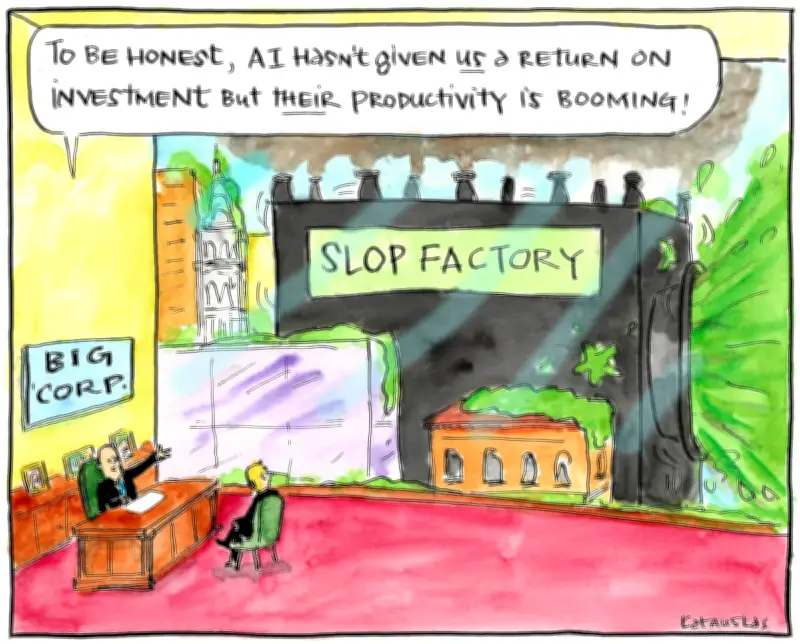
In the wake of a decade of unprecedented investment and breathless media coverage, the gap between the promise of artificial intelligence and its actual performance is becoming impossible to ignore. A growing body of evidence suggests that many AI deployments are failing to deliver the transformative productivity gains that were promised, leaving businesses and governments to grapple with a sobering reality.
Quantifying the Disappointment
Recent studies highlight the scale of the shortfall. According to a 2023 survey by the consulting firm McKinsey, only 14% of companies reported significant financial benefits from their AI initiatives, despite 90% having invested in the technology. Similarly, a study by the MIT Sloan School of Management found that AI adoption in the workplace has not yet led to measurable productivity improvements in most sectors.
The pattern is consistent across industries. In healthcare, for example, AI diagnostic tools have shown promise in controlled settings, but real-world implementation has been slow and often yields mixed results. In finance, algorithmic trading systems, once touted as the pinnacle of AI efficiency, have been implicated in market volatility, raising questions about their net benefit.
The Root Causes of the Hype-Performance Gap
Experts attribute the disconnect to several factors. First, many AI systems are trained on historical data that may not reflect current conditions, leading to errors when deployed in dynamic environments. Second, the integration of AI into existing workflows often requires significant organizational change, which many companies are reluctant to undertake. Third, the hype itself has created unrealistic expectations, leading to disappointment when AI fails to solve problems that were never clearly defined.
Moreover, the ethical and regulatory landscape has evolved more slowly than the technology, creating uncertainty that hampers deployment. In Europe, the proposed AI Act, while intended to foster trust, has been criticized for its complexity, potentially stifling innovation. In the United States, a patchwork of state regulations adds further friction.
Case Studies in Unfulfilled Potential
One notable example is IBM Watson, which was heralded as a breakthrough in oncology. However, a 2018 investigation by Stat News revealed that Watson's recommendations were often unsafe, based on hypothetical cases rather than real patient data. The system was subsequently scaled back, and IBM has since pivoted to more modest AI applications.
In the public sector, the UK's National Health Service has piloted AI for triage and imaging, but a 2023 evaluation by the Health Foundation found that only a handful of these pilots have been adopted at scale. The report cited concerns about data quality, interoperability, and the lack of robust evidence for clinical benefit.
Investment Continues Despite Doubts
Despite these setbacks, investment in AI continues to surge. Global spending on AI systems is projected to reach $500 billion by 2024, according to the International Data Corporation. Venture capital funding for AI startups remains robust, though a growing number of investors are demanding more rigorous metrics for success.
Some argue that the hype is a natural part of the technology adoption cycle, drawing parallels to the early days of the internet. However, the internet eventually delivered on its promise, while AI's transformative effects remain elusive. As Gartner's famous hype cycle suggests, we may be in the 'trough of disillusionment'—but it is unclear when, or if, the 'slope of enlightenment' will follow.
Moving Beyond the Hype
To bridge the gap, experts recommend a more measured approach. Instead of pursuing moonshot projects, businesses should focus on narrow, well-defined applications where AI can add clear value. They also emphasize the importance of investing in human capital—training employees to work alongside AI systems—and establishing robust governance frameworks to ensure ethical use.
As the initial excitement fades, the true test of AI will be its ability to deliver tangible benefits in the real world. The technology has enormous potential, but realizing that potential will require patience, pragmatism, and a willingness to learn from failures. Only then can we move beyond the hype and harness AI for the good of society.




