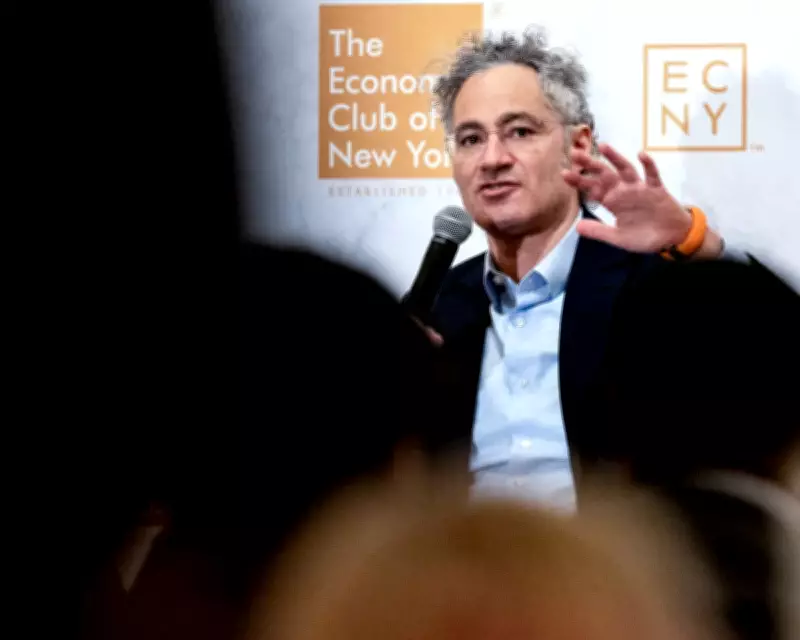
Palantir CEO Predicts AI Will Reshape Political Landscape, Targeting Democratic Base
In a striking assessment of artificial intelligence's societal impact, Alex Karp, co-founder and CEO of the controversial tech firm Palantir, has warned that AI technologies will significantly disrupt the economic and political power of Democratic voters, particularly highly-educated women. During a recent CNBC interview, Karp emphasized that these disruptions could fundamentally alter electoral dynamics in ways that many in industry and politics currently underestimate.
The Disruption Thesis: Who Wins and Who Loses in an AI-Driven Economy
Karp articulated a vision where AI disproportionately affects "humanities-trained, largely Democratic voters" by diminishing their economic power, while simultaneously boosting "vocationally trained, working-class, often male voters." This economic realignment, he suggested, would naturally translate into political consequences, potentially weakening the Democratic Party's traditional base of support.
The Palantir executive framed this as an inevitable outcome of technological progress, stating that anyone who believes such significant economic disruption "is going to work out politically" belongs "in an insane asylum." His comments come as Palantir promotes its AI-driven Maven Smart System, which the U.S. military uses for target visualization and nomination in combat operations.
Warning or Sales Pitch? Interpreting Karp's Political Analysis
Many observers have questioned whether Karp's assessment represents a genuine warning about AI's societal impacts or a calculated sales pitch to Republican power brokers. Publications like The New Republic have interpreted his remarks as "a direct, long-term pitch to the GOP" from a company deeply embedded in government contracting and Pentagon operations.
This interpretation gains credibility when considering the political positions of Karp and fellow Palantir founder Peter Thiel. Karp has publicly declared Palantir "completely anti-woke," while Thiel has previously lamented how women's suffrage impacted libertarian politics, suggesting in a 2009 essay that "capitalist democracy" had become an oxymoron since 1920 due to expanded voting rights.
The Broader Context: AI, Democracy, and Political Power
Karp's comments raise fundamental questions about whether "AI democracy" might itself become an oxymoron. Critics argue that AI technologies could disproportionately benefit autocratic tendencies by making propaganda dissemination easier, manufacturing consent for military actions more efficient, and providing convenient excuses for lethal errors ("whoops, the AI was responsible").
The timing of these remarks is particularly notable given former President Donald Trump's well-documented enthusiasm for AI technologies. Some analysts suggest AI could facilitate what they describe as Trump's "revenge tour" by reducing the economic influence of demographic groups he has frequently criticized, including highly-educated women.
Global Parallels: Women's Rights Under Pressure Worldwide
While Karp focused on American politics, his comments about diminishing women's economic and political power resonate with concerning global trends. In Afghanistan, new Taliban court rulings essentially greenlight domestic violence, with one woman recently told during divorce proceedings that "a little anger and a few beatings won't kill you."
Meanwhile, in Chile, anti-abortion president José Antonio Kast prepares to take office with a history of blocking women's rights initiatives, having even voted against divorce legalization in 2004. In Wyoming, Governor Mark Gordon recently signed a six-week abortion ban without exceptions for rape or incest, despite expressing some misgivings about those provisions.
The Accuracy Debate: How Vulnerable Are Different Worker Categories?
While Karp presents his disruption thesis as near-certainty, economists and technology analysts debate how accurately it predicts AI's employment impacts. While blue-collar jobs may enjoy some short-term protection from automation, most experts agree that technological advances will eventually affect virtually all occupational categories.
The more immediate question may be whether AI's economic disruptions will follow the clean demographic lines Karp describes, or whether the impacts will prove more complex and less politically predictable. What remains clear is that as AI systems become more sophisticated and integrated into military, economic, and social systems, their potential to reshape political power structures warrants serious examination and public debate.