Thousands of Seafarers Trapped in Gulf as Iran's Hormuz Threat Paralyzes Global Shipping
Thousands of maritime workers are currently stranded on oil tankers in the Gulf region after Iran's Revolutionary Guards declared they would "set ablaze" any Western vessel attempting to transit the Strait of Hormuz. This dramatic escalation has effectively closed one of the world's most critical shipping arteries, leaving crews trapped in what has become a dangerous war zone.
"We're Powerless and Hoping Nothing Hits Us"
A crew member aboard one of the stranded tankers, who spoke to Capital Post on condition of anonymity, described the surreal and terrifying situation facing maritime workers. "When Trump gave Iran ten days to agree to his deal or face consequences, I did the math and realized we might get stuck here," the seafarer explained from their cabin below deck. "And that's exactly what happened."
The crew member recounted watching explosions light up the sky while loading crude oil at a Gulf industrial complex. Initially ordered to stop loading, they were later instructed to resume operations despite the escalating danger. "We had no GPS, no communications, and we were sitting on more than a million barrels of floating oil," they said.

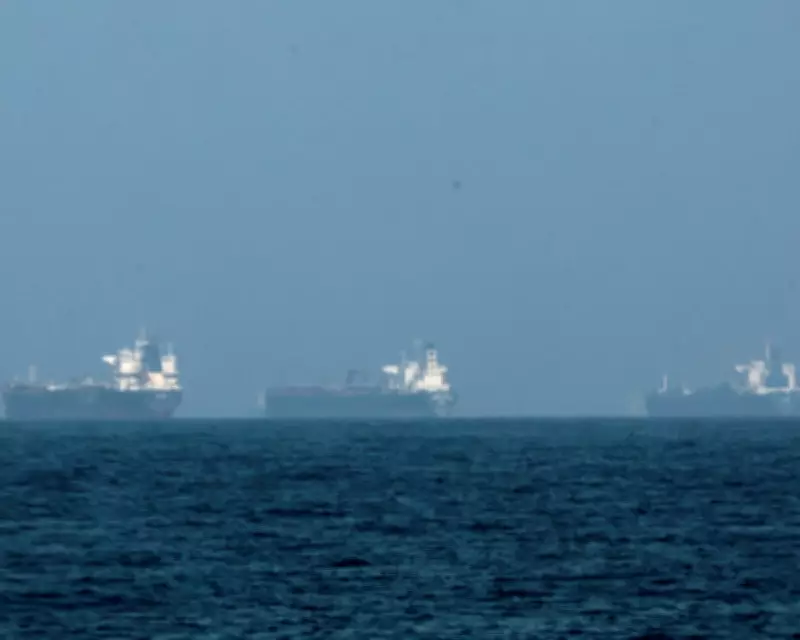
Now anchored off the coast of Dubai, the tanker appears to be stuck indefinitely. "We're powerless; just waiting and hoping that nothing hits us," the seafarer added, describing how military planes can be heard overhead and explosions sometimes visible in the distance.
Global Shipping Grinds to a Halt
The Strait of Hormuz typically sees about 100 tankers pass through daily, carrying approximately one-fifth of the world's oil and liquefied natural gas. However, marine traffic has evaporated as military aggression intensifies and insurance costs have skyrocketed or been withdrawn entirely.
According to maritime data firm Lloyd's List, approximately 200 tankers not under sanctions are currently stranded in the strait, along with hundreds of other vessels. This represents thousands of crew members effectively trapped in a conflict zone with limited options for escape or relief.
The seafarer interviewed has been aboard their tanker for three months and was scheduled to return to Europe after loading crude destined for East Asia. Instead, they find themselves among more than a dozen crew members from various nations including the Philippines and India, all sharing the same precarious situation.
Psychological Toll Mounts for Trapped Crews
"We send messages every few hours to the tanker owner to report that we are OK," the crew member explained. "In response we receive generic messages about mental health hotlines. But that's about it."
Communication remains a significant challenge, with limited internet access that frequently gets disrupted when GPS signals are jammed by either Iranian or American forces. "My mother is freaking out," the seafarer admitted, highlighting the emotional strain on families back home.
David Appleton, a senior leader at the trade union Nautilus International, emphasized the psychological impact. "When it all starts dragging on and people are supposed to be relieved and they can't be, psychological stress becomes the main thing," he said. "Many seafarers will remember the pandemic when they were trapped on board for months at a time."
Economic Consequences and Humanitarian Concerns
The effective blockade has already caused oil and gas prices to surge, threatening to upend the global economy by stoking inflation. The longer the strait remains closed to transit, the greater the risk to international markets and the thousands of seafarers held hostage by circumstance.
At least six vessels have been attacked in recent days, with two seafarers killed. On Wednesday, a large explosion was reported on an oil tanker near the coast of Kuwait, underscoring the immediate dangers facing maritime workers.
Stephen Cotton, general secretary of the International Transport Workers' Federation representing 1.2 million seafarers, has been inundated with requests for information from concerned members. "Seafarers are sometimes invisible," Cotton noted. "They are always on the frontline and our economies can't survive without them. But let's be clear: seafarers are innocent civilians."

Limited Options for Escape or Relief
The stranded tanker reportedly has enough food for approximately 60 days and is equipped with desalination equipment to produce water on board, though rationing may eventually become necessary. However, the fundamental problem remains: there's no safe way to evacuate crews from the conflict zone.
"You can't just get off a ship," Cotton explained regarding repatriation efforts. "The feedback from most ship owners is that it's a no-go zone. What we are exploring is what we can do."
No shipowner can legally force a seafarer to work in a high-risk area, raising difficult questions about who would replace those currently stranded even if a relief mission were logistically possible. "Who would be willing to take my place?" the interviewed seafarer asked. "You'd need to be really desperate for work."
As the crisis continues, trapped crews attempt to maintain some semblance of normalcy. "People might go to the gym, or watch movies in their cabins during downtime," the crew member described. "Some guys go fishing in the evening, but for obvious reasons we need to keep lights to a minimum so as not to attract attention."
The seafarer concluded with a poignant reflection on their eventual return home: "Honestly, when I do get home I want a very large, strong drink as soon as I arrive. But mostly I'm eager to see my pets, my family and my friends. There are hundreds of others in our position and I'm really concerned that we will not be heard."
Appleton summarized the union's position clearly: "Our position ultimately is that seafarers shouldn't be considered expendable. It's a civilian career." As the standoff continues, the world watches while thousands of maritime workers remain trapped at the epicenter of an escalating international conflict.